

Not too long ago, if you wanted to witness the wonders of the universe, you'd need to lug around a bulky telescope and possibly spend hours making fine adjustments to zero in on celestial targets. ZWO's Seestar S30 Pro is here to flip the script by offering a lightweight telescope that allows people of all levels to experience deep-sky exploration without worrying about the technicalities.
The S30 Pro is a compact, app-driven observatory that feels closer to a point-and-shoot camera than a traditional telescope. Yet it's reported capable of capturing deep-sky objects with surprising clarity, even in light-polluted environments.
To aid with astrophotography, the S30 Pro comes equipped with two Sony 4K imaging sensors. One is an IMX585 telephoto sensor that captures clean, low-noise images of targets like nebulae or distant galaxies. This is thanks to its larger light-sensitive area, which is four times that of the original S30. The other is an IMX586 wide-angle sensor capable of delivering sweeping panoramic views of the Milky Way. To minimize chromatic aberration, the smart telescope is outfitted with a four-element apochromatic lens with extra-low-dispersion (ED) glass.

Like similar so-called smart telescopes, the Seestar S30 Pro is automated in several ways to make astrophotography more accessible. For instance, it handles object location, tracking, and autofocus automatically. Furthermore, it adds several creative modes, such as one-tap Milky Way, 8K Milky Way stitching, Star Trails, and "Freeze the Ground" mode. For example, the 8K Milky Way stitching feature automatically generates mosaics far wider than a single frame.
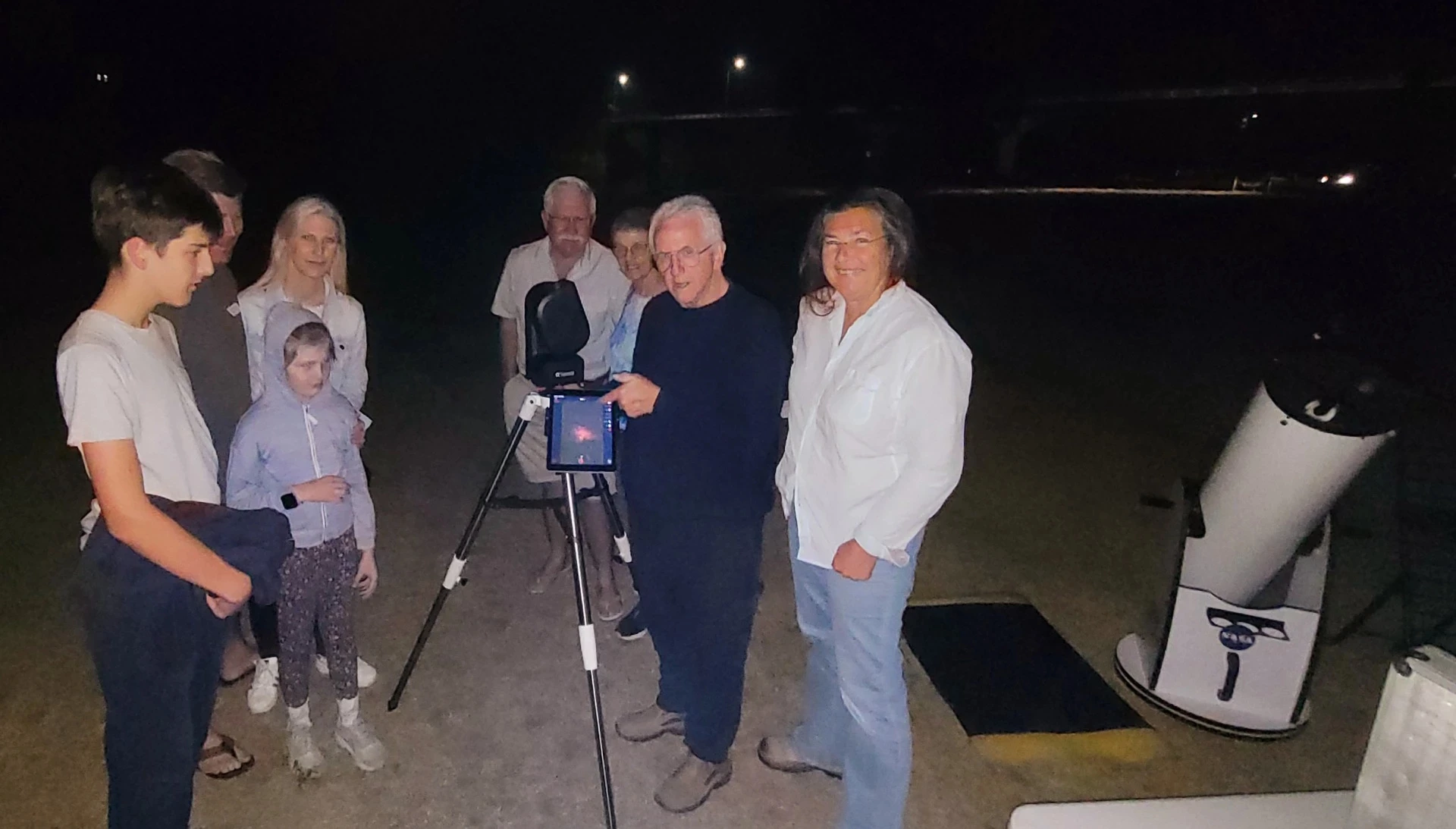
The S30 Pro is not only focused on automation, though. It brings AI‑powered knowledge of celestial objects into the mix. As you observe deep-sky objects, the integrated AI describes them, pushing the boundaries of stargazing by providing a guided tour of your immediate universe. This makes it ideal for classrooms, science clubs, and public outreach events.
In fact, the S30 Pro's built-in AI guidance system earned it recognition as a CES Innovation Awards Honoree 2026 in Educational Technology. It was specifically selected for being a compelling tool for STEM programs and public astronomy events.

Weighing just 1.65 kg (3.64 lb), the S30 Pro is easy to carry into the field. With its 6,000-mAh battery, it can operate for six hours. This means you can capture long sessions, which you can then store in its 128 GB internal storage (no stressing about space).
The smart telescope is designed for ease of use. You just turn it on, pair it with your phone or tablet via NFC, select an imaging mode, point it at a target, and start capturing. Frames can be stacked for merged clarity, and imagery further enhanced using third party editing software.
Compared to other lightweight options like the Dwarf III, which emphasize portability and casual astrophotography, the S30 Pro looks like it's aiming higher – with advanced sensors, optics, and imaging modes. Though such things won't be a match for the image quality and wide field of view delivered by the much pricier Vespera II. What truly sets it apart from other smart telescopes, however, is the AI-driven educational guidance.
The Seestar S30 Pro is available for pre-order until January 30 at US$549. After that, it rises to a regular price of $599 when shipping begins.
Product page: Seestar S30 Pro