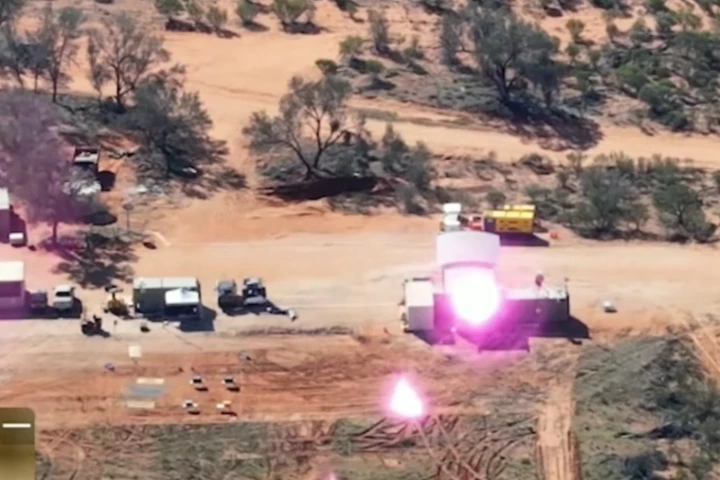
What comes to mind when you imagine fast charging? Smartphones going from zero to 100% in minutes? Or perhaps, EVs gaining 60 miles worth of charge in under an hour? Scientists have created a proof-of-concept quantum battery that charges one million times faster than it discharges … using a laser.
For many years, the concept of a quantum battery, which uses the principles of quantum mechanics to store energy, has remained theoretical, largely due to the complexities and unpredictability of quantum technology.
In a significant leap forward for the field, a group of researchers comprising scientists from the Australian Space Agency, CSIRO, RMIT University, and the University of Melbourne has created the world’s first proof-of-concept quantum battery, charged wirelessly with a laser.
The new prototype, still very far from being practical, took femtoseconds (quadrillionths of a second) to charge and stored the energy for nanoseconds. Technically speaking, the battery lasted one million times longer than it took to charge. To put that into perspective, that's like a phone taking 30 minutes to charge fully and then lasting for over 100 years. Another illustration is an 11-day-lasting battery that charges in one second.

"It’s the first prototype which does a full cycle of a battery: in other words, you charge it, you store energy, and you can discharge it," says lead researcher Dr. James Quach of CSIRO.
Before we get carried away, it's important to note that this is the very earliest stage of the technology. The current prototype has a capacity of only a few billion electron volts, barely enough to power anything. It sounds large, but 5 billion electron volts is about 1/200,000th of the energy of a flying mosquito.
Still, it is very welcome proof that the concept works, marking a significant breakthrough for the future of quantum energy storage.
"The research and proof-of-concept validates the exciting potential of quantum batteries to achieve rapid, scalable charging and energy storage at room temperature, laying the groundwork for next-gen energy solutions," Dr. Quach says.
In contrast to conventional batteries that primarily rely on chemical reactions to store and discharge energy, quantum batteries leverage unique quantum-mechanical properties, such as superposition and entanglement.
"The advantage of quantum is that the system absorbs light in a single, giant 'super absorption' event and this charges the battery faster," explains Associate Professor James A. Hutchison, key contributor in the research.
To the untrained mind, quantum technology can seem all fuzzy and weird. But to trained minds, it's all … pretty much the same. As with all things quantum technology, the researchers’ prototype exhibited some "strange" characteristics. In standard batteries, size is directly proportional to charging time. Small smartphone batteries fully charge in hours, while their much larger EV counterparts take overnight to charge. Quantum batteries do the exact opposite.
"Quantum batteries have this really peculiar property where the larger they are, the less time they take to charge", Quach explains. "Due to a feature known as 'collective effects’, in which quantum cells charge faster when there are more cells involved."
Without exaggeration, the potential of this research is extraordinary. Fully functional quantum batteries could eventually power quantum computers or small conventional electronic devices. Imagine having a full phone charge in the blink of an eye.
The researchers envision scenarios in which you could charge a drone with lasers while it's still in flight. They also believe the technology would "revolutionize the electric car industry", implying that charging an EV would be much quicker than refueling a gas tank. Dr. Quach imagines applications similar to the drone example, where the car wouldn't need to stop at all.
For now, however, all this is far future potential. We are more likely to see quantum energy storage systems powering quantum computers. The researchers agree.
"While there's still much work to be done in quantum battery research, we've made an important move towards realizing the possibilities," says Quach. "The next step for quantum batteries right now is extending their energy storage time. If we can overcome that hurdle, we’d be that bit closer to commercially viable quantum batteries."
The research was published in the journal Light: Science & Applications.
Source: CSIRO