
Tactile
-
 Could you imagine being able to "feel" the images on your screen? UCSB researchers have made this sci-fi-like idea a reality. They've developed a display where pixels physically rise off the surface when activated by laser light.
 -
 Engineers at Northwestern University have developed a device that goes on your fingertip to feel the sensation of interacting with textured surfaces on a touchscreen. It could be a major step forward in how we interact with personal tech.
 -
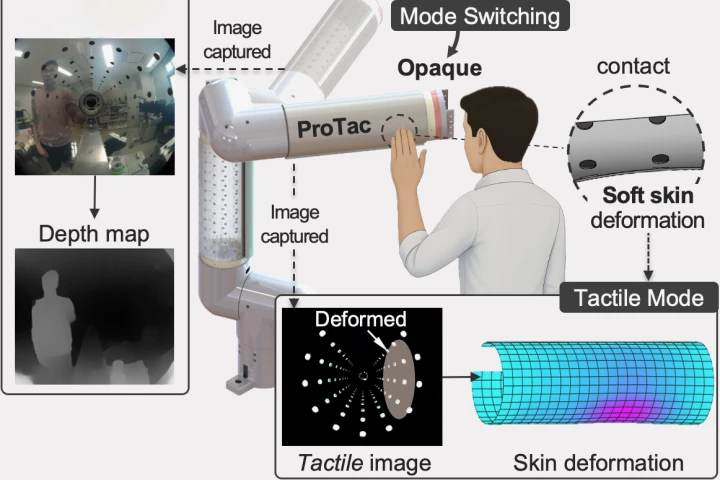 In order for robots to operate safely around humans, they need to see that people are approaching and they need to know when they make physical contact with those people. A new system allows them to do both, using cameras located inside their arms.
 -
 Some folks prefer to get a grip on things to better understand concepts. Researchers have developed smart gloves for tactile learners that use haptic feedback and AI to teach users new skills, fast-track precision training and control robots remotely.
 -
 While technology is making strides in absorbing our eyes and ears in virtual worlds, it’s harder to engage senses like touch. Engineers have now developed WeTac, a thin, wearable electronic "skin" that provides tactile feedback to users in VR and AR.
 -
 Although there already are experimental "telehaptic" systems that allow people to send and receive tactile sensations, they tend to be bulky and awkward. A new one is much slimmer and thus more practical, thanks to the use of piezoelectric materials.
 -
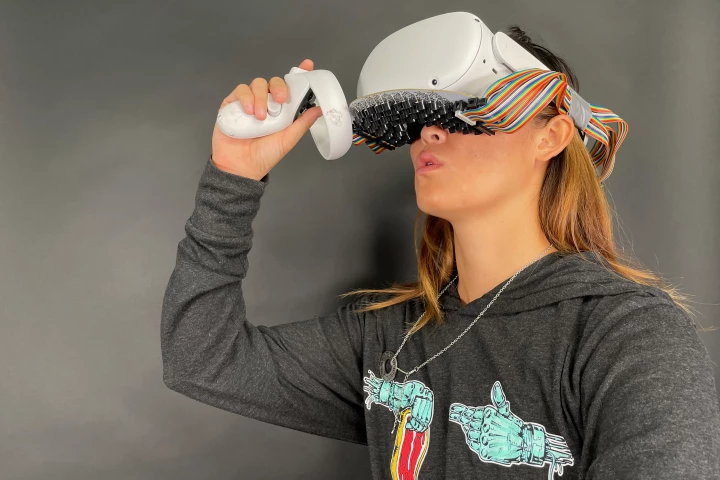 Along with providing users with sights and sounds, some VR systems also deliver tactile sensation to the hands. A new ultrasound-based setup, however, lets users feel the virtual world on and in their mouths – without making physical contact.
 -
 Amongst the challenges faced by the deaf is what's known as the "cocktail party effect," in which they have difficulty discerning one speaker's voice from others in crowded, noisy environments. A new device could help, however – by buzzing two of their fingers.
 -
 Anyone who has played a game of Jenga will know the delicate touch required to keep the tower of wooden blocks from crashing down, and it’s not the kind of finesse you’d associate with a typical robot. But MIT's robot arm can push and prod with the best of them.
 -
 We've already seen a number of systems designed to alert blind users to objects in their path, using cues such as audio tones or vibrations. The "Proximity Hat," however, applies pressure to the wearer's head, in the direction of the obstacle.
 -
 Suppose you had a tablet that only displayed one line of text at a time. It would be pretty frustrating, but it's a limitation that blind users of braille-displaying devices are faced with constantly. Thanks to new technolog, however, full-page braille tablets could soon be on their way.
 -
 In what could just as easily prove to be a very bad idea as it could a good one, a startup company called Feelreal has created a virtual reality mask and helmet that lets you smell virtual environments as well as feel a little of their atmosphere.
Load More