
Czech automaker Škoda took on an interesting side quest recently to improve road safety – but for bicycles instead of cars.
A team at the company, along with audiologists from the University of Salford in the UK, have hit upon a way to keep cyclists from colliding with pedestrians who've got noise canceling headphones on. Their solution: a better bicycle bell.
Focusing on the challenges of navigating traffic in busy London, the researchers used specialized testing equipment with hundreds of audio signals on a bunch of headphones well-regarded for their noise canceling capabilities. That includes both over-ears and in-ears from the likes of Bose, Sony, and Apple.

Now if you'll recall, active-noise-canceling (ANC) headphones work by picking up the sound around you with dedicated little mics, and playing an inverted frequency to cancel that out. Through its testing, the team found a point at which these cans were less effective at suppressing external noise: a low frequency band between 750-780 Hz. The next step was to create a bell that could hit this band so it could be heard at a distance with ANC headphones on.
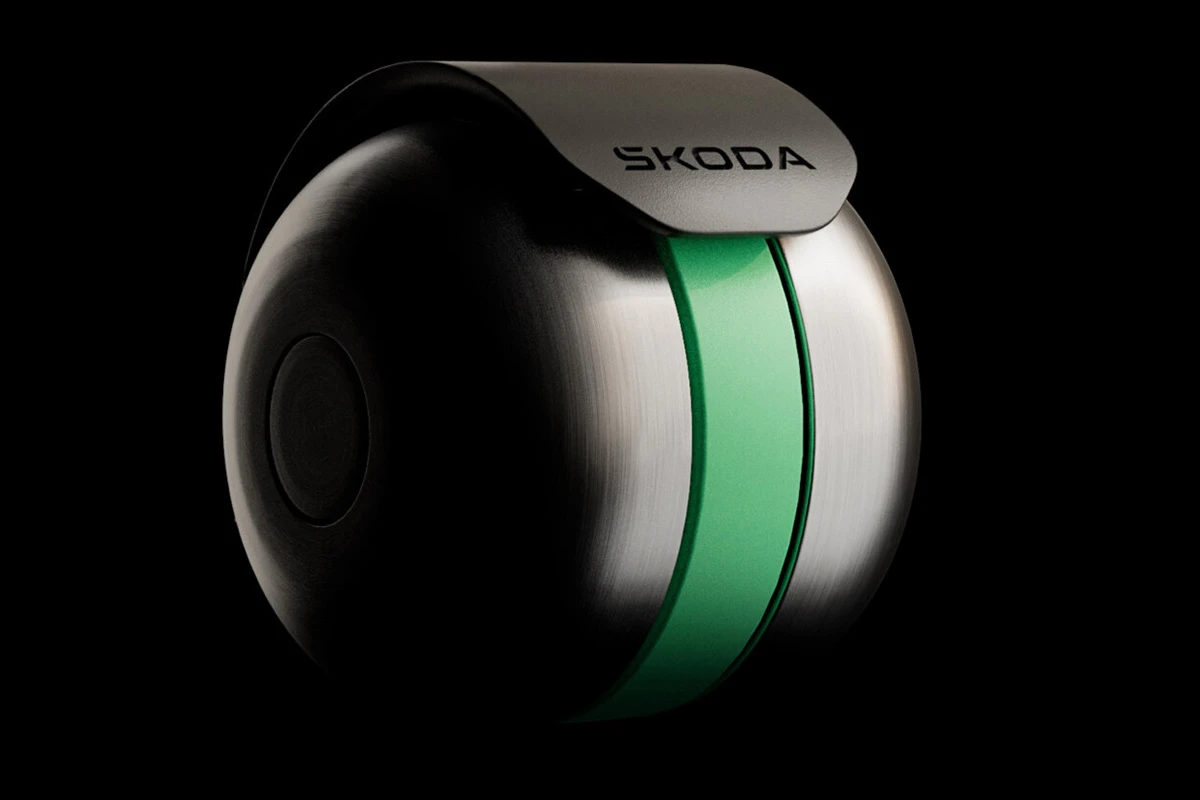
It's completely mechanical, and the magic is all in the design of the and its precise production. A lot of engineering went into sounding that low frequency, while keeping the build roughly the same size of a traditional bike bell.
The DuoBell, as it's called, is named for its additional feature. There's a second resonator tuned to a higher frequency that produces rapid, irregular strikes that these headphones' noise-cancelation algorithms can't process in time to stop them reaching your ears.

In a VR test where participants walked through simulated streets, the bell was reportedly heard 72 ft (22 m) earlier, and 5 seconds sooner. That gap allows for pedestrians to react and step out of the way of oncoming bicycles. It was even tested in the real world with Deliveroo riders, who Skoda claims are happy with how effective it is on London's bustling streets.
The company isn't selling the bell yet, but it's made the research findings freely available, and says it's working with partners to get this fitted onto more bikes across London. Fun fact: Škoda Auto got its start building bicycles all the way back in 1896 – so this is a sort of a return to its roots.

This is a marketing effort rather than an expansion of Škoda's product portfolio, but it's certainly a commendable one that I hope the brand runs with globally.
Source: Škoda