




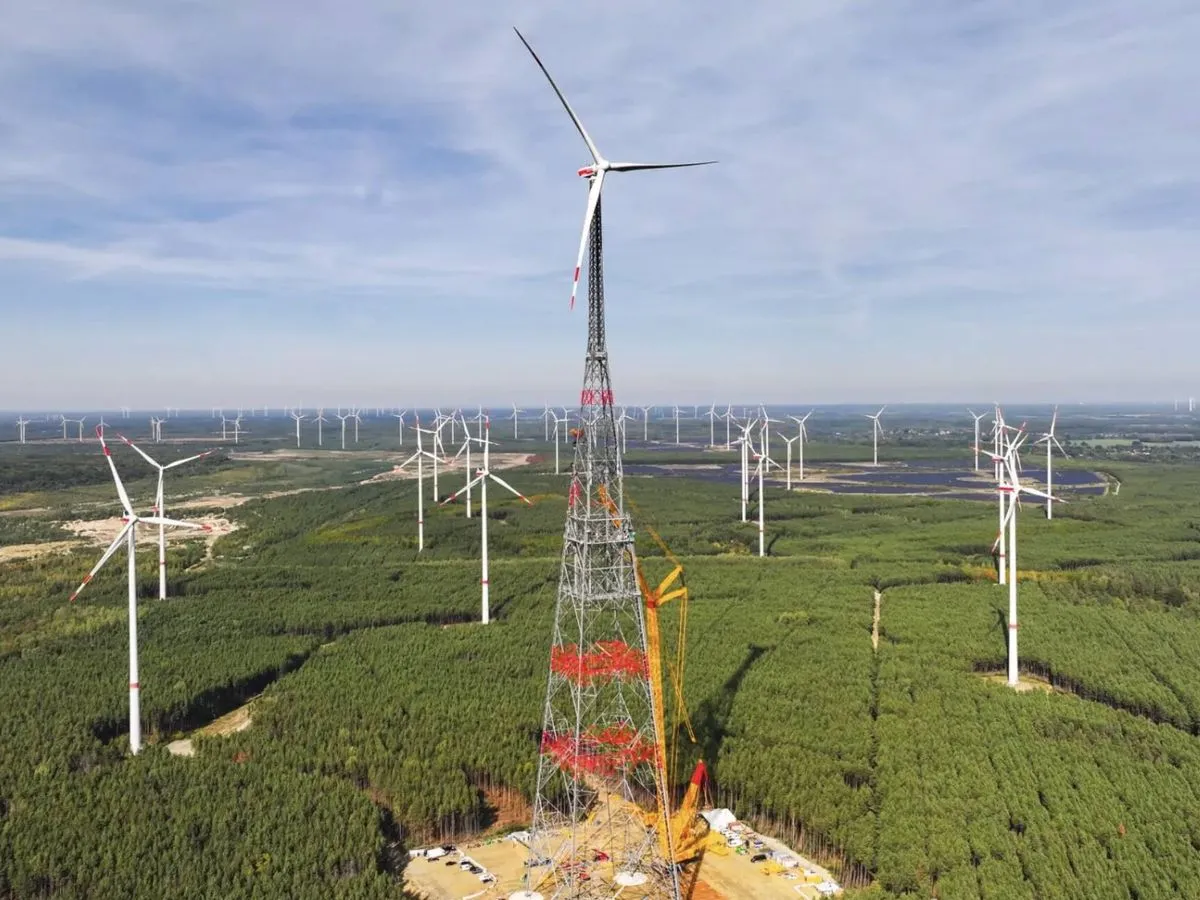

Germany is taking wind power to new heights with a turbine almost as tall as Berlin’s iconic television tower at Alexanderplatz. Standing 365 m (1,198 ft) in Schipkau, the new world’s tallest wind turbine aims to tap stronger, steadier winds and test whether existing wind farms could gain a second story.
Built by engineering company Gicon for Germany’s Federal Agency for Disruptive Innovation, SPRIND, the pilot explores a way to generate more electricity from sites already devoted to wind power.
Gicon’s turbine stands about 25 m (82 ft) taller than Dongfang Electric’s 26-MW prototype in China, a machine designed for offshore use but installed at an onshore testing site. However, height and rated generating capacity are different contests. Offshore turbines typically benefit from stronger, less turbulent winds, while sea transport eases some of the constraints involved in moving enormous components by road.
Gicon takes another route, raising its hub to 300 m (984 ft) to tap stronger, steadier winds above land. Its 3.8-MW pilot stands taller but has a much lower rated capacity than the Chinese prototype.
It also towers above prominent onshore installations. The Vestas V172-7.2 MW in Winnberg, Germany, reaches 285 m (935 ft) at its highest blade tip, using what Vestas and Max Bögl describe as the world’s tallest series-produced wind-turbine tower. An earlier height-record holder in Gaildorf reaches 246.5 m (809 ft). China’s Sany SI-270150 goes big in a different direction, pairing a 270-m (886-ft) rotor diameter with a 15-MW rated capacity – a different measure of scale from overall height.
To achieve such heights, Gicon’s design combines a conventional wind turbine with a steel lattice support structure and a telescoping inner tower. The mechanism allows the inner tower to rise into its operating position instead of requiring the entire installation to be assembled at its final height. For the final lift, the company used a specialized strand-jacking system, which raises heavy structures using bundles of steel strands. Once extended, the inner tower was secured in its operating position.
Gicon claims its design could produce roughly twice as much electricity as a conventional turbine with the same rotor diameter. The aim is to boost energy yield, not simply chase a bigger power rating. The company envisages future versions with rated capacities exceeding 7 MW, but rated capacity alone does not tell you how much electricity a turbine produces over a month or year. That total is its energy yield.
The company announced completion of the lift on September 29, describing the installation as Germany’s second-tallest structure. According to AP’s report, internal wiring remained to be installed ahead of a planned November 19 inauguration.
Reaching the target height proves a construction milestone, but it does not yet establish annual output, operating costs, or durability. Gicon and SPRIND are preparing a commercialization strategy and are aiming for series production. Preliminary assessments suggest Germany could accommodate up to 4,000 high-altitude towers within existing wind farms. That is an estimate of potential, but it gives the single installation a much bigger job than stealing the height record from China.
Before that ambition becomes a fleet, Schipkau needs to show what the extra altitude buys in practice. Gicon plans to use the findings to develop a wind farm with three to five extra-tall turbines, an intermediate step toward possible full-scale production.
Source: Gicon


