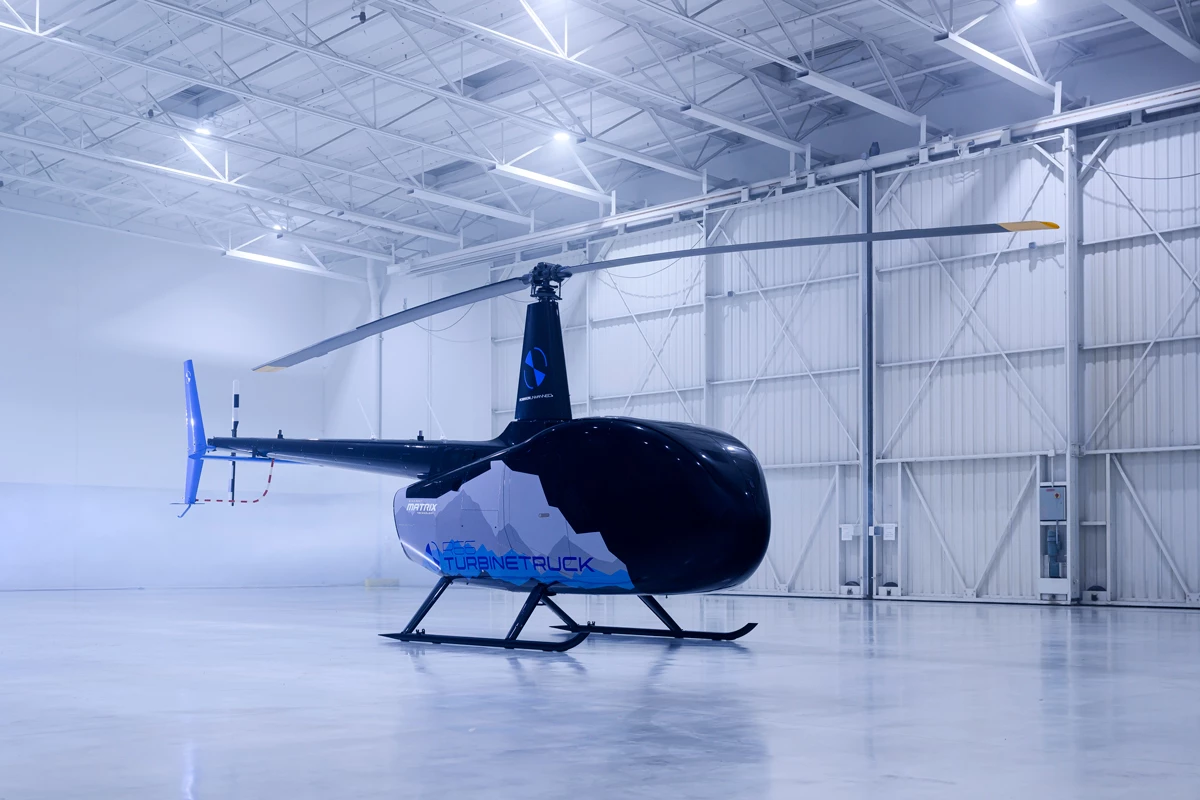

Robinson’s R66 Turbinetruck looks like many other light cargo helicopters, yet something about it seems a little off. But what? Oh, right – instead of a cockpit, the aircraft has a pair of clamshell doors and no place for a crew.
If there’s one constant in aerospace engineering, it’s that making an aircraft lighter, faster, more efficient, and able to carry more payload is always a plus. If a designer claims that what a plane really needs is to be heavier and carry less, it might be wise to get a second opinion.
With this in mind, engineers are always looking for things to toss out of an airframe. Too heavy? Replace steel with aluminum or magnesium. Cut holes in support structures. Better yet, eliminate some supports entirely and let the geometry of the fuselage itself carry the load.
How far can this approach go? Let me put it this way. I once imagined that an airliner’s skin must be as sturdy as the steel plating of a passenger ship. Then I was handed a sheet of the aluminum alloy used for fuselage panels. With little support and barely able to stand under its own weight, it seemed flimsier than the foil container holding my takeaway curry.
That same philosophy informs the R66 Turbinetruck. Developed in collaboration with Sikorsky, it's based on the Sikorsky S-70UAS U-Hawk, itself derived from the Black Hawk combat helicopter. In the U-Hawk, the cockpit is replaced by clamshell cargo doors, while the Sikorsky MATRIX autonomy suite takes over the role of the flight crew.
At first glance, it may look as though Sikorsky is simply repeating the same idea on a smaller platform, but there’s more to it than that.

According to Robinson, the R66 Turbinetruck represents a “democratization” of autonomous vertical-lift technology. Instead of modifying a large military helicopter, the concept applies the same autonomous approach to a smaller, easier-to-produce turbine aircraft. The result is an uncrewed rotorcraft intended as a high-utility, low-cost helicopter for both commercial and military applications.
The difference becomes clearer when comparing the R66 Turbinetruck with its predecessor.
The U-Hawk is a heavy-duty, multi-mission platform designed for straight out combat roles. It has two GE T700-GE-701C turboshaft engines, weighs in at 22,000 lb (9,979 kg), can carry an internal payload of about 7,000 lb (3,175 kg) or an external payload of 9,000 lb (4,082 kg). It can cruise at 159 knots (183 mph, 294 km/h) with a flight endurance of 14 hours with auxiliary tanks. It can also carry an array of heavy munitions that can deploy through either the forward clamshells or a rear ramp – and it costs a lot of money.
In contrast, the R66 Turbinetruck is designed to be light and inexpensive. Powered by a single Rolls-Royce RR300 turboshaft engine, it has a maximum gross weight of 2,900 lb (1,315 kg) and can carry up to 1,200 lb (544 kg) internally or externally. Its cruising speed is about 120 knots (138 mph / 222 km/h), with an endurance of up to four hours.
Because it is much cheaper than the U-Hawk, the R66 Turbinetruck can be considered relatively expendable in high-risk environments. It also consumes less fuel and requires less maintenance. Like the U-Hawk, it can be rapidly reconfigured for different missions thanks to its modular design and MATRIX autonomy software.
"With every new platform we welcome into the MATRIX family, we widen the network of uncrewed systems to serve a variety of civil and military missions," said Rich Benton, vice president and general manager of Sikorsky. "We view the U-Hawk and R66 Turbinetruck as complementary bookends that meet emerging customer needs across defense and commercial segments, delivering seamless capability wherever the mission demands. Sikorsky’s MATRIX autonomy suite is rapidly becoming the industry standard for safe, reliable and repeatable autonomy for those missions."
Source: Sikorsky