Space was so much simpler when I was a kid. Back in the 1980s, we still hoped to find habitable planets around every star. Nine planets orbited our own Sun. And “dwarf planet” sounded like a Saturday morning cartoon begging for its own toy line.
Last week, our solar neighborhood got a little more interesting with the potential discovery of a new icy world on the Solar System’s fringes, hidden against a crowded backdrop of stars.
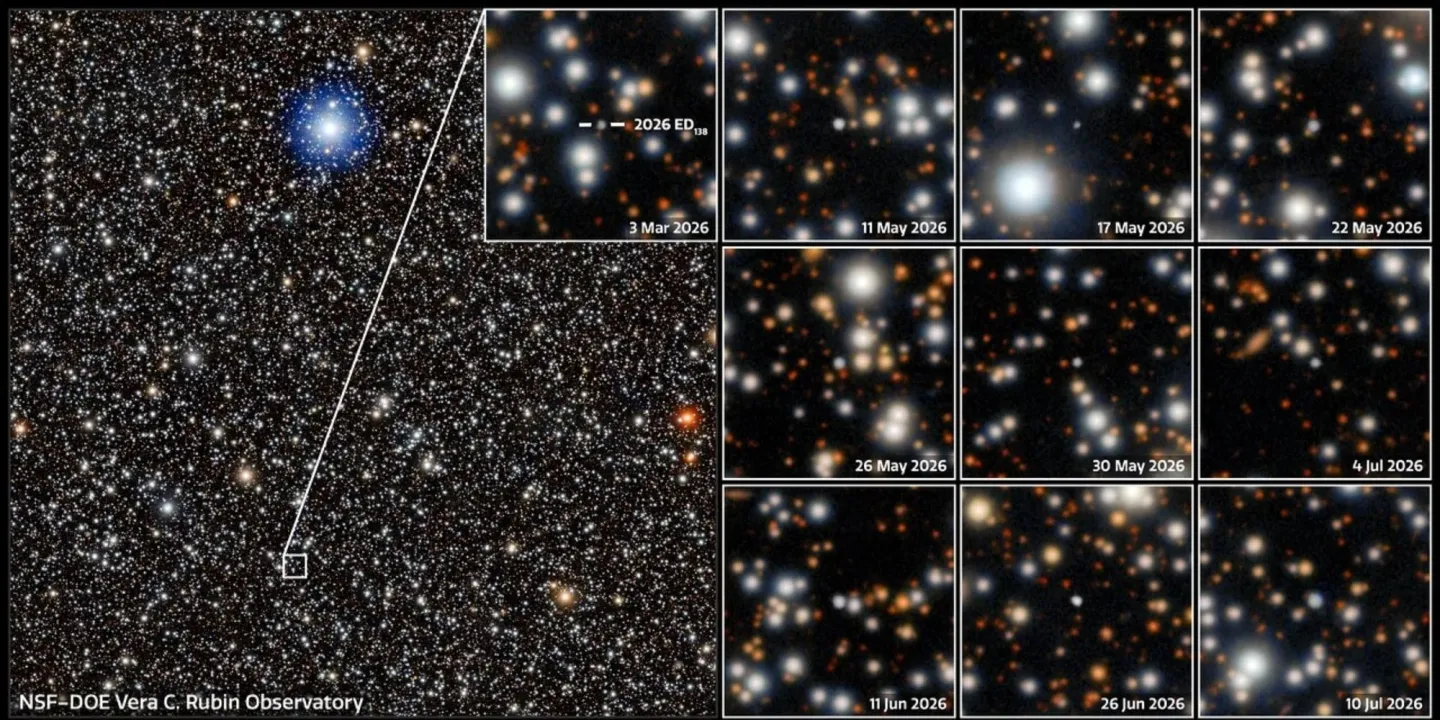
Provisionally named 2026 ED138, the object turned up in early observations from the Vera C. Rubin Observatory in Chile, and is big enough to qualify as a candidate dwarf planet.
Estimated to measure between 600 and 1,500 kilometers (373 and 932 miles) across, the chunk of ice and rock is roughly the size of Texas. For those who know their 90's Hollywood movies, that means it’s about the size of the asteroid Bruce Willis and crew were sent to bomb in the 1998 blockbuster Armageddon.
Thankfully, ED138 currently sits about 46 times farther from the Sun than Earth does, compared with Pluto’s average distance of about 40 times our own. No need for a crack team of space-trained miners to be launched on a one-way trip any time soon.
Despite this vast chasm, it may still seem a little surprising that nobody has noticed a state-sized icy world whipping through our stellar suburbs before.
There’s a good reason for its obscurity.
ED138 appears to orbit close to the plane of the Milky Way, where millions of background stars complicate the search for faint, moving specks. Noticing a tiny, barely-budging dot required software capable of connecting observations scattered through Rubin’s enormous collection of detections.
Earlier this month, Harvard & Smithsonian astrophysicist Matthew Holman was processing archived Rubin data with code he developed alongside colleague Kevin Napier, when a signal emerged. Given its distance, its brightness immediately suggested something unusually large.
“My first reaction was one of excited disbelief,” says Holman.
University of Washington astronomer Mario Jurić subsequently uncovered another 20 observations in Rubin’s records that hinted at a potential dwarf planet. Searches of older survey images pushed the object’s observational history back to 2016, giving astronomers roughly a decade of evidence to reconstruct its most likely orbit.
The discovery was finally announced this week, following observations collected while Rubin was still preparing for its main survey.
There is, however, a considerable difference between spotting signs of a distant world and getting a good, close look at it. Since a smaller body with a bright surface bounces as much light as a larger, darker object, any sunlight it happens to reflect leaves plenty of room for interpretation.
Until researchers can pin down its reflectivity with some degree of confidence, the candidate’s diameter should be considered nothing more than a ballpark estimate.
Observations at longer wavelengths could help resolve that ambiguity by measuring radiation emitted by the object itself, rather than simply the sunlight bouncing off its surface.
Size matters. Under the International Astronomical Union’s definition, a dwarf planet must orbit the Sun, be sufficiently massive for gravity to pull it into a nearly round shape, and have failed to clear its orbital neighborhood.
It also cannot be a moon. Sorry Moon. We still love you.
An icy body within ED138’s estimated size range has a good chance of being fairly round, making it a promising candidate. If confirmed, it would be given a snappier name than ED138 and join the ranks of Pluto, Eris, Haumea, Makemake, and Ceres.
Whatever its eventual classification, the discovery gives us a solid demonstration of what Rubin was built to accomplish.
Perched on Cerro Pachón, the observatory combines an 8.4-meter (28-foot) telescope with a 3,200-megapixel camera, the largest digital camera ever constructed. Over its decade-long Legacy Survey of Space and Time, Rubin will repeatedly take detailed snapshots of the southern hemisphere, covering as much of the sky as it can every few nights.
The result is effectively a cosmic movie: a record that lets researchers distinguish objects changing position or brightness from the apparently static scenery behind them. New asteroids, hidden comets, and occasional exploding stars could all appear in its time-lapse map, providing insights on everything from the nudge of dark matter to the history of our Solar System.
The path ED138 already hints at some planetary shenanigans. The object’s orbit is tilted around 25 degrees from the Solar System’s plane, indicating a gravitational encounter with a massive object like Neptune may have kicked it off its original path.
Before anybody dusts off the “Planet X found” headlines, ED138 is far too small and too close to fit the modern Planet Nine hypothesis. Its estimated diameter and distance put it in a different league from the proposed heavyweight, proposed to explain the unusual orbital clustering of some distant objects.
ED138 may not fit the missing giant’s job description, but such a rare find is to be celebrated nonetheless. Even if our planetary family no longer fits inside a classroom poster.
Source: Rubin Observatory