
Surgery
-
 Two humanoid robots just performed live surgery for the first time in history, hinting at a future where compact, affordable machines bring advanced surgical care to rural hospitals, battlefields, and other resource-strapped settings.
 -
 We're a step closer to entering an operating theater without any human life besides ours, following the world's first surgery performed by a robot responding and learning in real time. Its precision and skill matched that of experienced surgeons.
 -
 Today's AI technology could help robots get the hang of conducting complex surgeries. Researchers have taught a robot surgical system to expertly perform a bunch of surgical tasks as capably as human doctors, simply by training it on videos.
 -
 Sony has shown off its new surgical robot doing some super-precise work sewing up a tiny slit in a corn kernel. It's the first machine of its kind that auto-switches between its different tools, and has successfully been tested in animal surgery.
 -
 In a stomach-churning development, the UK Ministry of Defence has unveiled the latest version of the Surgical Advanced Mannequin (SAM) for training combat surgeons, which is almost too good at simulating battle injuries, including very realistic bleeding.
 -
 DARPA has selected Raytheon BBN to lead a team to develop an augmented reality device that can act as a virtual assistant for combat medics, guiding them through 50 different medical procedures using artificial intelligence.
 -
 It goes without saying that surgeons require a very delicate, precise touch. A new set of surgical training gloves were designed with that fact in mind, as they monitor their wearer's hand movements, and provide feedback on their technique.
 -
 While robotic laparoscopic surgical systems do make certain procedures safer and less invasive, those systems are still operated by human surgeons. Now, however, a surgical robot has performed a delicate operation entirely on its own.
 -
 Adhesives that hold underwater are elusive, but could be useful for marine repairs or tissue healing. Researchers have now developed a new type of adhesive hydrogel that combines the underwater stickiness of mussels with the strength of spider silk.
 -
 It’s hard to get medical adhesives to stick when blood is making everything wet. Now, MIT researchers have developed a new surgical glue that can halt bleeding within 30 seconds, inspired by the super-strong underwater adhesive used by barnacles.
 -
 Telerobotic systems already allow surgeons in one location to control robotic surgical tools in another, so they can perform operations at a distance. A new proximity-sensing system, however, could make such procedures safer and more precise.
 -
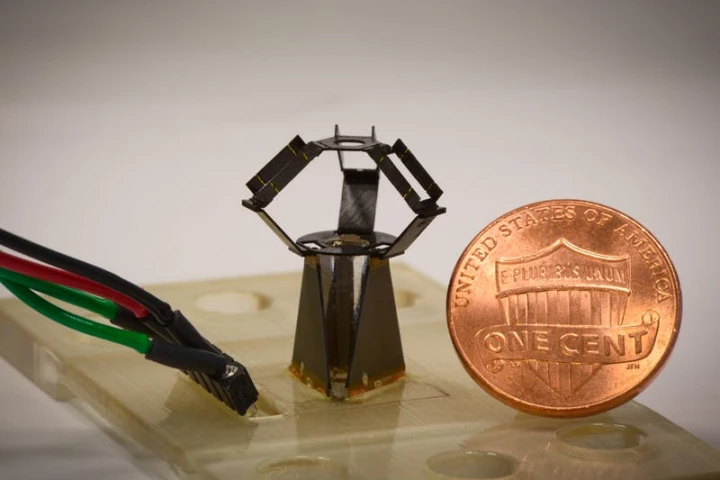 Harvard engineers have developed the world’s smallest Delta robot, dubbed the MilliDelta. As its name suggests, the new robot measures just a few millimeters, and could lend a hand in precise picking, packing, manufacturing and surgery on the micro scale.
Load More