
Urban Transport

Atlanta to host first fully automated on-demand public transit system

Atlanta to host first fully automated on-demand public transit system
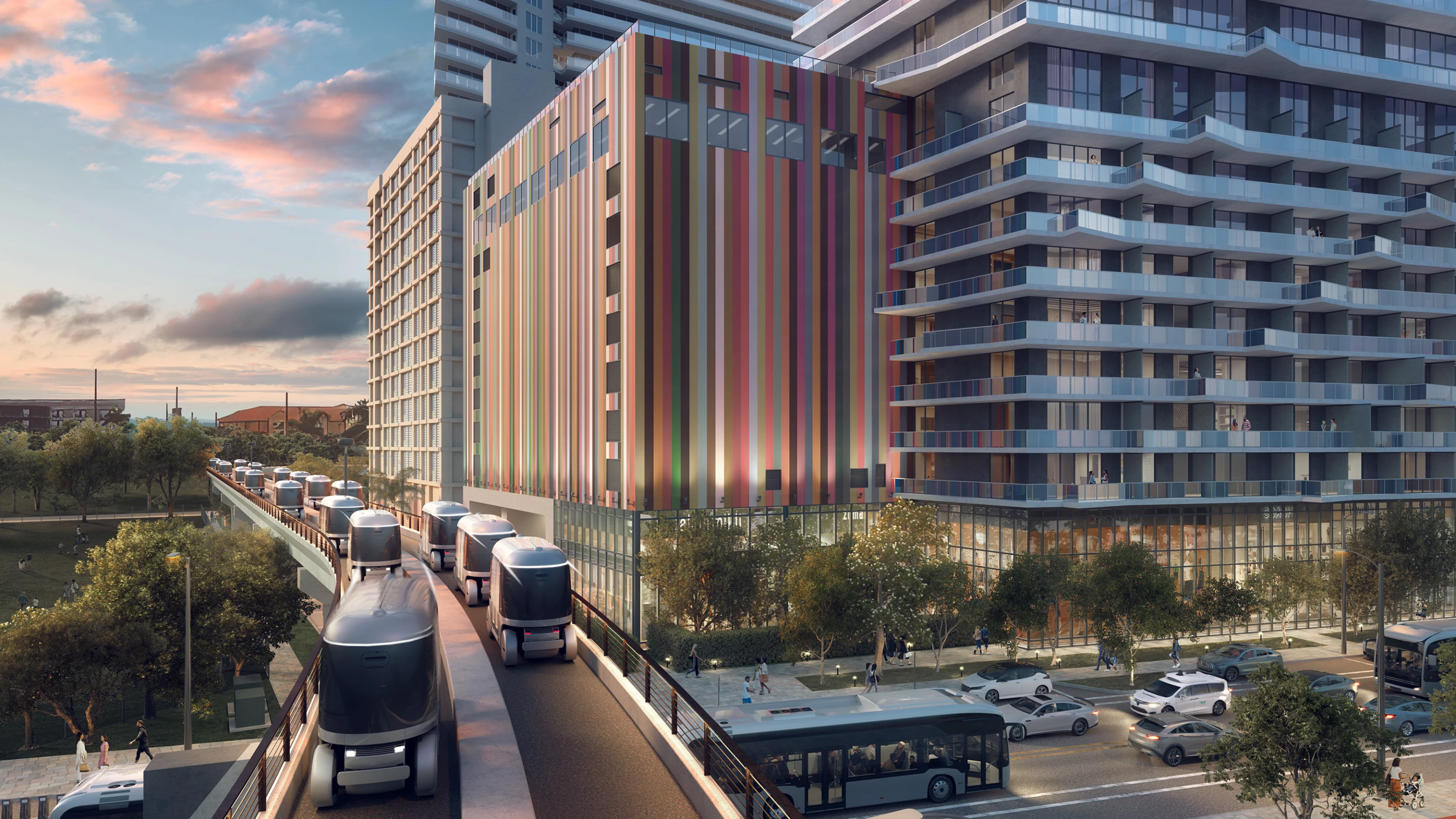
California's Glydways has broken ground on what's set to be become the world's first publicly accessible automated transit network
View 4 Images
California's Glydways has broken ground on what's set to be become the world's first publicly accessible automated transit network
1/4
California's Glydways has broken ground on what's set to be become the world's first publicly accessible automated transit network
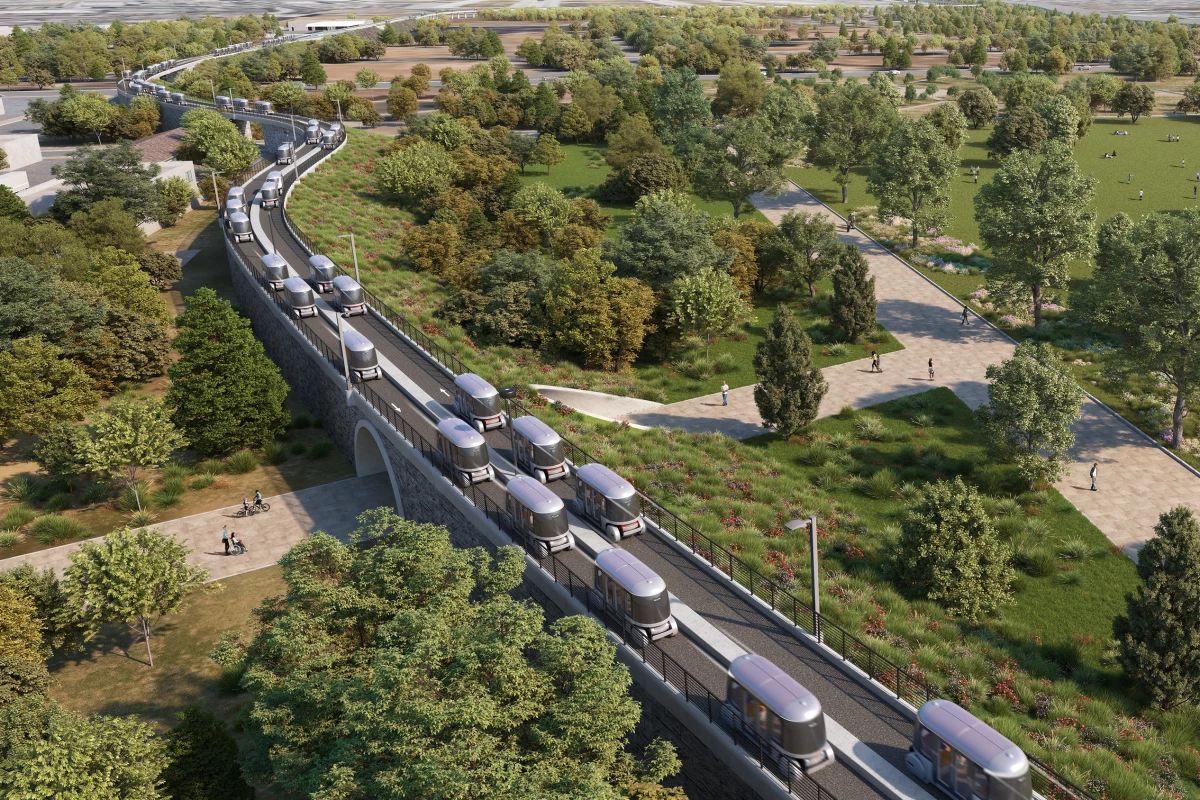
Glydways says that its automated transit network has the potential to squeeze 10,000 passengers per hour through a corridor roughly the width of a bike path
2/4
Glydways says that its automated transit network has the potential to squeeze 10,000 passengers per hour through a corridor roughly the width of a bike path
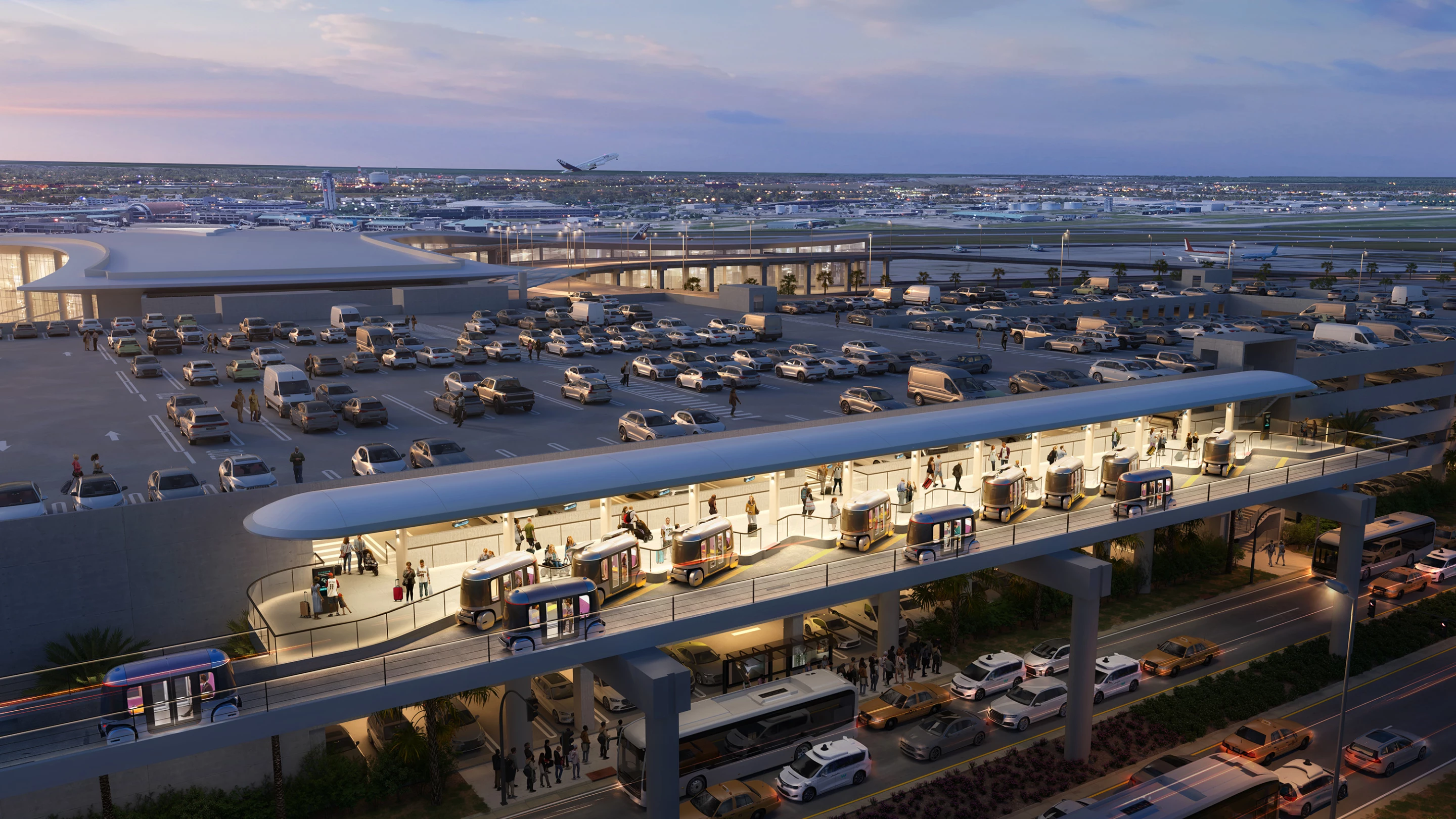
The South Metro Atlanta pilot route will run just half a mile, with access points at the ATL SkyTrain, the Gateway Center Arena entrance and midway at the huge parking lot
3/4
The South Metro Atlanta pilot route will run just half a mile, with access points at the ATL SkyTrain, the Gateway Center Arena entrance and midway at the huge parking lot
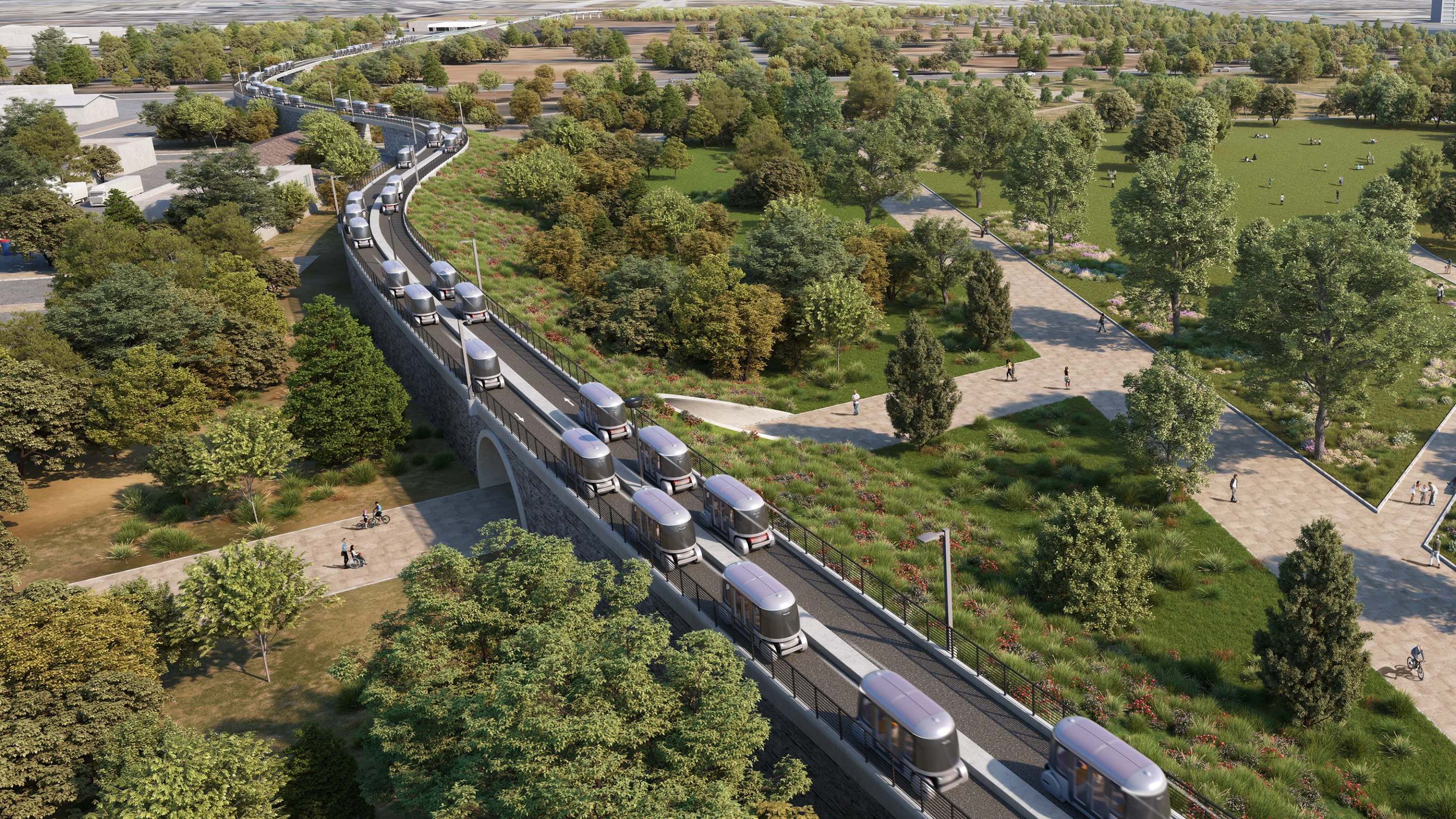
The Glydways automated transit network is designed to be fully accessible and on-demand 24/7
4/4
The Glydways automated transit network is designed to be fully accessible and on-demand 24/7
View gallery - 4 images

South Metro Atlanta is set to become home to a demonstration pilot for a publicly accessible automated transit network using autonomous electric vehicles on dedicated guideways. This system promises to end nail-biting traffic congestion, delivering a rail-like capacity at bus-fare prices without the traditional cost or construction timelines.

Glydways, the California company behind the technology, broke ground on the pilot loop recently. The initial 0.5-mile (0.8-km) guideway connects the ATL SkyTrain at the Georgia International Convention Center to the Gateway Center Arena, and marks the worldwide debut for the company's Automated Transit Network system. It's a free public test service scheduled to launch in December 2026.

The Glydways automated transit network is designed to be fully accessible and on-demand 24/7

The company argues that cities need "net-new capacity" – additional transportation bandwidth that doesn't compete with what's already there. "Just putting autonomous vehicles on open roads doesn't actually solve congestion," Mark Seeger, Glydways' co-CEO and founder, explained in a recent interview. "In many cities, it makes it worse."

It’s a pitch that's gaining traction globally. The company has already signed agreements with Dubai's Roads and Transport Authority and the Abu Dhabi Investment Office, and held discussions with officials in Tokyo, Florida, California, and New York.
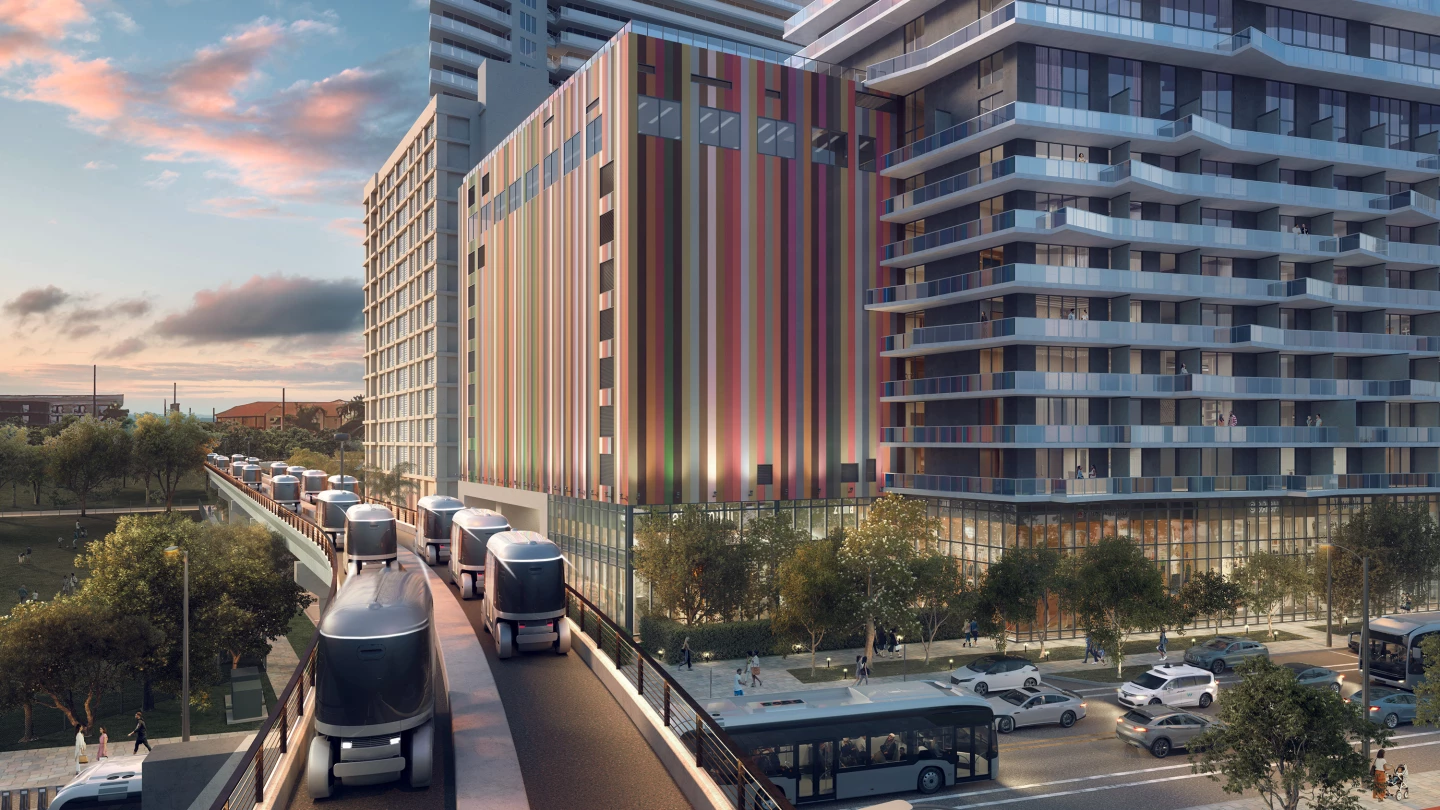
Glydways says that its automated transit network has the potential to squeeze 10,000 passengers per hour through a corridor roughly the width of a bike path

Glydways' small electric passenger pods run on purpose-built guideways with their own private lanes – not fighting for space with SUVs or getting stuck behind a garbage truck. The system is coordinated by AI software to operate 24/7 on-demand. The idea is that you request a ride via a mobile app, which prompts the arrival of your own vehicle or one shared with your group, and then you travel directly from point A to point B with zero intermediate stops.

The company claims its scaled system has the potential to move 10,000 people per hour through a guideway just 2 m (6.6 ft) wide – matching light rail throughput but without the massive infrastructure costs or decade-long construction timelines. In fact, Glydways says its guideway infrastructure deploys faster and cheaper than traditional rail systems, which can cost hundreds of millions of dollars to realize, though the company hasn't disclosed specific construction costs for the Atlanta pilot. And because the autonomous passenger vehicles operate on dedicated lanes, they can run at consistent speeds in tight platoons, something that's impossible in mixed traffic.

The company's economic model also relies on keeping operational expenses low through having no drivers, utilizing electric propulsion, and undertaking minimal maintenance on a controlled guideway system. And Glydways maintains that unsubsidized operation at bus-fare levels is core to the business model, though actual pricing estimates haven't been announced yet.
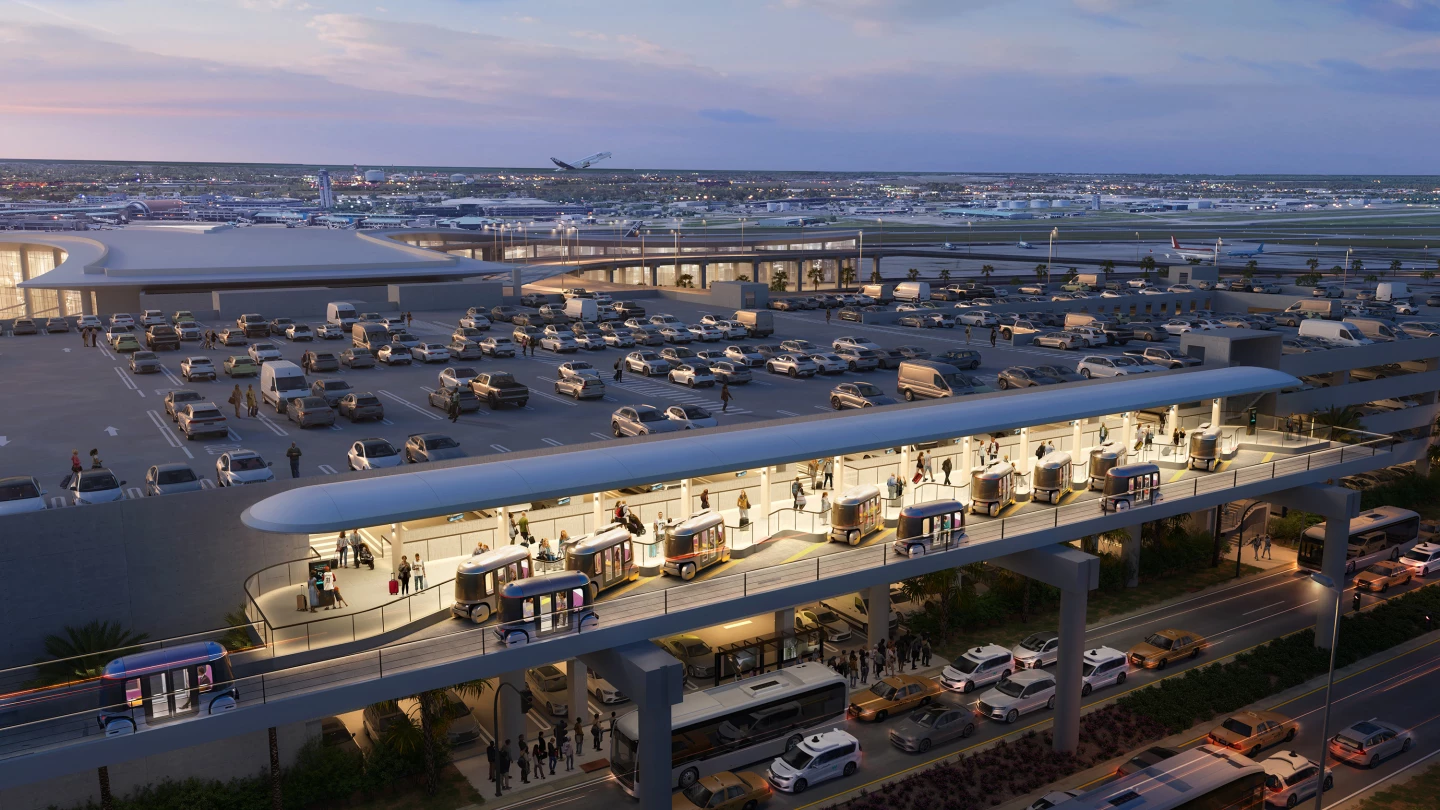
The South Metro Atlanta pilot route will run just half a mile, with access points at the ATL SkyTrain, the Gateway Center Arena entrance and midway at the huge parking lot

The initial Atlanta pilot route will serve as the global proving ground for the system. It connects Convention Center visitors and arena attendees to the existing ATL SkyTrain – a controlled environment with predictable demand patterns, ideal for proving the technology works before scaling up. A feasibility study led by the Metropolitan Atlanta Rapid Transit Authority will evaluate performance and determine whether the system should expand across the broader Atlanta region. If it works here, the model could extend to airport connections, suburban commuter routes, and other high-traffic corridors where traditional rail is too expensive.

"What begins in South Metro Atlanta is designed for the world," said company CCO, Chris Riley in a press statement. "This pilot demonstrates how an innovative new form of public transit can expand access, improve reliability, and help cities move more people without expanding roads or relying on legacy systems."

The real test isn't the technology – autonomous vehicles on dedicated lanes is fairly straightforward engineering. The test is whether the economics hold up at scale. Rail-like capacity at bus-like costs sounds great on paper. Whether it pencils out in practice or everything ends up like the Simpsons' Monorail episode is what the Atlanta pilot will help determine.

Source: Glydways

View gallery - 4 images
15 comments
15 comments
paul314
So this is basically dedicated mass transit only without having to ride in the same vehicle as strangers?
TechGazer
The important part seems to be dedicated transport routes and computer control. Automated light rail transit has already proven its value. I'm skeptical that pods carrying a few passengers will be more cost-effective than larger vehicles. I'm not sure how much the lower energy efficiency of rubber tires on concrete vs steel wheels on rails will add to annual cost. I expect extra costs and problems in areas with snow/ice. Elevated guideways might require less strength for the same passenger capacity, due to spreading out the weight. Loading/unloading areas might be more expensive (fewer people passing through doorways per time).
Oh well, that's the purpose of a demonstration project.
Rick O
The benefit over a bus or subway, is that you're no longer beholden to strict schedules that may not fit your life, and waste a large amount of your time. That's why people choose cars over public transit so often. If you eliminate that issue, you gain popularity. Not being surrounded by strangers that may or may not be mentally ill is certainly a side benefit. If they were to use rails for most of it, with a second set of wheels to move a vehicle on/off the tracks at loading stations, that would increase efficiency and decrease issues with tire wire and lateral traction. They could also use the side shifter wheels for regen braking that might be quicker than braking on rails, especially for emergency stops. I think this has good potential to replace subway and other commuter trains.
SussexWolf
Looks pretty much the same as the Heathrow Pod Parking system that’s been operating since 2005. Newer technology in the pods, and a larger, more complicated network, but the underlying concept of on-demand, driverless pods on a cheap trackway, is the same.
lalo97
@Paul 314 Presumably, that wouldn't be the entire value proposition. I'd also imagine that being able to go directly to one's own destination without having to waste time stopping at dozens of other places (during which people get on and off) would also be a benefit. In the city where I live I can get across town to my friend's house in 20 minutes by car. If I were to take public transport, with transfers, it would be more like 90 minutes. Obviating the slowness of rolling public transport seems like a huge win.
Peachiro
@lalo97 That would be true during light traffic times, but when it's busy, wouldn't it end up turning into a long, low density bus/train? Instead of stopping at a few spots, some where no one gets off, some where almost everyone gets off, you're stopping at every single person's private stop. A route with only a few locations where almost everyone wants to stop, presumably like this pilot route, may mitigate that, but its broader utility may be limited.
Chase
I'll believe it when I see it.
Jim B
Looks like another silly Techbro Gadgetbahn. As other commentors have pointed out rubber wheels on concrete are way less efficient than steel wheels on steel rails. And to increase the capacity of the system you would want to make the pods bigger and link them together, at which point you have just reinvented the Docklands light railway from London!
Also if the vehicles are running on a fixed route it is much cheaper and operationally easier to have them pick up power from a third rail or overhead wire than to use batteries.
The DLR uses smaller lighter train cars than regular heavy metro train cars, enabling the use of lighter cheaper viaducts. The use of above ground stations means that the stations don't have to be staffed, and the trains are self driving.
If you want to improve light metro transit you've got to improve on the DLR. A few things people could try would be to make it maglev using permanent magnets and electro magnets like the prototype China Red Rail so that it is lowe noise and vibration, and is also lower maintenance, enabling more 24 hour service. If the trains are light enough and the viaduct strong enough you could have dangle trains under the viaduct and trains on top too, allowing local and express trains (although this would double any tuneling costs).
martinwinlow
Completely bonkers ... and about 20 years too late.
If they build this, it will very quickly be out-paced by robotaxis, probably before it is finished. On top of that, the rides will have to be free or no-one will use it as robotaxis will be so cheap (probably less than 1/2 of what Uber currently charges).
MovieMutt
This is CRAZY!! Tesla is now launching autonomous 2 seat cybercabs with full production beginning in April 2026. They will be able to drive anywhere on existing roads and even dirt roads. You do not have to spend millions on building dedicated roadways with all the right of way permits and construction delays when you just need to buy a fleet of cybercabs and let them loose. Tesla will also be building the Robovan which can transport larger groups. WAKE UP and STOP the BLOATED SOLUTIONS.
Load More