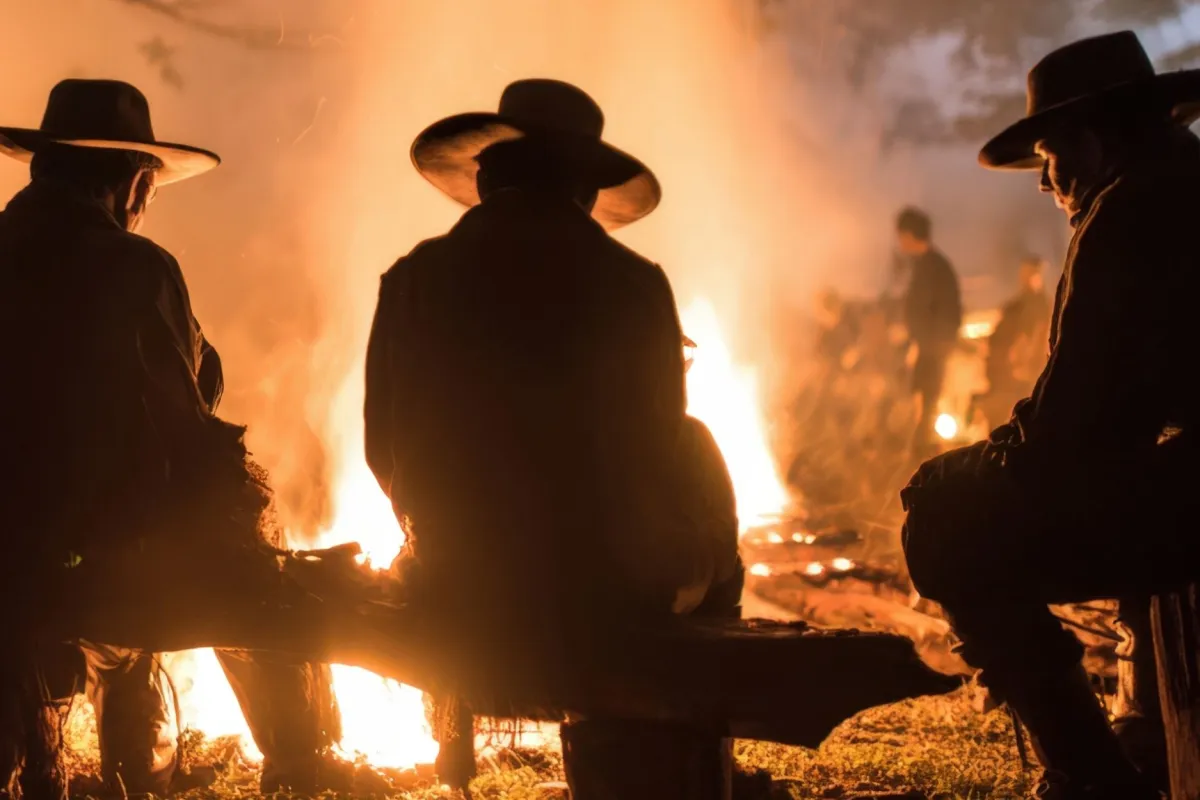


Come, sit. Let me tell you a story. Listen closely now.
For hundreds of thousands of years, our species has enjoyed the warmth and protection of a good fire before bedtime. We huddle against the darkness, share our thoughts, maybe tell a tale or two, and build bonds.
University of St Andrews primatologist Catherine Hobaiter and Dartmouth College anthropologist Nathaniel Jay Dominy think these two things – fire and human speech – may be fundamentally linked.
In a peer-reviewed paper recently published in Royal Society B: Biological Sciences, the two researchers bring together testable claims from a number of fields to argue that the conditions surrounding an evening fire shaped the evolution of spoken language.
While their proposal is purely hypothetical, it could help solve the enduring mystery of why our species is so unique in our ability to communicate so well with sound, especially compared with our closest relatives.
Conversations with chimpanzees and gorillas aren’t exactly rich in metaphor and critical analysis. That doesn’t make their hooting, teeth-baring, chest-beating, or branch-shaking any less of an act of communication.
If physical gestures serve our relatives just fine, why did our own branch of the family tree gradually favor biological changes in our brains and anatomy that permitted our characteristic complexities in language and precision in speech?
There is no shortage of speculation, as Hobaiter and Dominy summarise in their paper. “A range of human behaviours are thought to be language-dependent, but – while they undoubtedly benefit from and are enriched by language use today – most can be ruled out as the key initiating force of language evolution,” they state.
Tool use? Speech is handy, but not exactly essential. Just ask chimps, birds, and even octopuses.
Transfer of knowledge? Social coordination? Spoken instruction and sharing intentions through speech isn’t even universal among humans, let alone unique to our species.
While spoken language might benefit us in myriad ways, no single activity requires it, let alone explains what triggered its ongoing evolution over tens to hundreds of thousands of years.
In addition to speech, our management of a localized fire for food, safety, and comfort is another uniquely human behavior, one that seems to have coincided with the development of complex spoken language.
“Coincided” could be the critical word there, though anthropologists have wondered whether time spent around an open fire may have facilitated social changes in our species, providing both the time and incentive to reflect collectively in the form of storytelling.
Hobaiter and Dominy support this idea with half a dozen claims that could, in principle, be tested, lending some scientific credence to the idea that complex human speech was selected for in the warm glow of a crackling campfire.
As anybody who has been camping knows, the flicker of bright flames against the darkness can be as much a visual distraction as a point of focus. Studying the effects of this fluctuating luminescence on interpreting gesture may tell us whether speech has significant benefits around an evening campfire.
Staying up late to hear grandpa drone on about his time in the Great Mammoth Strike may not help us get much sleep, which would be a big tick against theories that suggest late-night chit-chat provided more pros than cons.
But what if the longer wavelengths of the embers could both extend the hours of socializing without heavily impeding our sleep cycle? That’s another question for future experiments to solve.
“Given that the absorbance of longer wavelengths (660–1000 nm) by mitochondria improves their membrane potential and increases ATP production, it is plausible that one of the greatest benefits of fireside storytelling is photometabolic,” Hobaiter and Dominy suggest.
Our evolution is unlikely to come down to simple scenarios, making it unlikely that campfires caused speech to develop. By the same token, it’s not hard to imagine that increased opportunities to expand social bonds, share complex political concepts, and prepare members of a community with another’s experience could favour characteristics related to complex language in a species like ours.
Evidence is needed to build a case for or against the role of firelight in promoting rich, spoken language in our species. For now, it's a story worth debating while sitting around a warm fire one evening.
This research was published in Royal Society B: Biological Sciences.
Source: Scimex