


Two billion years before we made history and split the atom, the Earth had already accomplished it and was running its own nuclear reactors. And they operated for hundreds of thousands of years, as the first signs of multicellular life emerged.
In 1972, engineers at the Eurodif uranium processing plant in Pierrelatte, France, were inspecting uranium ore shipped from natural-resource-rich Gabon in western Africa, when they noticed something peculiar. The uranium-235 (U-235) content was lower than expected, and not just in some of the rocks but in all sourced from this particular mine. The rocks were missing some of their U-235, and because uranium’s isotope ratios are fixed, the only way to explain this was that it had already undergone nuclear fission. Essentially, here was cold, hard evidence that the uranium had already been used as nuclear fuel.
Physicist Francis Perrin sat with the discovery, unsure what to make of it. Natural uranium contains 0.720% of U-235, but these rocks from the town of Oklo in Gabon contained just 0.717%. It was a small – just 0.003% – but significant difference.
While the evidence pointed to the rocks having already been part of a nuclear reaction, the scientists found this hard to believe. But following further analysis, they found isotopic fingerprints produced by fission, which confirmed that this uranium ore from Oklo had once powered a natural nuclear reactor – in fact, several of them – deep below the Earth's surface.
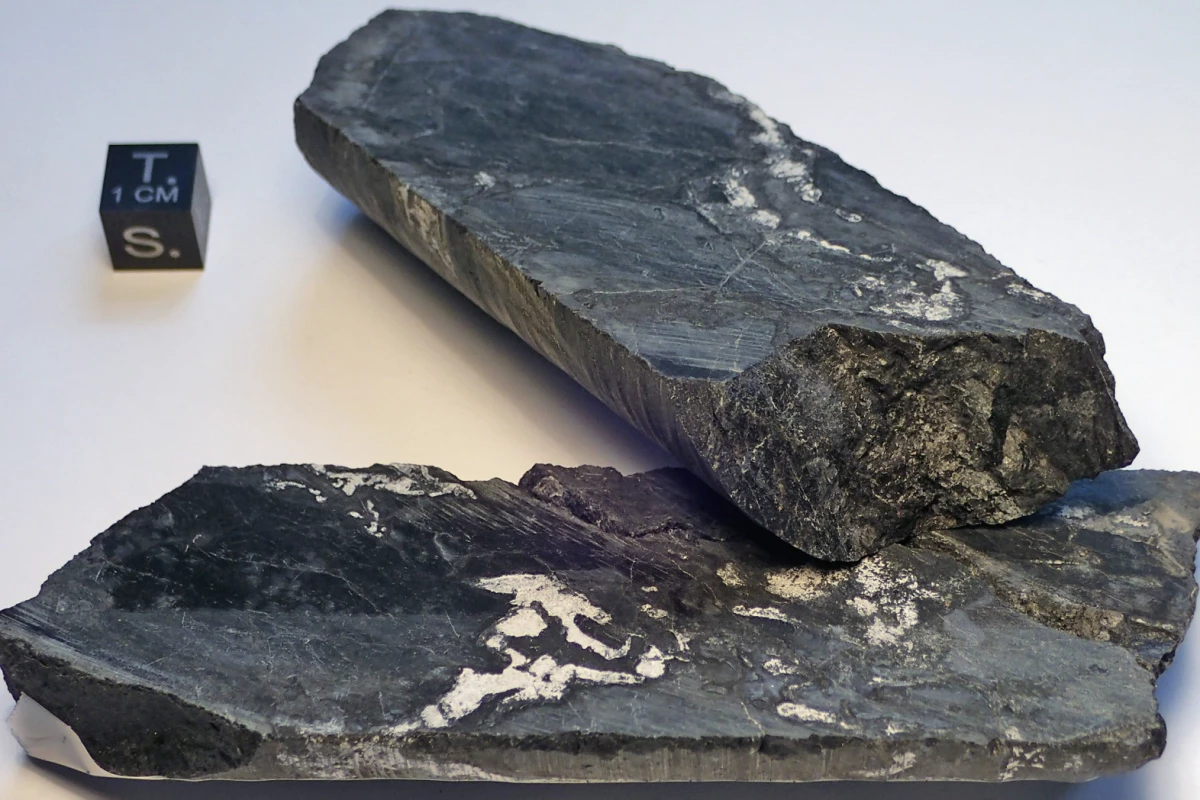
“After more studies, including on-site examinations, they discovered that the uranium ore had gone through fission on its own,” said Ludovic Ferrière, curator of the rock collection at Vienna’s Natural History Museum, where samples of the rocks have been permanently housed since 2019. “There was no other explanation.”

Mother Nature, it seemed, had beaten us to nuclear power by almost two billion years. Of course, the Earth was a very different place two billion years ago, and natural uranium contained around 3% U-235 – similar to the enrichment level used in some modern reactors. This alone isn't enough for nuclear fission to sustain itself, but at Oklo, groundwater that flowed through these rocks acted as a natural neutron moderator – similarly to how water is used in many of today's reactors. And when the groundwater flowed right, fission reactions had taken place.
Further research found that these natural reactors were not continuously in operation but cycled on and off over hundreds of thousands of years. While uranium-235 atoms occasionally split on their own, the conditions at Oklo allowed these rare events to cascade into a sustained chain reaction. Hydrogen atoms in groundwater, which filled cracks and pores in the surrounding rock, slowed the fast-moving neutrons released by fission just enough to trigger further atomic splits and keep the reaction going. Then, the heat generated would have boiled the water away, removing the natural neutron moderator, shutting down the reactor – until things cooled off and water again flowed in among the rocks.
“Like in a man-made light-water nuclear reactor, the fission reactions, without anything to slow down the neutrons, to moderate them, simply stop,” said Peter Woods from the International Atomic Energy Agency (IAEA). “The water acted in Oklo as a moderator, absorbing the neutrons, controlling the chain reaction.”
Since the discovery in 1972, at least 15 reactors have been identified within the main Oklo uranium ore deposit, as well as additional sites nearby at Bangombé. Each has the tell-tale isotopic fingerprints that could only be made by sustained nuclear fission. Each one is believed to have produced around 100 kilowatts of thermal energy when active – so, not a whole lot by modern standards, and only a fraction of that at any given time as things powered down or up.
"The 'Oklo phenomenon' is one of the most amazing and surprising [discoveries] of the 20th century that was made in the domains of geosciences and nuclear physics," said researchers in a 2011 paper.
In case you're wondering, what happened beneath the Earth's surface at Oklo couldn't occur naturally today. The proportion of U-235 in natural deposits has fallen to about 0.7%, too low to sustain a chain reaction without human-led enrichment. While the area lives on as a hub for uranium mining, it's also become a valuable place of research for scientists.
“That’s what makes it so fascinating: That the circumstances of time, geology, water came together for this to happen at all,” Woods said. “And that it was preserved until today. The detective story has been successfully solved.”