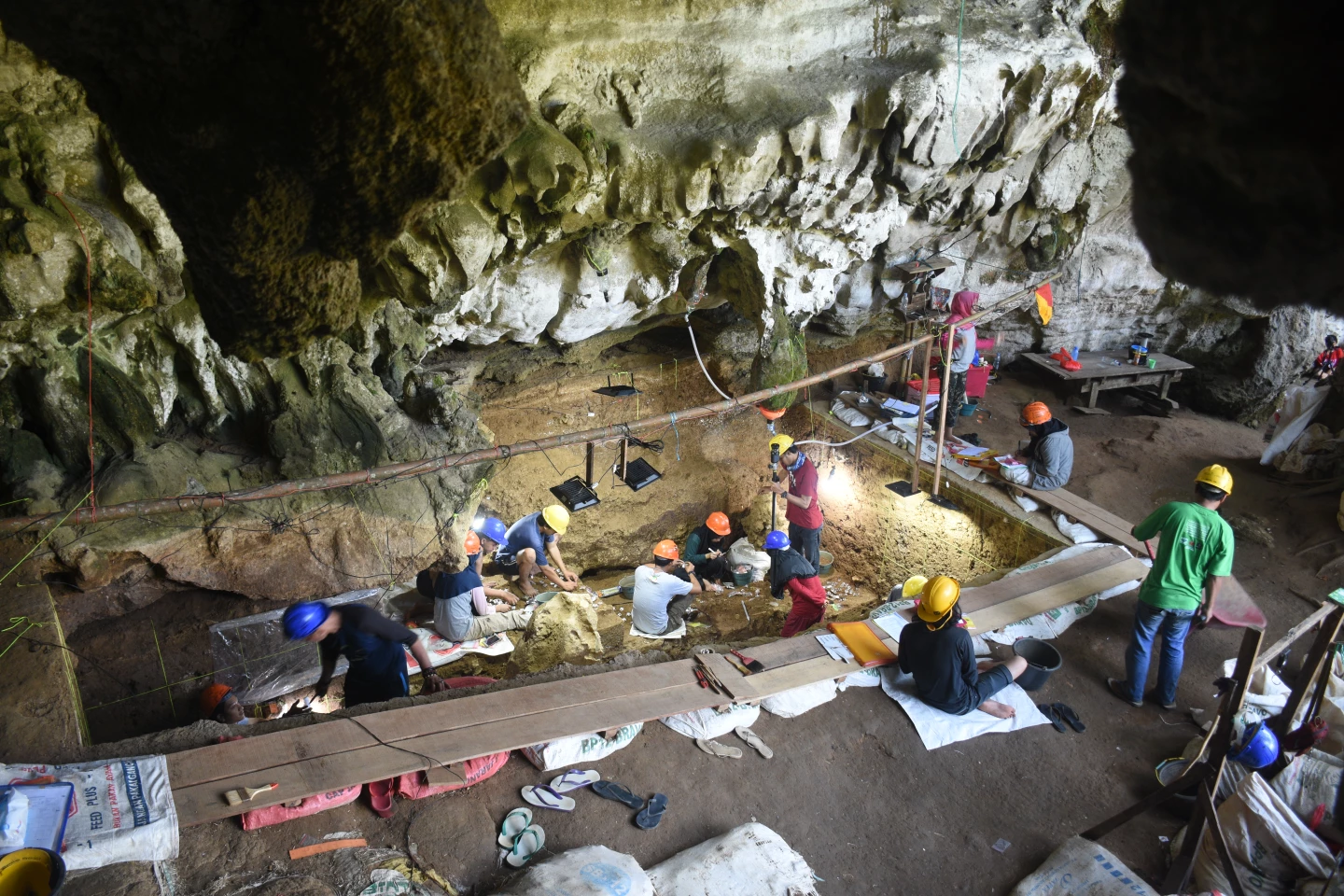
A 26-ft (8-m) deep excavation in Indonesia has revealed that humans and a hominin species that pre-dates humans used the same cave. The enticing possibility even exists that both species overlapped, sharing the space at the same time.
Sitting roughly in the middle of the Indonesian archipelago, the island of Sulawesi is the the fourth largest in the country and the 11th largest island in the world. That also makes it the largest landmass between mainland Southeast Asia and a region known as Sahul, which consists of New Guinea and Australia. This made it an important stop on migratory paths from Asia to Australia and as such, a valuable treasure trove for archaeologists looking into the past to untangle evolutionary riddles.
On the south side of Sulawesi, the Leang Bulu Bettue cave has attracted interest from scientists who have been excavating it since 2013. In 2023, a team of researchers concluded a dig that reached a depth of about 26 ft. This allowed them to peer back in time by approximately 200,000 years. In a recent study published in the journal PLOS ONE, an international team of researchers led by scientists at Australia's Griffith University found evidence of a dramatic shift in the archeological record about 40,000 years ago.
Prior to that time, the excavation revealed tools used by what the team has concluded is a now-extinct hominin species. These primitive implements are known as cobble-and-flake tools in which river stones, or cobbles, are flaked into usable tools, including pick-like objects. In a surprise discovery, the researchers also found the bones of monkeys in the same layers as these tools. That's significant because tracking and capturing an intelligent, agile, and fast animal like a monkey would have required advanced hunting skills not normally attributed to early hominins.
Because the scientists weren't able to find fossils from this species, they haven't concluded who exactly they might have been, but they offer a few possibilities including homo erectus, Denisovians, a dwarfed relative of home erectus, or a still-unidentified hominin.
What's clear is that at the 40,000-year-ago mark, humans arrived and shook things up.
"This later phase featured a distinct technological toolkit, and the earliest known evidence for artistic expression and symbolic behavior on the island – hallmarks associated with modern humans," says study lead Basran Burhan. "The distinct behavioral break between these phases may reflect a major demographic and cultural transition on Sulawesi, specifically the arrival of our species in the local environment and the replacement of the earlier hominin population."
Findings supporting the arrival of humans on the island include jewelry, portable artwork on stone slabs, more advanced stone tools, and a shift in the types of animals being butchered and consumed.
While it's still unclear if humans and the now-extinct hominins lived in the cave at the exact same time, the researchers say that the Leang Bulu Bettue cave provides the best chance of finding an overlap.
"That is why doing archaeological research in Sulawesi is so exciting," said Adam Brumm, Burhan's supervisor at Griffith. "For example, you could dig as deep as you like at an Australian site and you’ll never find evidence for human occupation prior to the arrival of our species, because Australia was only ever inhabited by Homo sapiens. But there were hominins in Sulawesi for a million years before we showed up, so if you dig deep enough, you might go back in time to the point where two human species came face-to-face.”
For now, the dig will continue with the hope that it will provide an even clearer window into evolution and migration.
"There may be several more meters of archaeological layers below the deepest level we have excavated at Leang Bulu Bettue thus far,” Basran concludes. "Further work at this site could therefore reveal new discoveries that will change our understanding of the early human story on this island, and perhaps more widely."
Source: Griffith University via Scimex