

Hypersonic vehicles aren't much use if you don't know where they're going, so Northrop Grumman is developing new navigation systems for autonomous craft that can stand up to the rigors of flying at speeds of over Mach 5.
During the Second World War, the Allies invented the proximity fuse. It was a rather clever bit of engineering. The fuse was installed in the nose of anti-aircraft shells and when fired they sent out a very short-range radio signal. If an aircraft flew into the radio bubble, it set off the shell, spraying the hostile with shrapnel.
Not having to actually hit the target or setting a timer fuse and hoping it exploded at the right altitude was a major advantage, but there was a bit of a hurdle to overcome. When fired, a shell is subjected to 20,000 g of acceleration, or enough to reduce a human being to something that looks very similar to strawberry jam.
It also doesn't do much for the electronics used to make the proximity fuse, so engineers had to work overtime to make the fuse as tough as possible.
Hypersonic vehicles face a similar problem. Traveling over five times the speed of sound generates immense friction and drag, resulting in the leading edges reaching temperatures beyond 1,650 °C (3,000 °F). This puts extreme thermal stresses on the airframe and heats the interior of the craft to the point where sensitive sensors and electronics required for navigation can be damaged. In addition, there are loads of mechanical stresses, vibrations, and accelerations of up to 60 g.
If this wasn't bad enough, the materials used to protect the vehicle against heat are often ablative. That is, they carry away heat by evaporating, which can alter the mass of the vehicle and its aerodynamic characteristics, making navigation more difficult.
Okay, but what's the fuss? Why not just rely on GPS like every yachtsman who slept through piloting class and can't remember how to work a sextant?

The answer is that military hypersonic vehicles have to deal with GPS jammers and spoofers that can block signals or transmit false ones to send the missile flying off to the middle of nowhere. Not only that, but flying at hypersonic speeds can result in the missile being surrounded by a halo of ionized plasma that can effectively block incoming signals. In essence, the missile blocks incoming transmissions much like a spacecraft reentering the Earth's atmosphere.
To get around this, Northrop Grumman is developing a highly sophisticated navigation system that is self-contained and compatible with AI-powered autonomous flight systems.
The principle is a very old and simple one called dead reckoning – a very basic skill used by tyro sailors and nuclear submarine commanders. The idea is that if you know your starting point and are able to keep a careful track of your speed and direction, you should be able to calculate where you are with reasonable accuracy.
Yacht skippers do this with a compass, log, chart, dividers, a straightedge, and a bit of luck, as do small plane pilots. Submarine navigators rely on a more sophisticated inertial navigation system of gyrocompasses and accelerometers to calculate positions while submerged – which is most of the time.
While the principle is very simple, it requires the ability to carefully measure all of the factors that can shift a vessel around, as well as extremely accurate clocks and the ability to handle complex calculations to prevent errors from creeping in and the vessel drifting off course.

Believe me, for putting your spine into cold chills there's very little that beats dead reckoning in a fog while approaching a coast only to discover your sums are off and you've made landfall 30 miles from where you calculated. I was very glad that day that lighthouses can be identified by how they flash in sequence.
The major problem that the Northrop Grumman engineers faced was to make an inertial navigation system for a hypersonic vehicle that is robust enough to survive the battering it gets in flight.
The core technology to what is called the Northrop Grumman Advanced Hypersonic Technology Inertial Measurement Unit (AHT IMU) is a Mini-Hemispherical Resonator Gyroscope (mHRG). This is a wine-glass shaped hemisphere of quartz that resonates, producing a standing wave oscillation. As the gyroscope turns, the standing wave stays in place like a magnet compass needle pointing north.
So what? Gyrocompasses have been around for a century. Well, none like this one. The AHT IMU is solid-state without any moving parts like bearings or mirrors to wear out. This means it's so reliable that Northrop Grumman says it can run 70 million hours without error and is 3.5 times more accurate than a much larger laser gyrocompass. In addition, it is described as being inherently radiation hardened.
The Yang to the AHT IMU's Ying is the system's Silicon Accelerometer (SiAc) that is integrated with a custom Application-Specific Integrated Circuit (ASIC) for signal processing. This is also solid-state, yet it can measure changes in acceleration down to a micro-g, which is what you need while maneuvering at hypersonic speeds.
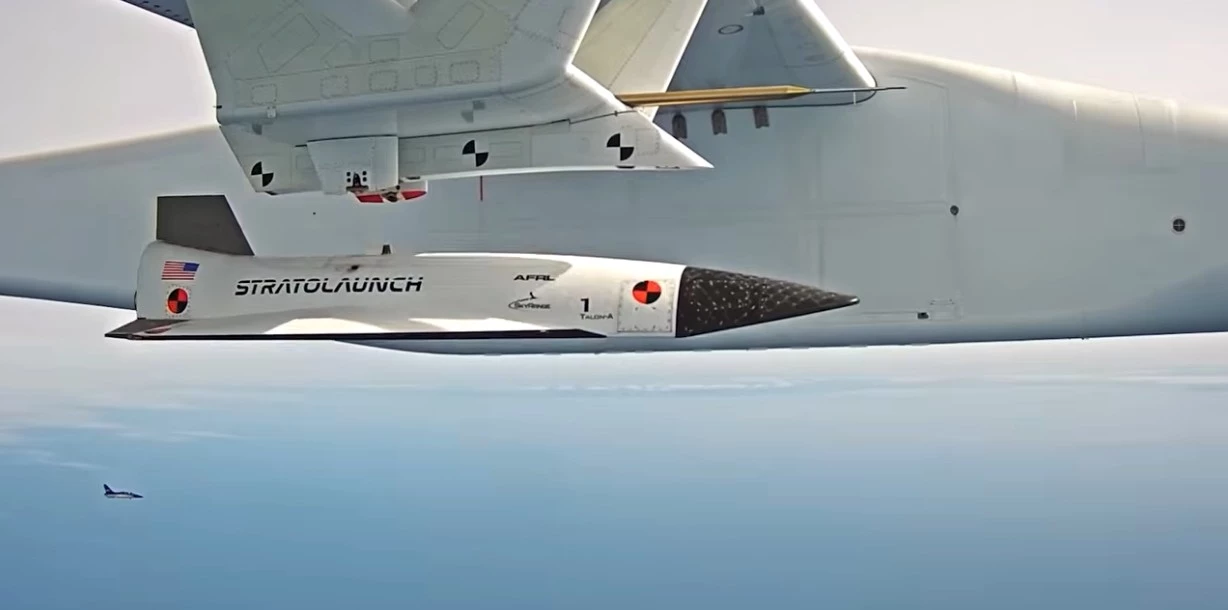
The whole unit is ruggedized and self-contained. According to Northrop Grumman it's already been test flown in a Stratolaunch Talon-A hypersonic vehicle, where it performed to expectations. So far it has flown over five hours, providing the development with considerable telemetry data.
Source: Northrop Grumman