




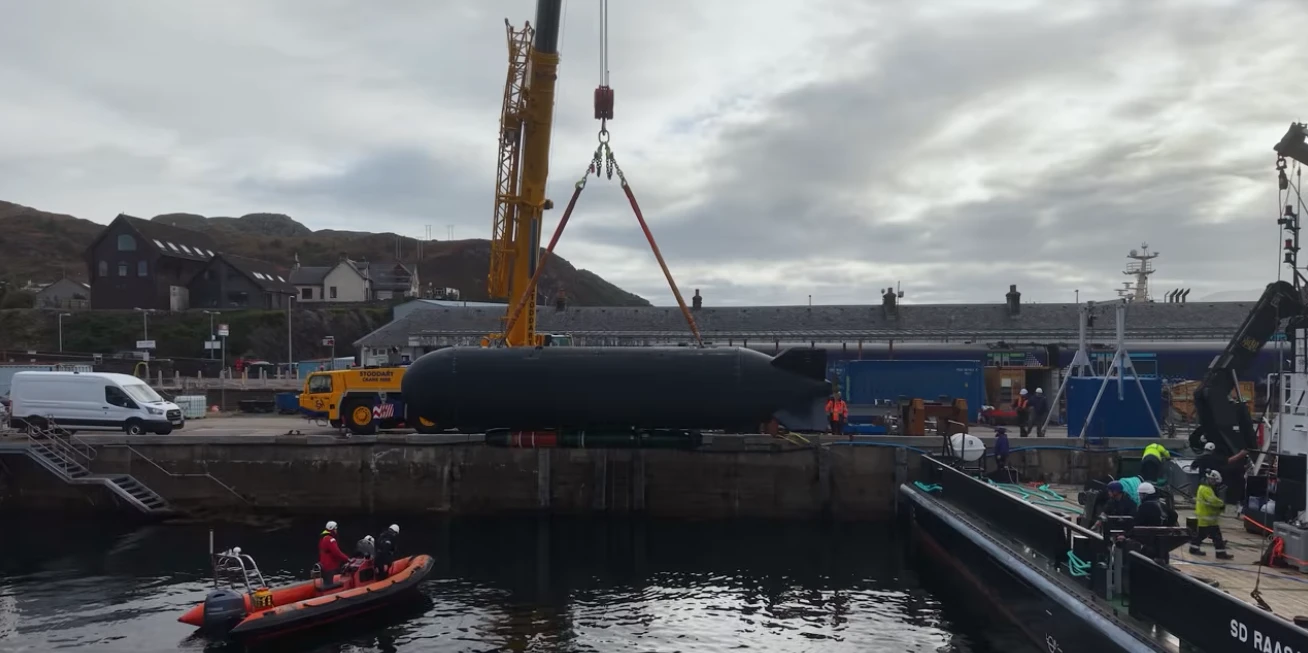

The US Navy and the Royal Navy have achieved a major milestone in autonomous warfare, successfully launching a US Mk 48 Heavyweight exercise torpedo from the Royal Navy’s robotic submarine, XV Excalibur. The test demonstrates growing autonomous combat capabilities designed to complement conventional crewed platforms.
The AUKUS agreement between Australia, the United Kingdom, and the United States represents two distinct tracks. While Pillar 1 is aimed at increas\ing security in the Indo-Pacific theater by enabling Australia to acquire and eventually build conventionally armed, nuclear-powered attack submarines, Pillar 2 serves as one of the most extensive military technology exchanges in history. It accelerates joint development across emerging technologies and enhances interchangeability among allied forces.
Under Pillar 2, the US Navy and Royal Navy are working to give robotic submarines like Excalibur the same punch as crewed attack submarines, along with the ability to interchange weapon systems between the two navies.
The demonstration at the British Underwater Test & Evaluation Centre (BUTEC) in Scotland paired two distinct naval eras. The Mk 48 heavyweight torpedo is an artefact of the Cold War. Entering service in 1972, it was developed as a weapon that could take on Soviet deep-diving, high-speed submarines with titanium hulls like the Alfa class. Weighing 1.7 tonnes, it carries a 645-lb (292-kg) PBXN-103 high-explosive warhead and can swim at up to 55 knots (63 mph, 102 km/h) over a range of up to 32 nautical miles (37 miles, 60 km) at a depth of 800 m (2,600 ft).
In contrast, Extra Large Uncrewed Underwater Vehicle (XLUUV) Excalibur is a product of the 21st century, which emphasizes autonomous vehicles operating in teams with crewed vessels. With an overall length of 40 ft (12 m) and a displacement of 19 tonnes, it looked a bit like a bathtub toy with the Mk 48 strapped to its bottom. However, that's part of how the technology is trending. By removing all the crew spaces, controls, and support equipment, robotic submarines can be made much smaller, compact, and retain many of the same capabilities. Some designs even do away with the pressure hull in favor of hardened modules.
The test shows how the three nations are working on rapidly developing ways to integrate software, interfaces, and heavy ordnance, as well as demonstrating how autonomous platforms can be used as front-line weapon launchers, and, last but not least, the increasingly common theme of very rapid systems development. According to the US Navy, the test went from approval to completion in only seven months – a timescale that would once have been regarded as the far side of unrealistic.
"This successful test marks a historic first for allied undersea warfare," said Adm. Daryl Caudle, Chief of Naval Operations. "Proving that we can seamlessly launch a US heavyweight torpedo from a Royal Navy autonomous underwater vehicle validates our shared vision for true interchangeability. By integrating weapons, payloads, and mission architectures across allied platforms, we are increasing the flexibility, scale, and combat power of our combined forces and ensuring they are ready to meet the strategic demands of tomorrow."
Source: US Navy


