
Princeton
-
 Many quantum effects can only be produced at extremely cold temperatures, which limits how useful they would be in real-world tech. Now, Princeton researchers have demonstrated a strange quantum state taking place in a material at room temperature.
 -
 A new technology representing a "revolutionary change" in how magnets are made for tokamak reactors could form a key piece of the nuclear fusion power puzzle, by facilitating the type of sustained streams of plasma needed for it to become a reality.
 -
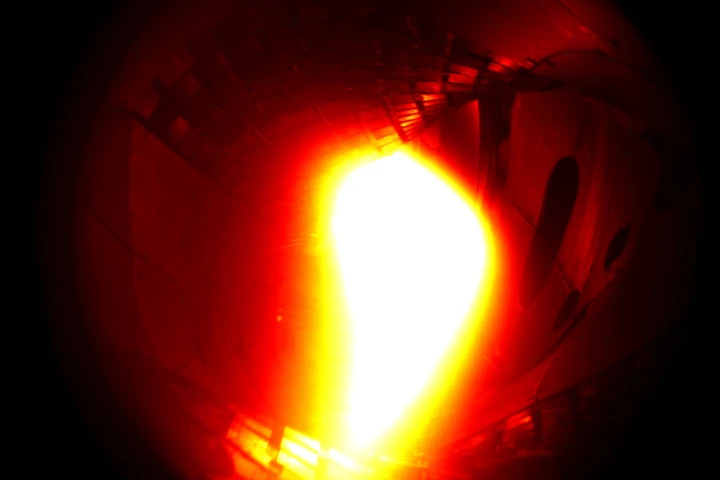 Physicists have confirmed a major advance in the performance of the Wendelstein 7-X fusion reactor, with efforts to address inherent energy losses in the design potentially enabling the reactor to host plasma twice as hot as the Sun's core.
 -
 A crewed mission to Mars may be more practical thanks to a new rocket concept developed by Fatima Ebrahimi, a physicist at the US Department of Energy’s (DOE) Princeton Plasma Physics Laboratory (PPPL), that uses magnetic fields to generate thrust.
 -
 Nuclear fusion could be an essentially unlimited energy source, but large eruptions in the plasma can damage reactors. But now physicists have found a way to prevent those large eruptions, by triggering lots of small ones through the injection of tiny pellets of beryllium.
 -
 A Princeton University team has successfully combined biology and electronics by means of 3D printing, creating a bionic ear that can "hear" radio waves.
 -
 Princeton University engineers have developed a new laser sensing technology that is expected to enable the remote distant detection of explosives, airborne pollutants and greenhouse gasses.