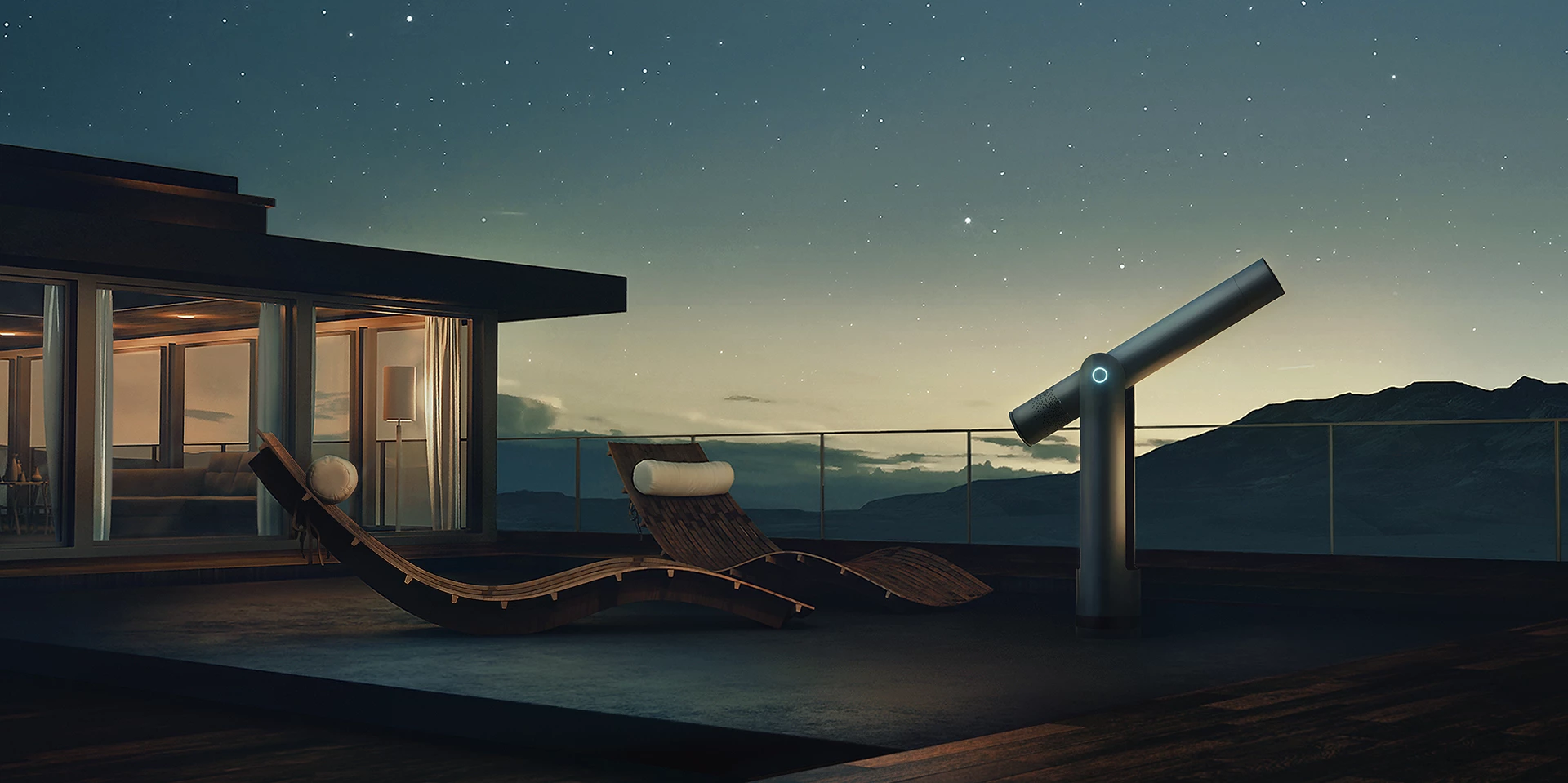

One would think that a US$99,000 telescope requires specialist training and a thick instruction manual. But the new Hyperia from French company Vaonis flips that assumption on its head. It's powerful enough for professional observatories yet runs entirely from a simple smartphone app.
Vaonis has been bringing astrophotography to the masses for years now. The company has stripped away the complexity, allowing anyone to snap spectacular images of galaxies and nebulae hundreds of light-years away without wrestling with multi-component setups requiring serious technical chops – all wrapped in Vaonis's trademark minimalist design.
The Hyperia started as a custom build for the Palais de la Découverte in Paris, which needed a next-gen digital observatory. After wrapping up the installation, Vaonis saw the bigger picture and decided to sell the system commercially.

The new telescope comes with a feature that will make experienced astrophotographers drool: Canon optics. With a significant 150-mm aperture and a long 1,050-mm focal length, the telescope packs a refractor – basically a lens-based design that uses curved glass to gather and focus light – with a F/4 aperture ratio. Inside are 17 lenses with Air Sphere Coating technology, engineered to cut down reflections and boost resolution.
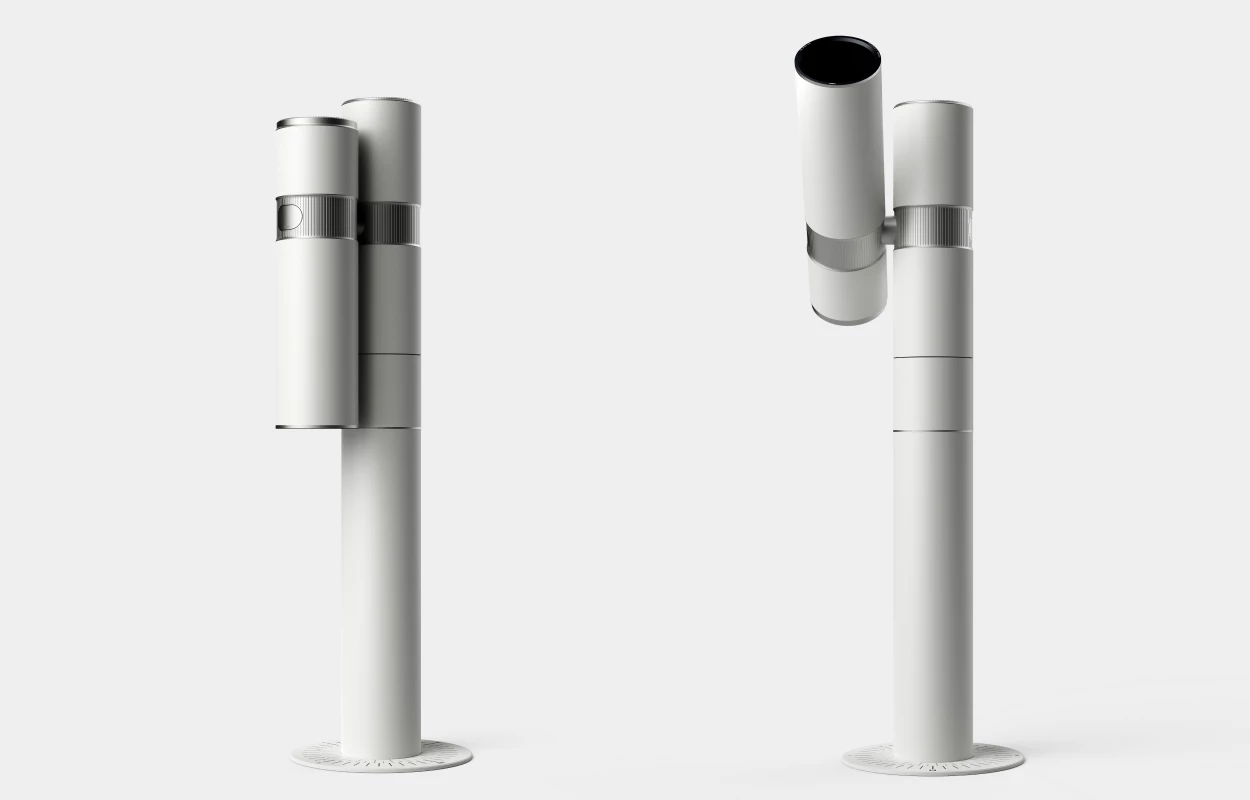
The Canon image sensor is a back-illuminated 45-megapixel full-frame flavor, the same category as pro cameras like the Canon EOS R5 II. The whole system stands around 6 ft (1.8 m) tall when open, and tips the scales at around 154-165 lb (70-75 kg).
The Hyperia uses an ultra-precise direct-drive tracking system that locks celestial targets in the center of the sensor. The system compensates for the Earth's rotation by counter-spinning the sensor while the telescope follows the sky, keeping everything rock-steady.
This allows exposures stretching up to 30 minutes, soaking up huge amounts of light to reveal incredibly faint objects in sharp detail. The system also packs two integrated 2-in (51-mm) filters for capturing different wavelengths – perfect for composing color images or bringing out specific features like nebulae.
Those images don't have to stay on the device. Hyperia can livestream observations and beam images to planetariums, classrooms, or theaters. The company bills it as "a reliable medium for learning," letting dozens of people watch what the telescope sees in real time.
"Each individual exposure contains both real light from the celestial object (the signal) and random noise," explains Stephanie Simpraseuth, the company's Marketing Manager, via email. "During the stacking process, the signal accumulates and reinforces the object's true light, while the noise – being random and different in every frame – averages out. Stacking also makes it possible to eliminate satellite and aircraft trails that may appear in individual exposures. This entire process is fully automatic."
That automation starts with the app. Hyperia connects via Wi-Fi or Ethernet and runs through a smartphone and tablet app. Users can hunt for celestial objects, program automatic observation sessions, set up multi-night runs, and tweak image processing on the fly.
"By using the time and geolocation of the control device, Hyperia can automatically orient itself in the night sky," Simpraseuth explains. "The user selects a target from a curated catalog, a sky chart, or by entering celestial coordinates. Hyperia then automatically slews to the target and performs an operation called astrometry – measuring the precise positions of stars to double-check its accuracy."
Beyond the automatic processing, the system lets you dive into manual adjustments if you want to squeeze every drop of performance from that full-frame sensor. The weather-resistant housing can sit outside for five years without maintenance – just plug it in and level it. No dome, no extra weather protection needed.

The new telescope represents a genuine leap toward accessible professional astronomy, stripping away the technical barriers. But cutting-edge tech doesn't come cheap – as mentioned earlier, you won't get much change from $100k.
For regular stargazers, Vaonis offers friendlier price points: the Vespera II delivers automated astrophotography with 4K resolution and smartphone control from $1,690. And the beefed-up Vespera Pro, with better optics and more power, starts at $2,999.
Vaonis isn't alone in the accessible smart telescope market. DwarfLab sells the Dwarf III and Dwarf Mini, both running Sony sensors with motorized tracking. Celestron's Origin also relies on Sony for the sensor and has a Rowe-Ackermann Schmidt Astrograph optical system with Raspberry Pi brains.
"Hyperia is primarily designed for the professional market – such as observatories, planetariums, and science museums – but orders are also open to individual users," according to Simpraseuth. Preorders kicked off January 4 during CES, with deliveries planned for 2027, though there's no firm date yet.
Product page: Vaonis Hyperia
Note: New Atlas may earn commission from purchases made via links