It may seem like a horse-drawn Zeppelin, but Astro Mechanica seems to be all-in on its revolutionary hybrid-electric supersonic jet engine as it partnered with UK-based engineering firm Helix to add high-energy density radial-flux motors to the tech.
In the 1940s, Commander Lee Lewis, Commander G. Halvorson, S. F. Singer, and Dr. James A. Van Allen came up with one of the strangest mixtures of technologies ever – the rockoon, which was a combination of a rocket and a balloon. At first glance, it seemed about as silly as things could get, with a small rocket being hoisted high into the air by a balloon to ignite at high altitude.
It seems not only daft but overcomplicated, yet it addressed a very real problem, which was how to get a rocket to fly through the dense lower layers of the atmosphere without wasting a lot of fuel. It also meant that sounding rockets could be safely launched from ships far out at sea where the spent vehicles could crash into the water nowhere near inhabited areas.
The idea of a hybrid-electric engine for supersonic aircraft may elicit a similar initial response, but there is some very firm engineering logic behind it.
Put simply, conventional supersonic engines are jet engines that are capable of reconfiguring themselves to operate at air speeds beyond Mach 1. That means shifting the flow of air and moving components about to slow down and cool incoming air so it doesn't destroy the engine as well as making sure that the engine runs as efficiently as possible.
The problem is that such an engine is a checklist of trade offs that always ends up leaving everyone dissatisfied. An engine might be extremely noisy, it might require a heavy complicated gearbox to maintain proper compression at different speeds, it might not work very well at low speeds or during takeoffs and landings, or it may end up gulping fuel or taxiing like a pregnant hippopotamus.
Ideally, what you want is an engine that can both generate the power required for supersonic flight and the ability to maintain optimum airflow and compression during all phases of flight. The caterpillar in the aeronautical salad is that these tend to be mutually exclusive and fuel inefficient.
What Astro Mechanica is working on is a Duality Propulsion System to address this inefficiency with a combined-cycle turboelectric adaptive engine. At home, that means an engine that splits the power generation and propulsion into two separate but parallel sets of machinery.
It's still a jet engine that burns fuel but that's in a dedicated gas turbine that operates solely as a turbogenerator to create electricity at subsonic speeds. Since that's all it does, its architecture can be fairly simple.
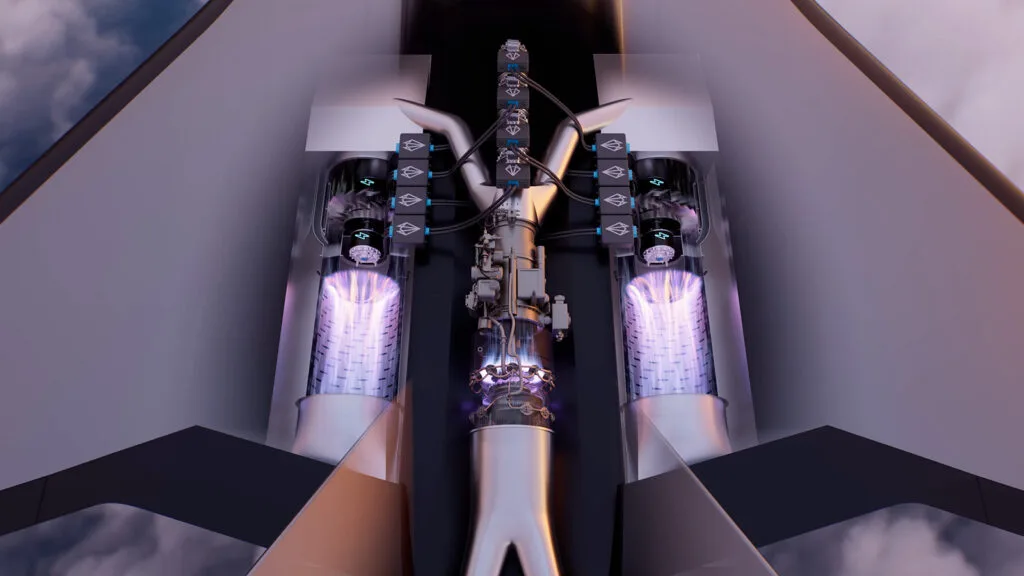
This is where Helix comes in. Beginning life as Integral Powertrain Ltd, Helix makes high-energy density radial-flux electric motors that can crank up to 950 kW in the fifth-generation version. Originally developed for Formula E racing and electric hypercars, these motors turn the compressor/fan element, which is a bladed disk known as a "blisk." This allows the flow of air and the speed of the compressor to be precisely controlled independently of the gas turbine's combustion output, so the engine can reshape its operating mode to achieve optimum efficiency at every speed.
What that translates to is that the generator and the propulsors can do their thing without bothering one another in flight. It also allows the engine to effectively act as three different engines, depending on speed.
During ground operations, including taxiing, takeoff, climbing, and subsonic cruising, the engine acts like a highly efficient turbofan, with the blisks drawing in the air and accelerating it to shoot out the back. This means the blisks can even be run on the runway without the turbogenerator, reducing noise and fuel costs, and this efficiency is maintained when the turbogenerator is running during low-speed cruising.
When the aircraft goes supersonic, the engine functions like a turbojet, with combustion going active to produce high-velocity thrust. The electric motors continue to drive the compressor at the exact speeds necessary to feed the core with compressed air. This maintains optimum air compression regardless of the turbine's thrust output and allows for a smoother, more efficient transition to supersonic speed. It also avoids the aerodynamic challenges that plague conventional supersonic engines.
If the aircraft boosts past Mach 3, the game changes seriously as the engine transitions into an all-fuel, ramjet-like configuration with virtually no moving parts involved. At such speeds, the air compresses itself as it hits the air intake and the engine acts like a large duct, which allows the turbogenerator to shift to running other systems instead of propulsion.
California-based Astro Mechanica is currently testing the fourth generation of its engine prototype and is hoping for a first flight within three years. The main goal is transpacific range capability for affordable on-demand, supersonic passenger travel. However, the short-term looks more at national defense, orbital launch capability, and long-range cargo delivery.
"We are incredibly proud that our electric motors are powering Duality given its potential to reshape aviation and aerospace," said Derek Jordanou-Bailey, Aerospace Chief Engineer at Helix."For decades, Helix has worked at the very cutting-edge of electric powertrain technology and are now a critical enabler in electrification journey of many high-performance sectors. Astro Mechanica’s engine shows that our unrivaled power density stands to completely transform the engineering and economics of whole industries."
Source: Helix