


Okay, CERN's Large Hadron Collider (LHC) might have uncovered the Higgs boson and helped redefine our concept of physical reality, but what has it done for us lately? How about a side hustle heating several thousand homes in the neighborhood?
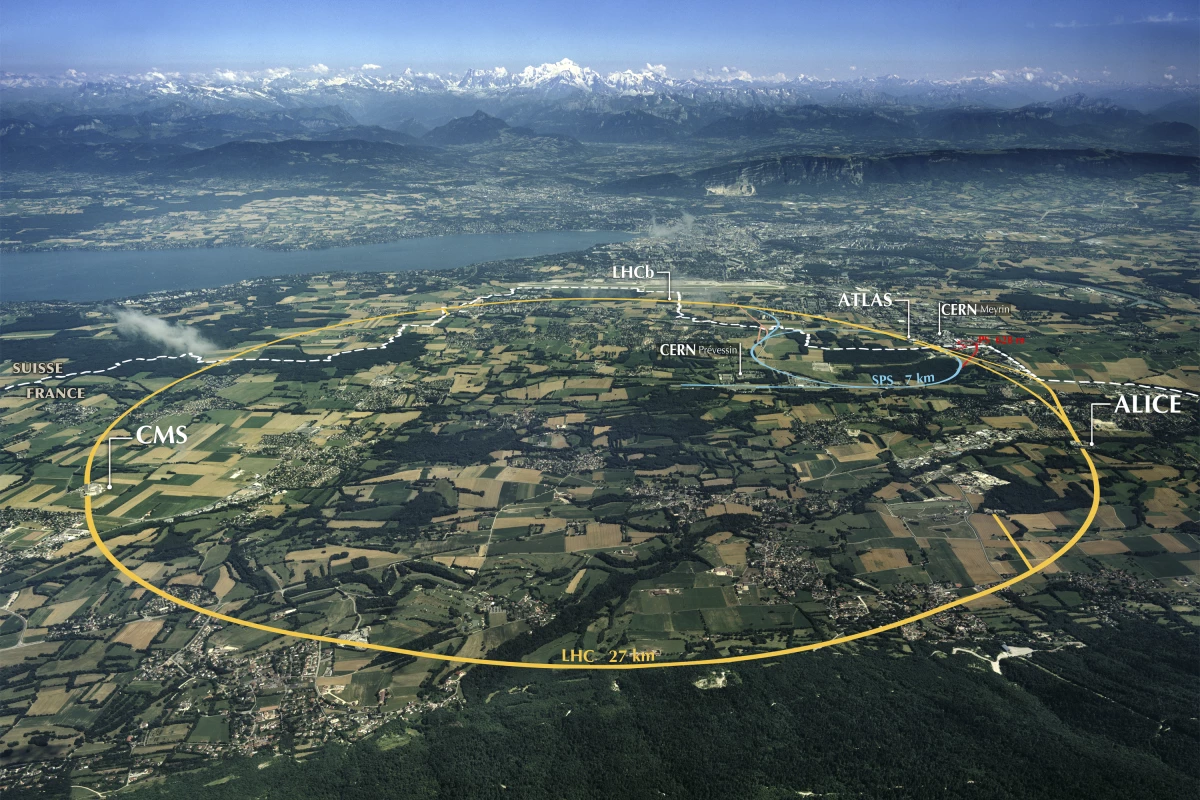
With a circumference of 26.7 km (16.6 miles), the LHC it is the largest particle accelerator ever built. In order to smash together subatomic particles at fantastic relativistic velocities so they blast apart like a pocket watch chucked into a jet engine, it needs a lot of power. We're talking about a giant machine that consumes 600 to 750 GWh per year.
Aside from generating electricity bills that would rival my overdraft, it also results in waste heat – lots of waste heat.
Previously, this heat was dispensed into the atmosphere through evaporation cooling towers, but CERN's new plan is to put this waste heat to some use while improving the facilities environmental signature by way of what's called the Large Hadron Collider beauty (LHCb) experiment.

That may not be the greatest name, but we're talking about particle physicists who use words like "charm" and "quark," so let's give them some leeway.
The idea behind LHCb is to install a heat exchanger at the Point 8 installation on the accelerator ring, which is in proximity to the French town of Ferney-Voltaie. In partnership with the local authorities, the heat from the accelerator is collected from the exchanger and redirected into a district heating system, which provides heat to several thousand domestic residences and commercial properties in the Zone d’Aménagement Concerté Ferney-Genève Innovation development area.

The system was inaugurated last December and is now becoming fully operational.
"Typically, hot water would then pass through a cooling tower, releasing heat into the atmosphere so that the cooled water could be reinjected into the equipment," explains CERN’s energy coordinator, Nicolas Bellegarde. "In the new set-up, hot water initially passes through two 5-MW heat exchangers, which transfer thermal energy to the new heating network in Ferney-Voltaire."
Source: CERN