

For millions of people, losing their sense of smell quietly reshapes daily life. Meals lose nuance, familiar places feel strangely distant, and critical warning signals like smoke, gas or spoiled food become harder to register. Smell’s deep links to memory and emotion make its absence especially disorienting, and once damaged, the system is notoriously difficult to restore. That challenge has led some researchers to stop asking how to fix smell, and start asking whether its information might reach the brain another way.
Smell loss, or anosmia, affects tens of millions of people worldwide, often following viral infections, head trauma, or neurological disease. Unlike vision or hearing, olfaction depends on fragile neural pathways that connect directly to brain regions involved in emotion and memory. When those pathways are disrupted, the result is not just sensory loss, but a profound change in how people experience the world.
In a study published in Science Advances, researchers explored an alternative strategy that sidesteps the damaged olfactory system entirely. Instead of trying to restore smell itself, they focused on preserving what smell provides: information about the chemical environment around us. In other words, they asked whether perception could be rebuilt by disentangling how odors are detected from how they are experienced.
Their prototype device does exactly that. It separates detection from perception, first capturing odors in the air with an artificial sensing system and translating them into a digital signature. That information is then delivered to the brain through a different sensory channel, one that remains functional even when smell is lost. Rather than activating the olfactory nerve, the system stimulates the trigeminal nerve, a sensory pathway in the nasal cavity responsible for conveying touch, temperature, and irritation.
The stimulation produces a distinct physical sensation inside the nose. Users are not smelling in the traditional sense. Instead, with training, the brain learns to associate specific stimulation patterns with particular odors, allowing people to tell smells apart through sensation rather than scent. In effect, the brain builds a new interpretive map, using touch to stand in for chemical perception.
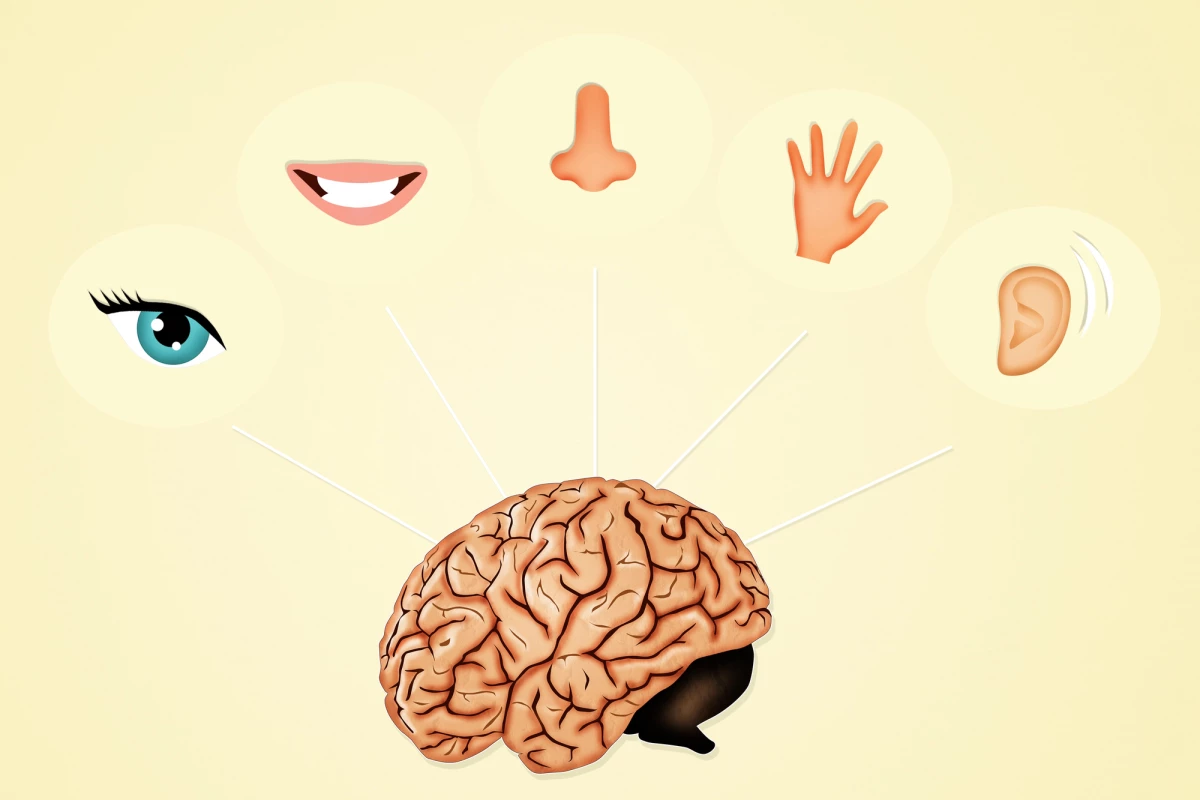
This approach draws on a concept known as sensory substitution, in which information from a missing or impaired sense is rerouted through a functioning one. The nasal cavity is uniquely suited for this strategy because it houses both systems side by side: the olfactory network for smell and the trigeminal system for somatosensory signals. By leveraging that second pathway, the device offers a way to transmit odor information without relying on the damaged circuitry of smell.
To test the idea, the researchers ran a series of experiments involving 65 participants, including people with normal olfaction and others with partial or complete smell loss. Participants were able to detect odorant molecules using the device, and most could reliably distinguish between different odors. Crucially, the system performed just as well for individuals who could not smell as it did for those who could, suggesting that the trigeminal pathway provides a stable and broadly accessible route for transmitting these signals.
The device does not restore the sensory richness or emotional immediacy of smell, and the researchers are careful not to frame it as a replacement. At this stage, it remains a proof of concept. But it demonstrates something new: that the brain can learn to access chemical information through touch when smell itself is no longer available.
More broadly, the work reflects a shift in how sensory loss might be addressed. Rather than focusing solely on repairing damaged systems, it suggests that perception itself can be rebuilt by translating information across senses.
For people living with anosmia, that reframing offers a quieter form of possibility, not the return of smell, but a new way to engage with the chemical world through learning, adaptation, and experience.
This study was published in the journal Science Advances.