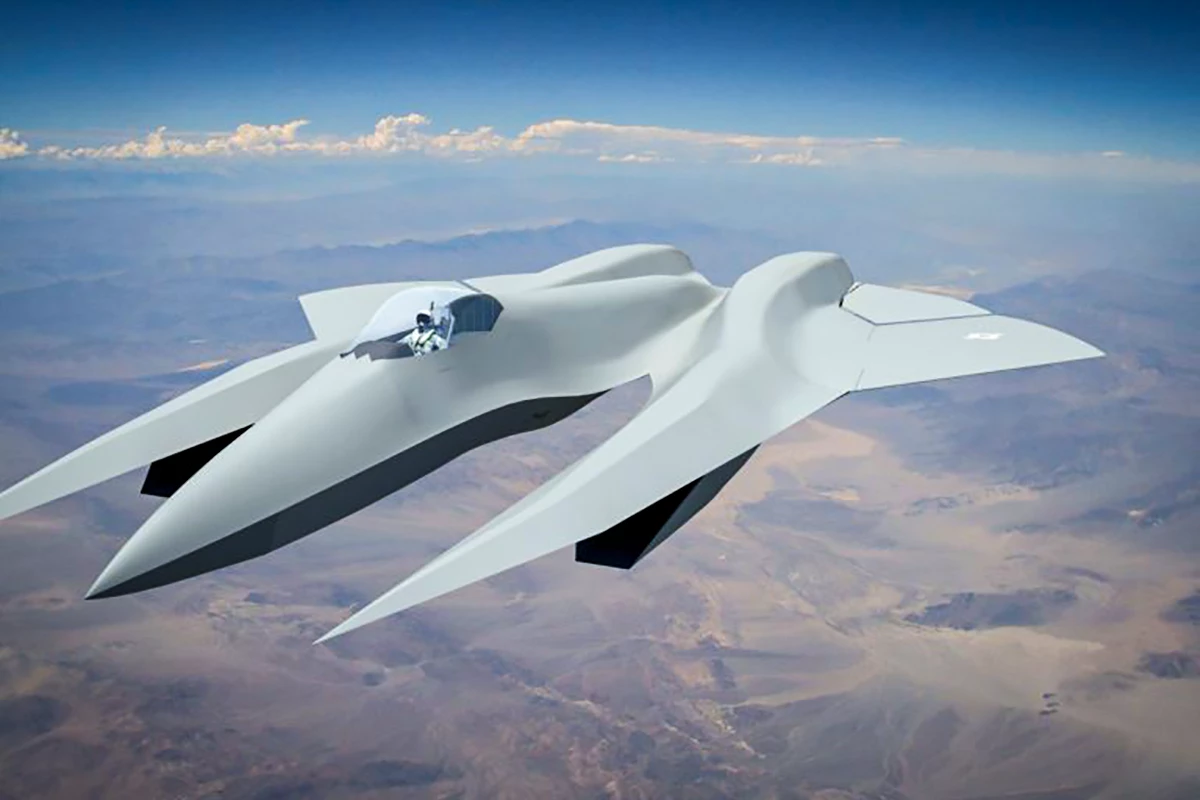



There's a new contender for the US Navy's F/A-XX Next Generation Air Dominance (NGAD) fighter program to replace the F/A-18E/F Super Hornet, and it looks like something out of Batman's hangar thanks to a peculiar triple-fuselage design.
The NGAD initiative aims to produce a family of systems to create and support sixth-generation fighter aircraft. This includes the F/A-XX, which is the Navy’s alternative to the US Air Force’s F-47 fighter. That may seem a bit redundant, but the Navy insists that it requires its own multirole, carrier-based aircraft to complement and eventually replace the F-35C Lightning II.
Where the Air Force wants a plane that focuses on air superiority, the Navy wants one that can take on surface attack, air-to-air combat, and electronic warfare missions. In addition, the F/A-XX will need the ability to act as a command center for controlling a swarm of uncrewed Collaborative Combat Aircraft (CCA), carrying additional weapons and sensors.
Currently, the competition to build the F/A-XX is between Boeing and Northrop Grumman, but now there's a third in the form of a dark horse candidate from Stavatti Aerospace called the SM-39 Razor.
On paper, the SM-39 looks very impressive with renderings of an aircraft featuring three fuselages fixed to a cantilever variable-camber mutable wing integrated into a blended wing-body. That's a roundabout way of saying that it looks like the Batwing. It's supposed to have a top speed of Mach 4 – twice that of the Boeing and Northrop Grumman designs – and an equally faster super-cruise speed of Mach 2.5. It also claims greater tactical range, service ceiling, payload, rate of climb, and thrust.
In all, it looks like the SM-39 would walk away with the prize without breaking a sweat. It doesn't just out-perform the others, it does so by a fantastic margin. Plus, it's made out of a revolutionary titanium foam instead of carbon composites.

So, game over? Not quite.
The problem is twofold. First, the SM-39 has attracted a lot of skepticism – not least because of doubts that a turbofan powerplant could achieve Mach 4, or that the unorthodox design could handle near-hypersonic speeds without generating shock waves that might choke the air intakes or lead to catastrophic stresses where shock cones collide. It also wouldn’t be very stealthy, as the skin of the aircraft could reach temperatures of up to 400 °C (752 °F), turning it into what has been described as a “flying torch.”
The second issue is that Stavatti hasn’t built a single aircraft since it opened for business in 1994. Describing itself as a clean-sheet design firm, it regularly releases concepts from its headquarters in Niagara Falls, New York, but it hasn’t produced any prototypes – much less brought a model into production.

Essentially, Stavatti appears to make its money from venture capital, private equity and angel investments, government incentives and tax abatements, contract proposals, and claimed intellectual property sales. Estimates place its annual revenue at about US$3 million per year, and it’s reported to have only 25 employees. That's a bit short of the heavy hitters in the defense aerospace field.
In short, Stavatti has a reputation for producing vaporware. In addition, the US Navy has not confirmed any submission from the company to the competition. That’s not to say the SM-39 is all smoke and mirrors. The history of aviation is full of surprises, and this may well be one of them, but I wouldn’t bet the farm on it.
Source: Stavatti