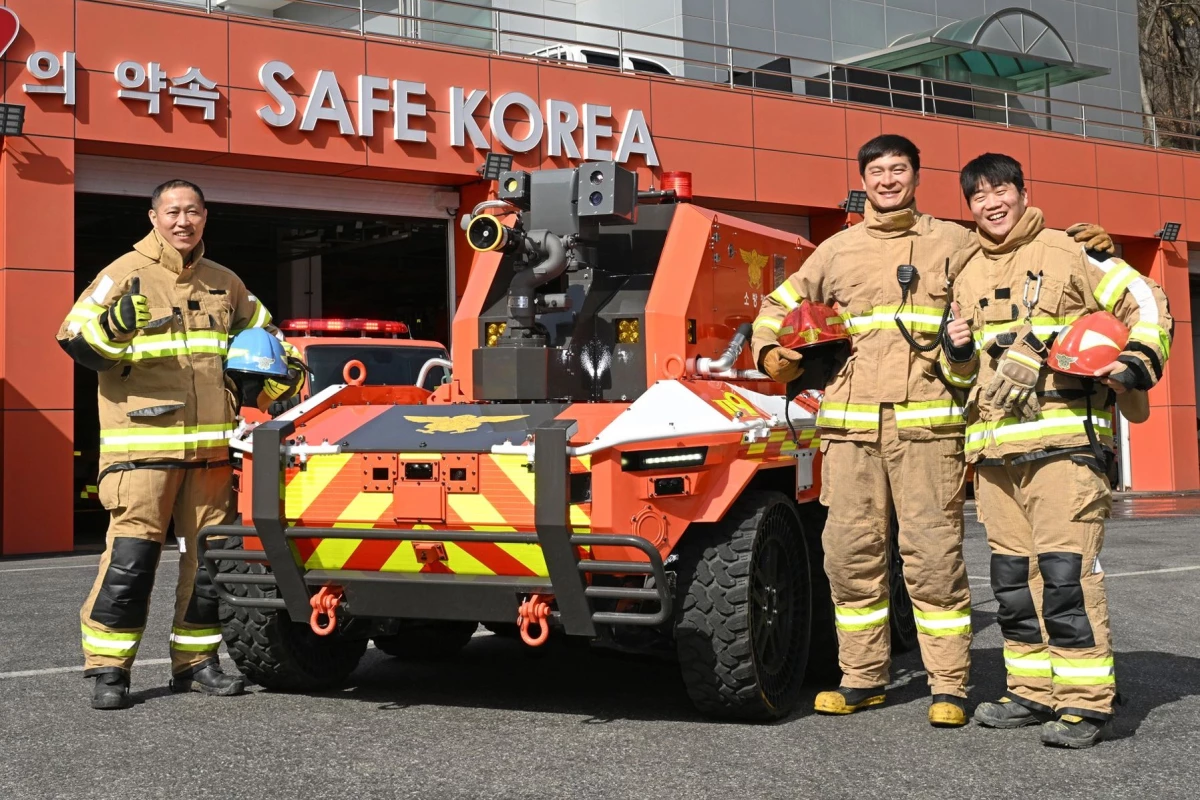
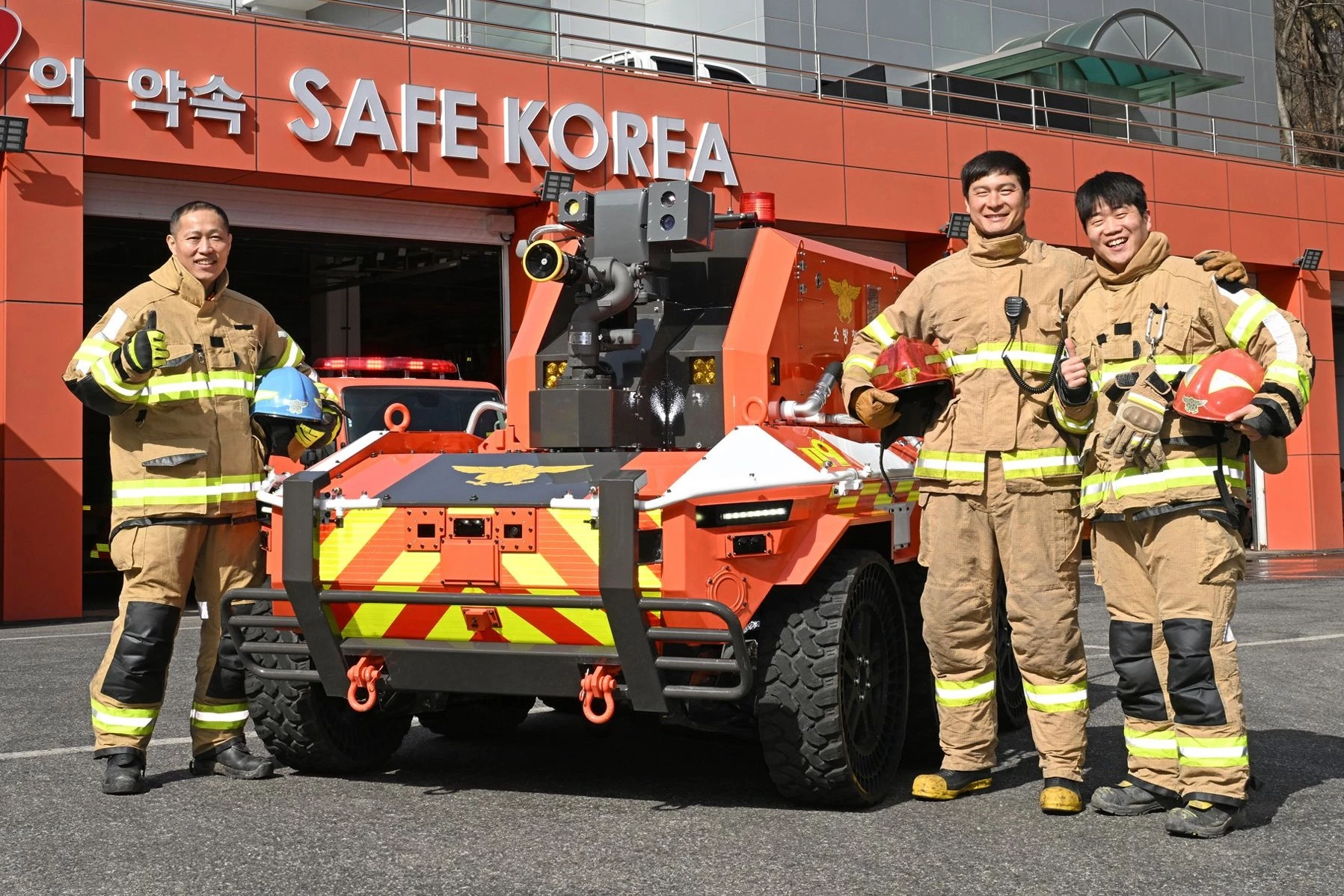
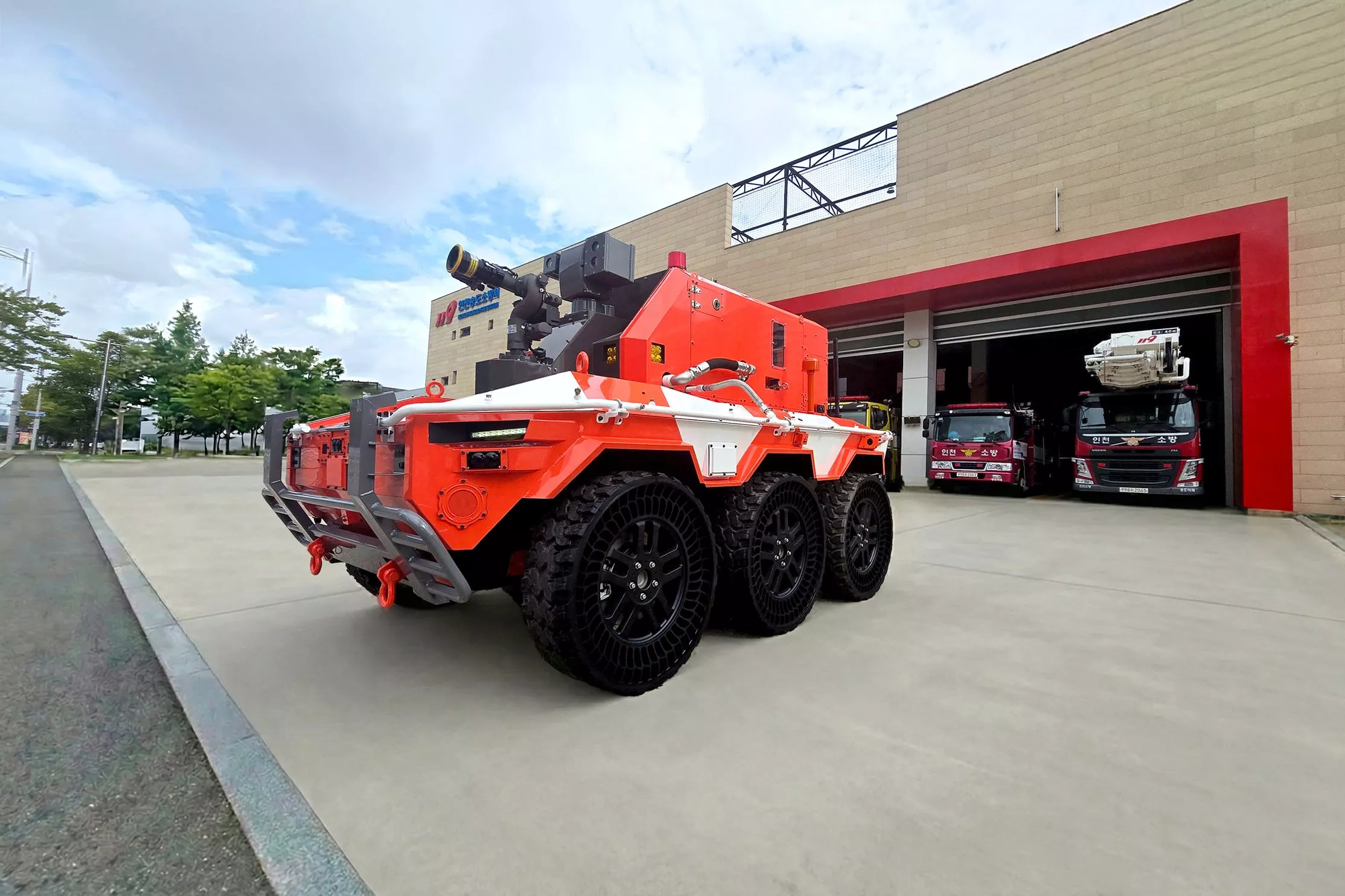

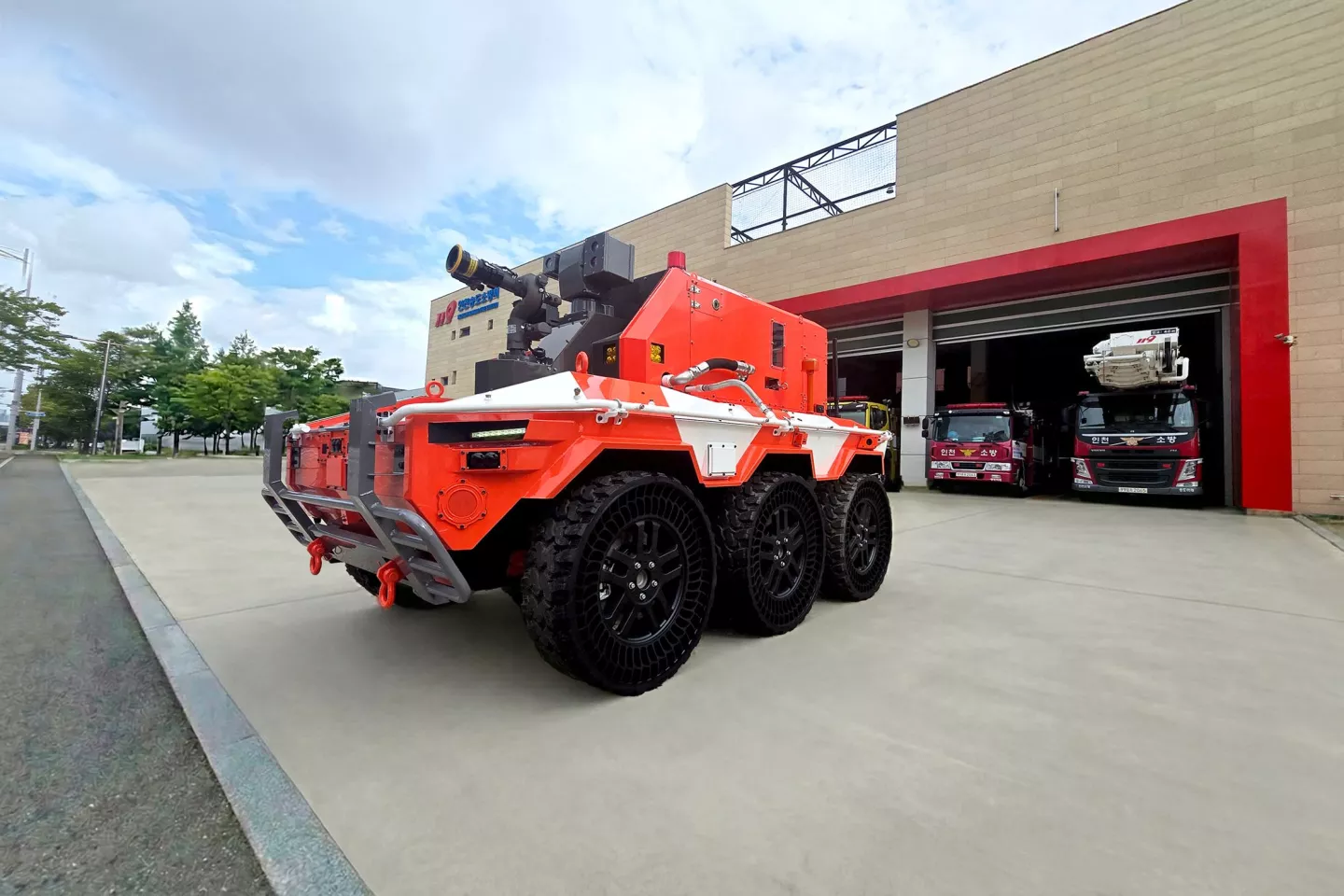
Hyundai has donated four super-tough unmanned robotic vehicles to firefighters in Korea for use in high-risk situations. The autonomous vehicles will deal with the initial stages of a fire to provide more information and safety to firefighters.
According to Hyundai, the Korea National Fire Agency reports that 1,788 firefighters have been injured or killed in the country over the past decade while at the scenes of fires. Seeking to bring that number down and give firefighters a helping hand, Hyundai has given one of its electric unmanned firefighters to two different stations in South Korea, with another two on the way to two additional firehouses.
The robotic firefighters, which you can see in action in the following video, are built on the base of the HR-Sherpa multi-purpose unmanned vehicle made by Hyundai Rotem, Hyundai Motor Group's arm responsible for manufacturing rail vehicles, military equipment, large industrial equipment, and more.
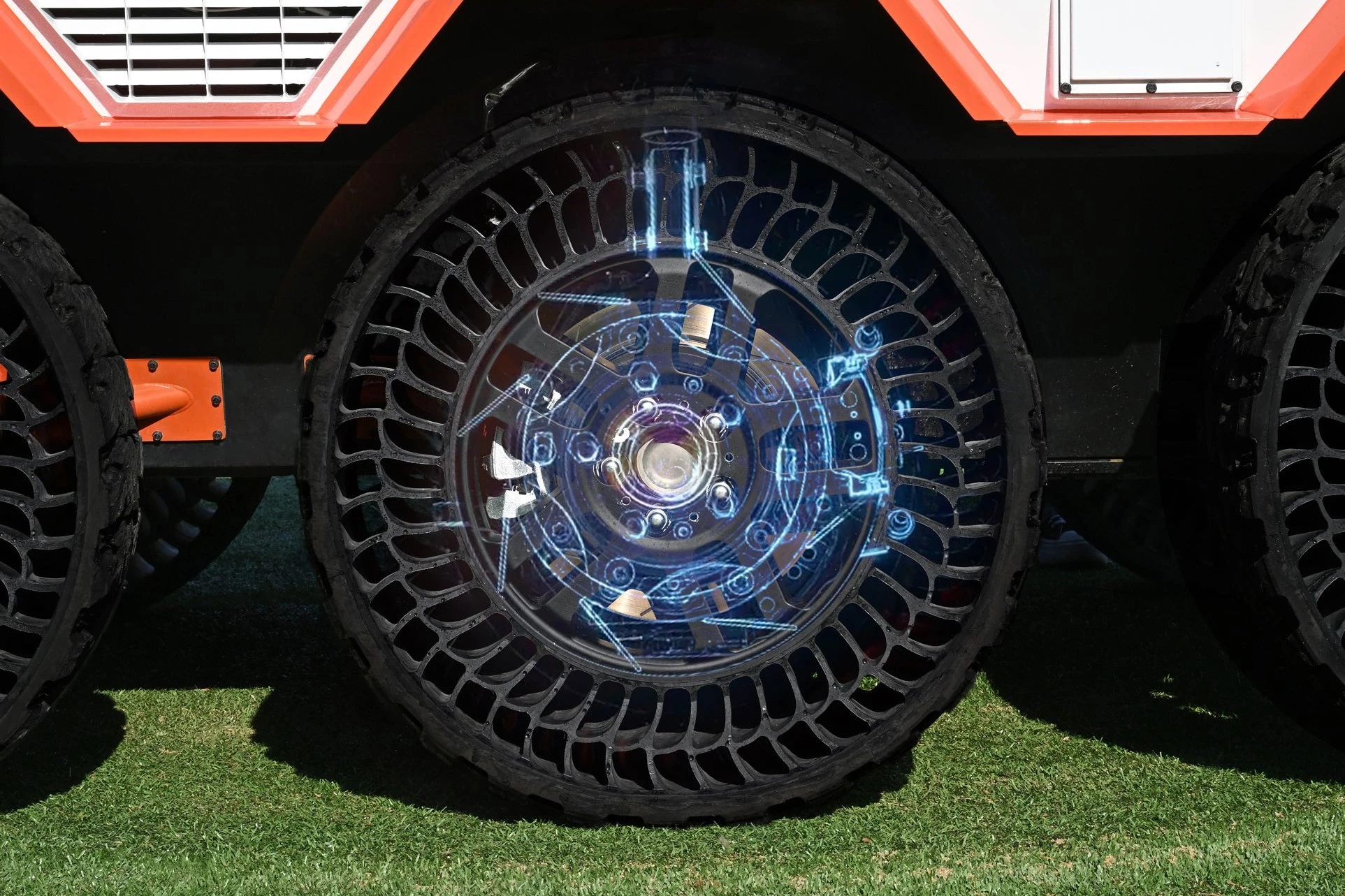
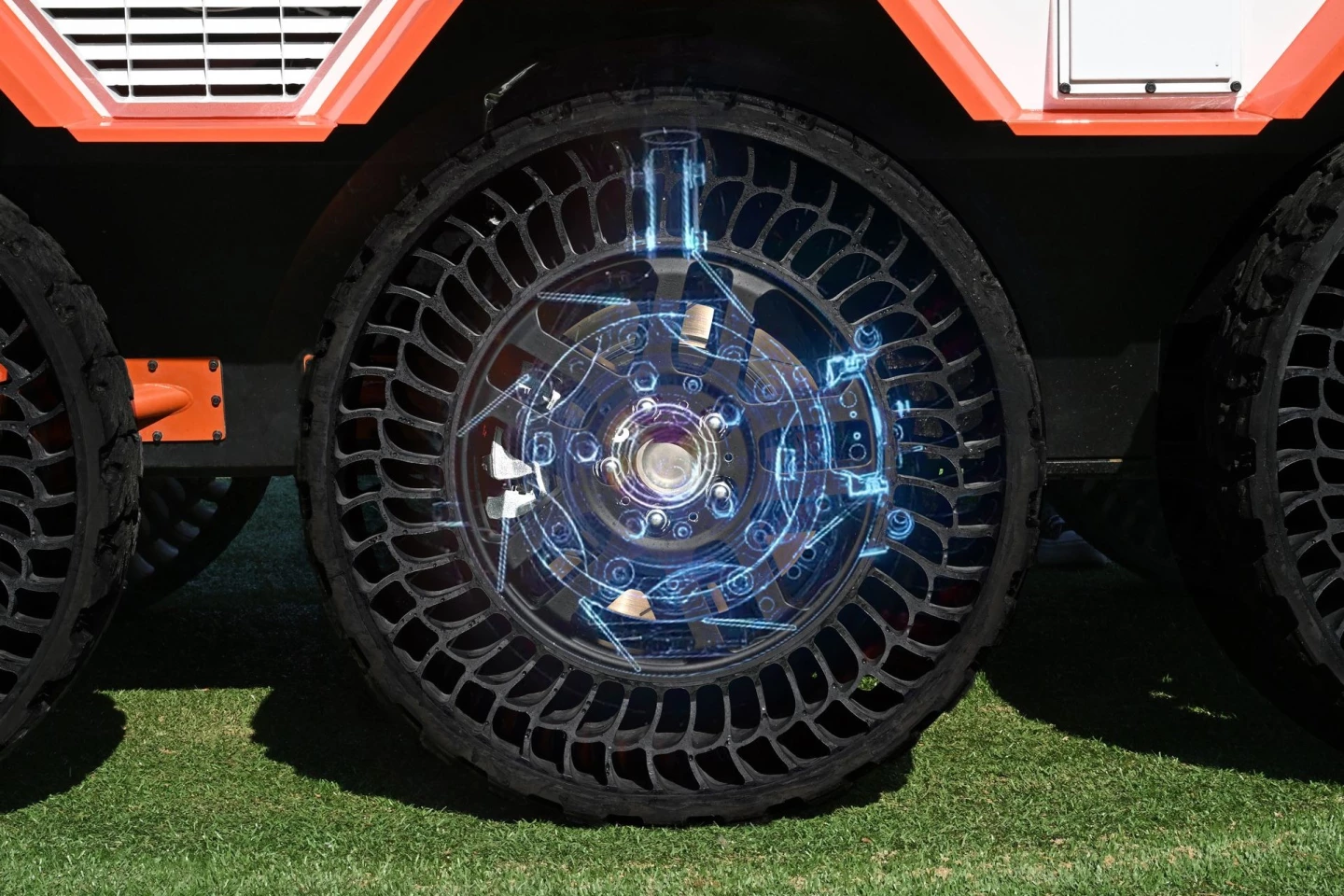
To take on the extreme conditions in blazes, the HR-Sherpas were equipped with a water cannon that can shoot out both focused streams and more diffuse sprays; a set of regular and infrared cameras that can effectively see through smoke; temperature-resistant tires; independently moving wheels each equipped with their own motors; and a self-spraying system that shoots a curtain of water out around the vehicle to keep it cool. Hyundai says the spray can keep the vehicle at a temperature between 50 - 60 °C (122-140°F), even when environmental temperatures climb up to 800 °C (1,472 °F).
The vehicle is also equipped with an advanced self-driving assist system that allows it to monitor the surrounding terrain to navigate effectively on its own. The robotic firefighter can travel at a top speed of 50 km/h (31 mph), it can roll over barriers up to 300 mm (12 in) tall, and it can handle inclines of up to 60% vertically and 40% transversely. It's also equipped with a self-illuminating hose reel that can provide a light source in dark conditions and also help guide firefighters to safety or to an injured person.
The idea is that these robust vehicles can now enter burning buildings before firefighters to not only start to tackle the blaze, but also to provide detailed information about the situation inside. They'll help firefighters develop on-the-spot plans to douse the flames, as well as allowing them to stay safe while scanning for survivors in situations where a building's collapse might be imminent.
The development of the vehicles is part of a larger trend in which robotic vehicles are being used to tackle tasks that endanger humans, such as the autonomous electric coal-mining trucks released last year in Mongolia, and the mine-clearing robots made by Croatian firm, DOK-ING. There's even a water-cannon-equipped robodog made by Unitree that can also help fight fires.
"The unmanned firefighting robots that we are donating embody Hyundai Motor Group’s core technologies and represent a new form of mobility built on our shared goal of ‘technology that saves lives,’" said Hyundai's Executive Chair, Euisun Chung "We hope they will serve as reliable teammates, entering dangerous scenes ahead of others to safeguard the firefighters’ safety."
Next, Hyundai plans to explore embedding AI technologies into the autonomous firefighting vehicles so that they can be even more robust at what they do.
"The true value of this robot is not merely its heat resistance or fire suppression power, but its role as a ‘Physical AI’ that operates in actual disaster sites," said Seung-ryong Kim, Acting Commissioner of Korea's National Fire Agency. "In extreme environments where firefighters cannot enter, it will collect and learn from real-world operational data to develop into a sophisticated disaster response platform. This will usher in an era of hybrid convergence where humans and robots overcome their respective limitations, marking a ‘paradigm shift for AI in firefighting.’"