
Microfluidic
-
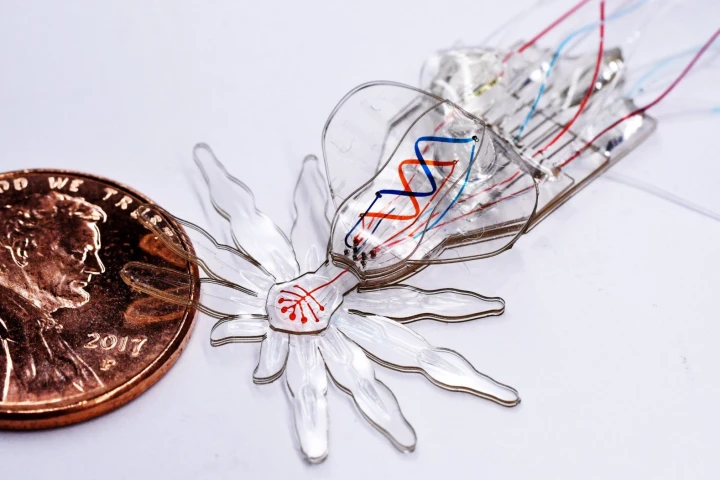 If robots are ever going to work alongside humans in the real world, they're going to need a softer touch. Harvard researchers have developed a new method for producing small-scale squishy robots, and demonstrated it by creating a flexible robotic peacock spider, driven by a microfluidics system.
 -
 When it comes to hazardous fluids, the less that researchers have to finely manipulate them, the better. It was with this in mind that scientists recently developed a new material that does something special when exposed to liquid – it rolls itself into a straw-like tube.
 -
 A new fabric developed at the University of California, Davis, has tiny channels that pull sweat through the fabric where it forms into droplets that drain away.
 -
 An experimental new type of electrical wire can heal itself back together when cut in two.
 -
 A new in-shoe device is designed to harvest the energy that is created by walking, and store it for use in mobile electronic devices.
 -
 Researchers have developed a method of laser-welding transparent pieces of plastic to one another, based on altering the wavelength of the laser light.
 -
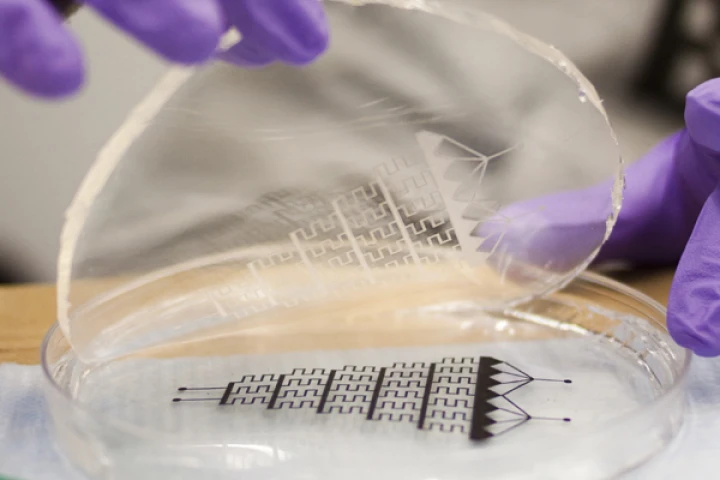 A high school physics teacher has invented a method of producing microfluidic devices, using little else than a photocopier and transparency film.