
NIST
-
 High-entropy alloys (HEAs) are metallurgy’s version of having your cake and eating it too, combining multiple elements to create unusual mixes of desirable properties. The problem is that they can be difficult to create, requiring proper mixing of the constituent elements at the atomic level.
 -
 A recently developed system could revolutionize the world of 3D printing, by streamlining the adoption of new print media. Such materials could include ones made from all-renewable ingredients, or that are more recyclable than current options.
 -
 Researchers at NIST have shown that a cloud of atoms can be used as a receiver to pick up video transmissions. The team demonstrated this “Atomic Television” by transmitting live video feed and even video games through the atoms to a monitor.
 -
 Inspired by the dual-focus visual system of a 500-million-year-old trilobite, researchers have created and tested a light field camera with the greatest depth of field ever demonstrated. Everything between 3 cm and 1.7 km from the lens stays sharp.
 -
 Flashover is a very dangerous phenomenon, in which all of the exposed combustible materials in an enclosed area near-simultaneously ignite. Thanks to a new AI-based system, however, firefighters may soon receive warnings when flashover is imminent.
 -
 Some advanced electronic devices only function at extremely cold temperatures. Now engineers at NIST have developed a tiny cryogenic thermometer that uses a new mechanism to keep an eye on these sensitive instruments without taking up much room.
 -
 Although we may think of 3D-printed items as being hard, they're actually often made from soft gels, as is the case with bioprinted body parts. A new system now allows such objects to be printed at a much smaller scale than ever before.
 -
 Researchers have come up with a way to generate truly random numbers using quantum mechanics. The method uses photons to generate a string of random ones and zeros, and leans on the laws of physics to prove that these strings are truly random, rather than merely posing as random.
 -
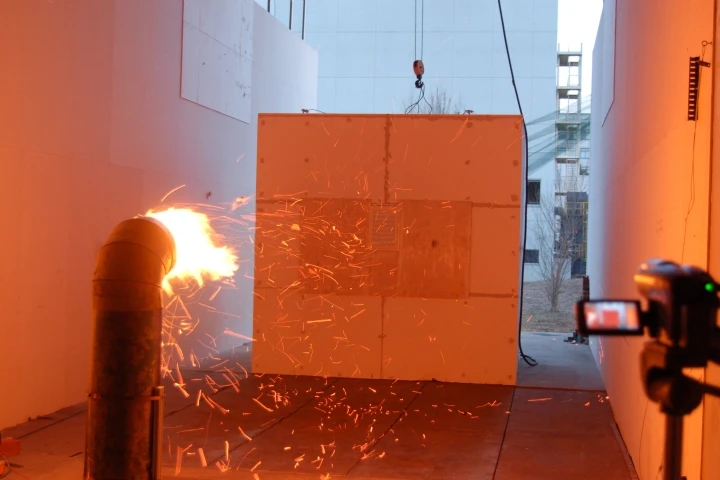 The NIST Dragon is a device that creates burning embers, to test how well building materials can withstand the effects of wildfires.
 -
 NIST researchers have developed the world's first two-qubit programmable quantum computer.