Aircraft

Split-wing aircraft gets new propulsion system

Split-wing aircraft gets new propulsion system
Horizon Aircraft's Cavorite X7 hybrid eVTOL now features two larger vertical lift fans in its front canards instead of four smaller ones, along with other updates
View 4 Images
The canards and tails have been reprofiled in order lower drag, thus improving energy efficiency and stability while cruising
1/4
The canards and tails have been reprofiled in order lower drag, thus improving energy efficiency and stability while cruising
A patented mechanism allows the wing surfaces to slide open for vertical lift from the fans, and slide closed as the X7 transitions to forward fixed-wing flight
2/4
A patented mechanism allows the wing surfaces to slide open for vertical lift from the fans, and slide closed as the X7 transitions to forward fixed-wing flight
The X7 is 11.6 m long (38 ft) and has a 15-m (50-ft) wingspan
3/4
The X7 is 11.6 m long (38 ft) and has a 15-m (50-ft) wingspan
Horizon Aircraft's Cavorite X7 hybrid eVTOL now features two larger vertical lift fans in its front canards instead of four smaller ones, along with other updates
4/4
Horizon Aircraft's Cavorite X7 hybrid eVTOL now features two larger vertical lift fans in its front canards instead of four smaller ones, along with other updates
View gallery - 4 images

Horizon Aircraft's Cavorite X7 already sported a radical design, even within the wild world of hybrid eVTOLs. That design has now been updated, however, for enhanced aerodynamics, cruising performance, and flight safety.

We first heard about Canadian company Horizon Aircraft back in 2021, when it unveiled the X7's predecessor, the Cavorite X5.

Like the X7, it utilized a unique split-wing design to take-off and land vertically like a helicopter. In the case of the X7, that design placed five battery-powered vertical lift fans in each of the two wings, along with two smaller fans in each of two canards at the nose (for a total of 14 fans).

Once the aircraft gained altitude, a gas-powered pusher propeller in the rear took over for forward flight, with the wings and canards now providing lift just like they would on a fixed-wing aircraft – they were assisted by aerodynamic covers that slid up over the fans.
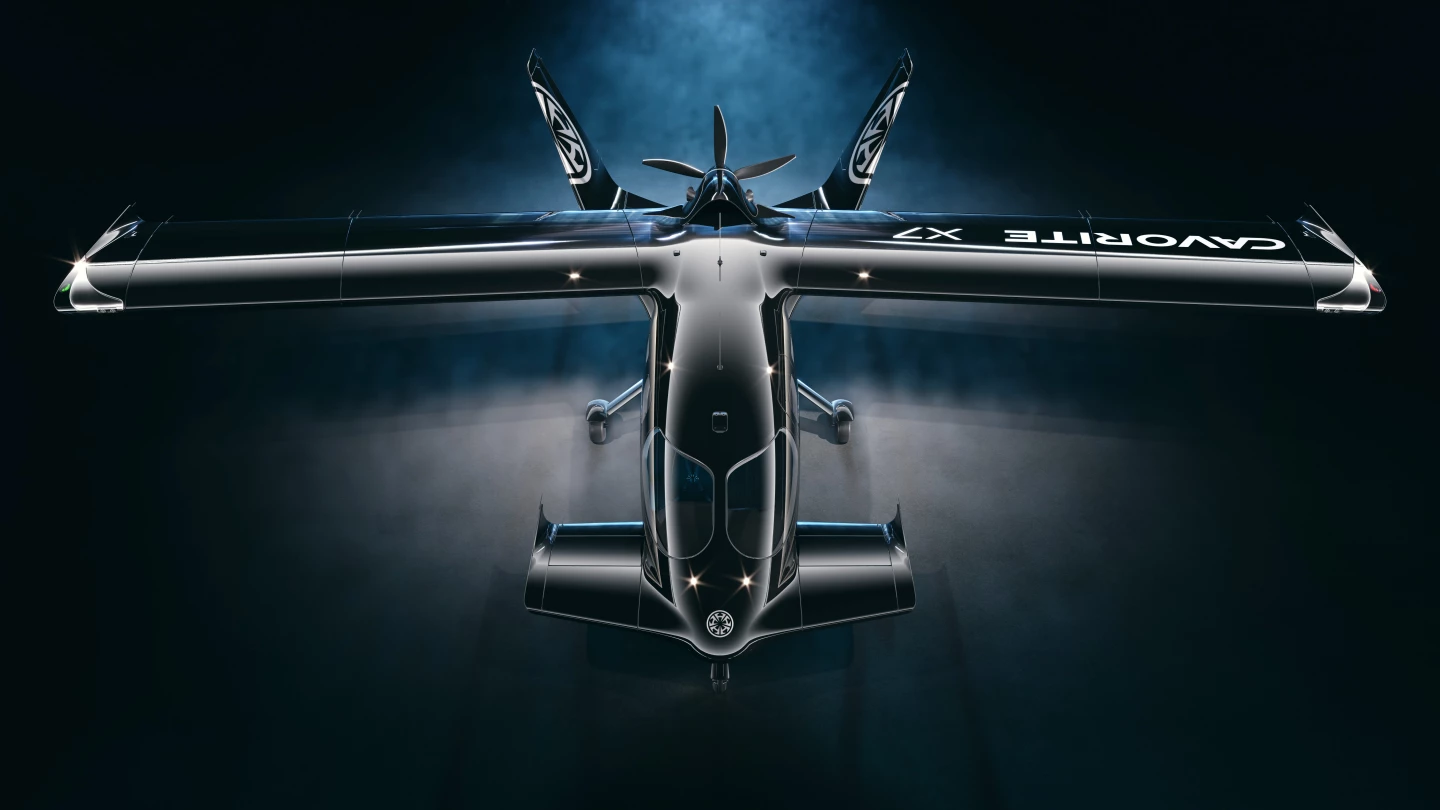
A patented mechanism allows the wing surfaces to slide open for vertical lift from the fans, and slide closed as the X7 transitions to forward fixed-wing flight

It's a clever design, but Horizon figured it could do even better by reducing the number of fans to 12.

Last Wednesday (Jan. 21/26), the company announced an update to the design, which will partially involve replacing the four smaller canard fans with just two fans (one in each canard) that are the same size as those in the wings. This change will improve manufacturing efficiency, increase performance and simplify maintenance, reportedly without compromising safety margins.

The X7 is 11.6 m long (38 ft) and has a 15-m (50-ft) wingspan

The canards and tails have also been reprofiled in order lower drag, thus improving energy efficiency and stability while cruising.

Finally, the cabin has been slightly extended and its windows have been redesigned, in order to increase legroom and improve sightlines.

Basic specs for the planned production version of the Cavorite X7 remain the same. Plans call for the six-passenger (plus pilot) aircraft to be capable of a 450-km/h (280-mph) cruising speed with an impressive 800-km (497-mile) range with reserves.

Is our hybrid electric aircraft another air taxi?

Source: Horizon Aircraft

View gallery - 4 images
1 comment
1 comment
Towerman
The Le now shifts to cover the fans in forward flight. That's clever !