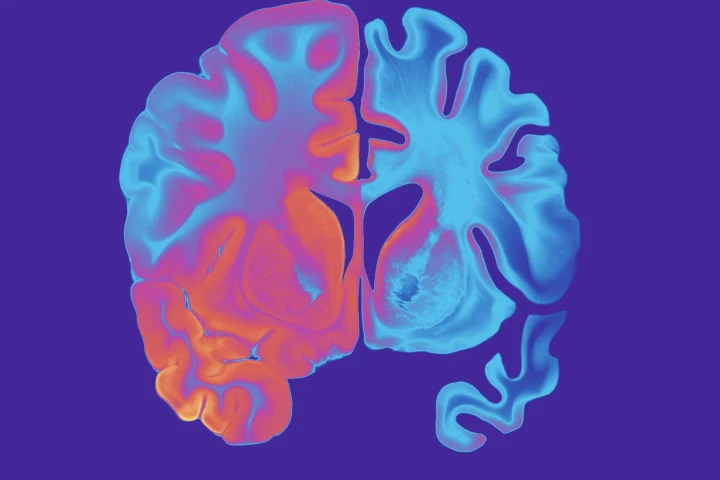


A hallmark tangle of proteins present in the brains of people with dementia may have a watery weakness.
Scientists at Northwestern University in the US and the University of California, Santa Barbara, have discovered a consistent anchor point on tau proteins where the molecules meet before contorting into a pathogenic shape.
The findings, published in the Proceedings of the National Academy of Sciences, suggest that a thin cap of water molecules coating this anchor point helps drive the attachment process – and that blocking the site may substantially hinder the growth of the problematic protein tangles.
Tau typically helps stabilize the internal scaffolding of nerve cells. But in diseases known as tauopathies, including Alzheimer’s disease and frontotemporal dementia, tau can misfold. Misfolded tau can also recruit other healthy tau proteins, encouraging them to adopt the same abnormal shape, accumulating as knotted threads known as fibrillar aggregates.
Tau proteins aren’t created in a diseased form. Yet for reasons unknown, soon after their production, the proteins join existing tangled shapes and mirror their diseased form.
To investigate, a team of researchers led by Northwestern University chemist Songi Han tracked the activity of shortened lengths of engineered tau as they encountered pre-existing tau fibers. Using nuclear magnetic resonance spectroscopy, they monitored individual regions of the protein as they clumped.
One site stood out. A region around amino acid 300 made contact with existing aggregates more rapidly than the other sites examined, suggesting it acts as an initial anchor. Other parts of the protein followed, allowing it to adopt the fiber’s structure as it was incorporated into the tangle.
The researchers describe this as a “dock-and-lock” process: tau first docks at a preferred contact point, then locks into the growing fiber as the rest of the molecule aligns.
As significant as the anchor point seemed, tau’s “stickiness” couldn’t be explained by protein structure alone.
Molecular simulations and experiments on water dynamics revealed that the region around the amino acids showed an unusual arrangement of water molecules.
Water behaves in different ways around different sections of a protein. Molecules pooling close to regions that repel water can be forced into distinctive arrangements that are energetically costly to maintain, resembling pieces of a jigsaw puzzle pushed into patterns poised on the verge of scattering.
The team found evidence that water molecules covering a tau tangle’s anchor zone were particularly prone to being ejected. All it would take is an incoming tau molecule to draw near. The ejection of water molecules favors the interaction, supporting the alignment needed for the messy tangle to grow.
To test whether the water-coated anchor point was essential to the process, the researchers attached a chemical block to different locations on tau. When the chemical block was attached to the site around amino acid 300, the fiber’s growth was inhibited. Chemicals at other positions had much less effect.
This result suggests the zone is more than a place where proteins happen to meet: it plays a crucial role in locking incoming tau into the growing structure.
The finding could help researchers design treatments to interfere with tau aggregation, potentially slowing the spread of misfolded proteins. It may also offer a more targeted approach than attempting to block the entire protein or its established aggregation-prone regions.
“Once you know that aggregation-prone tau proteins always have a hotspot that is first attracted to the same site of tau that is stacked to fibrils, then you know there’s always some part of the protein that you can target to neutralize,” says the study’s senior author, Songi Han. “If you know where to block its action of misfolding, you could block it to prevent it from propagating.”
However, the work remains an early step towards that goal. The experiments used a short tau construct carrying a disease-associated mutation, rather than demonstrating that the same “hotspot” can be blocked to prevent disease progression in people. The precise location may also vary between tau forms and diseases.
Further research will need to establish whether the mechanism holds across different tau structures and whether drugs can safely disrupt it in the brain.
This research was published in PNAS.
Source: Northwestern University