


The next frontier in unmanned aerial vehicle (UAV) technology is all about keeping these aircraft fueled indefinitely. If we can crack it, drones could stay in the air longer, avoid landing to recharge when it's physically impossible or too dangerous, and carry on with their missions without interruption.
Interestingly, there are two key approaches currently being explored to achieve this. The first is electromagnetic wave-based far-field wireless power transfer. DARPA had engineers start to look into this as far back as 2021, awarding Dr. Ifana Mahbub from the University of Texas a total of US$750,000 to develop a way to precisely direct electromagnetic waves toward drones in the air for line-of-sight charging.
Last year, Dr. Mahtub founded KinetixBeam to build long-range wireless power systems that use advanced phased arrays and reconfigurable metasurface lenses, and conformal rectenna to charge drones.
More recently, DARPA trialed its Persistent Optical Wireless Energy Relay (POWER) system in New Mexico, and delivered 800 watts of power using a laser over a distance of 5.3 miles (8.6 km). It used a receiver developed by Arlington, Virginia-based Teravec Technologies, and a specialized transmitter. This scalable tech broke previous optical power transfer records and could one day be integrated into drones, but the tests in May 2025 involved terrestrial equipment.

Further along in the journey to realizing this technology is Kent, Washington-based engineering company PowerLight Technologies, which has been working on laser-based power transmission for the last two decades.
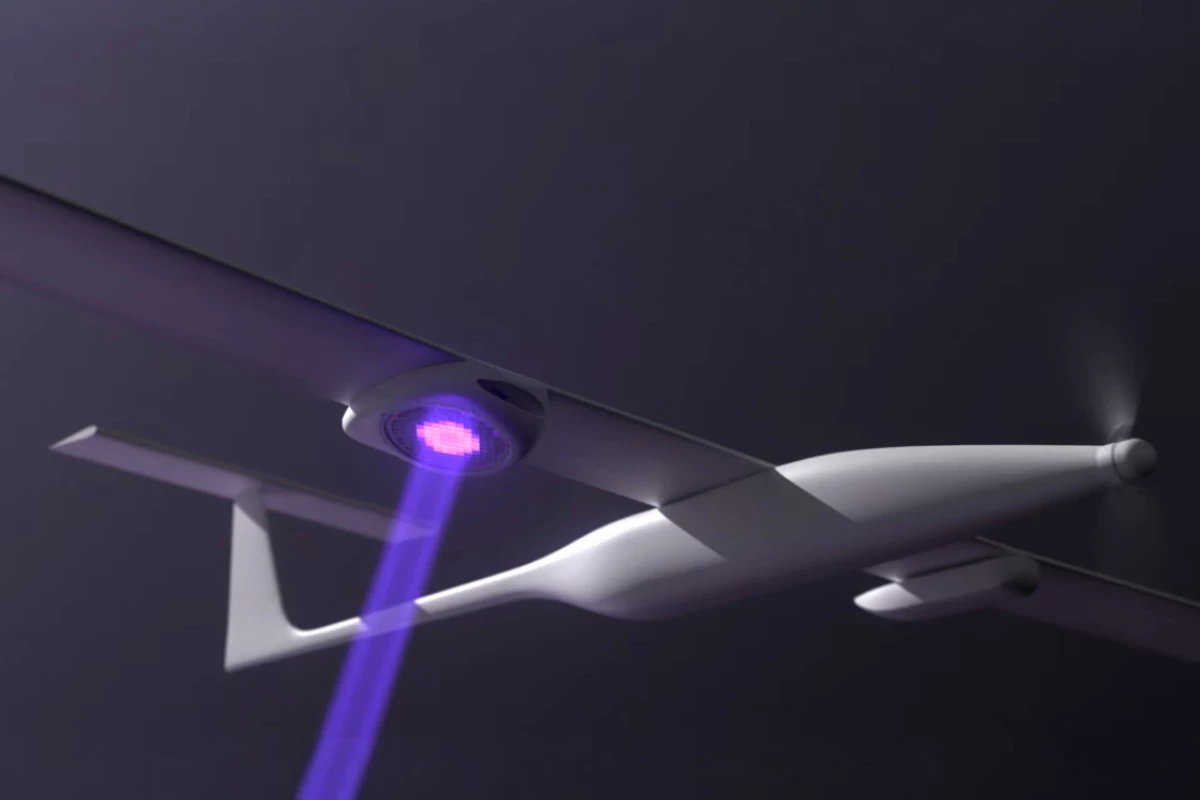
The firm noted last December that it had successfully developed and tested a power beaming system that could deliver kilowatt-class power to a drone flying above at an altitude of 5,000 ft. It claims its powerful non-visible laser beam can transmit power "over kilometers."
To that end, it's created a portable (but still sizeable) transmitter capable of tracking and locking on to airborne UAVs, along with safety mechanisms for the power beam, and real-time control and monitoring tech. That means the transmitter could be placed or towed to an optimal location from which it can continually recharge a drone flying overhead.
PowerLight trialed its tech using a new 6-lb (2.7-kg) receiver mounted on a long range electric K1000ULE drone that's made by Kraus Hamdani Aerospace and used by the US Navy and Army.
Essentially, PowerLight's transmitter system takes power from a battery and converts it into high-intensity light. It's then sent through the air using beam shaping optics as a non-visible laser beam to the drone's onboard receiver. That device converts the light back to electrical power using a photovoltaic cell array.

For its part, PowerLight says its transmitter and receiver subsystems are "entering the final stages of validation." It will conduct fully integrated flight trials this year using a K1000ULE.

When they're ready for prime time, these technologies can vastly enhance the capabilities of sophisticated drones as they engage in all kinds of essential functions, including defense support and reconnaissance, search and rescue missions, and oil and gas pipeline overwatch – no longer constrained by battery capacity. We could also see them keep drones in the air longer in urban areas, as they help with traffic management, air pollution monitoring, and other tasks that help keep cities humming.