


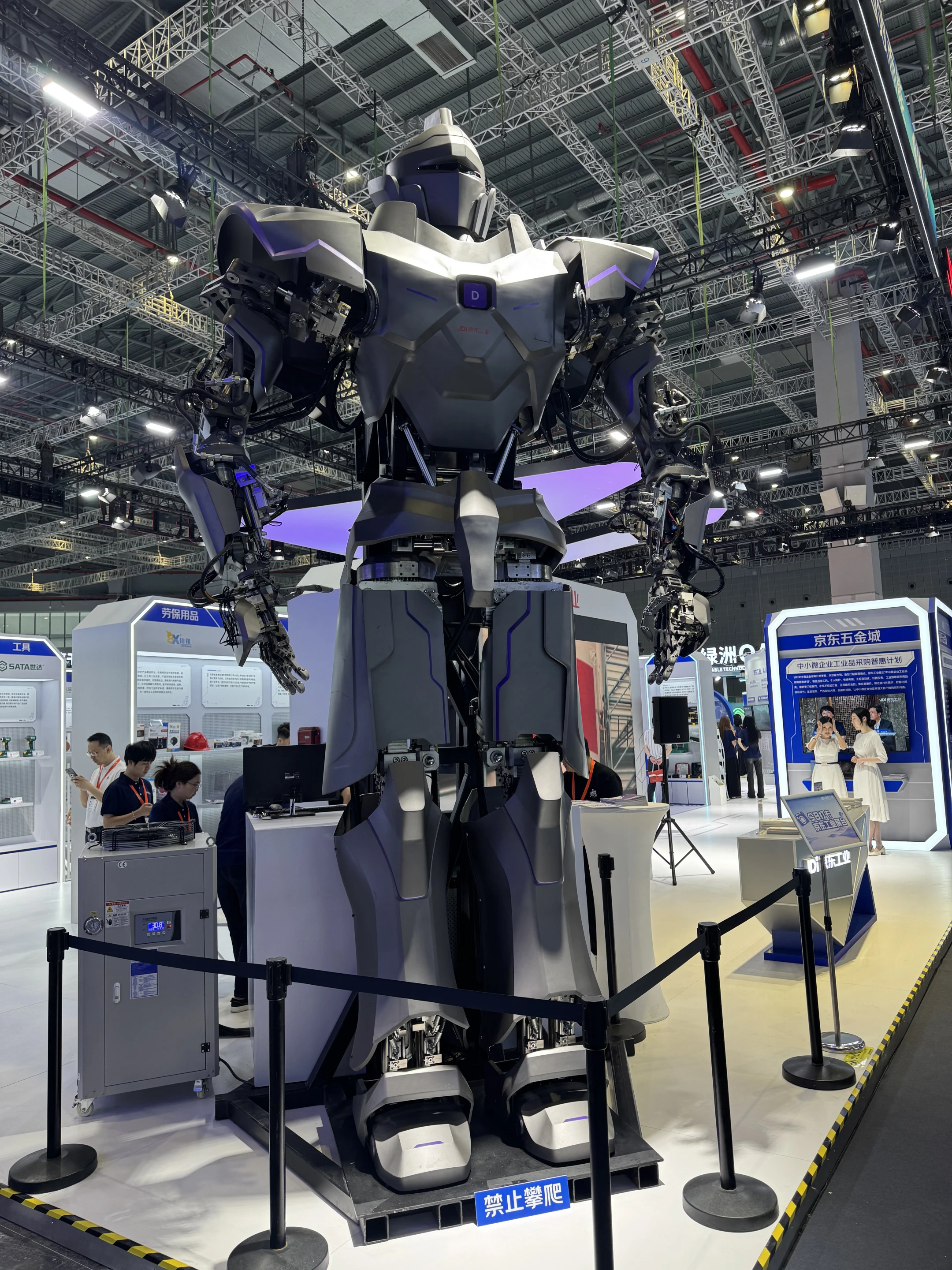


China is making sure giant robots don’t only belong to anime and sci-fi anymore. A Beijing company has presented a hydraulic-electric humanoid that towers as tall as a monster truck, built for heavy work yet precise to a fraction of a hair's width.
The new giant mecha, created by NeodraDynamics, is called Neo1. It first showed up at the World Robot Conference in Beijing, before being unveiled with JD Industrial – the industrial-supplies arm of Chinese e-commerce giant JD.com – at the China International Industry Fair (CIIF) in Shanghai, which ran October 12 to 16.
NeodraDynamics pitches Neo1 for heavy assembly, mining, rescue and nuclear maintenance, the kind of risky jobs you hardly see people lining up for.
The company describes a machine of roughly 13 ft (4 m) in height, with a weight of 1.2 metric tons (2,646 lb) and 41 controllable joints. Engineers measure a robot's flexibility in degrees of freedom. Each is a movement the machine controls separately, such as bending an elbow. Of Neo1's 41 joints, 39 are driven by small hydraulic actuators, the parts that make a joint move. The actuators push a piston with pressurized oil, much like the arm of an excavator, only shrunk down. The other two are electric and rotate the forearms.

According to the company, each actuator weighs about 1 kg (2.2 lb) and produces "ton-level" continuous thrust, meaning a push it can sustain rather than a brief burst. That describes a single part, not the whole robot, so it does not mean each arm can lift a ton. The company's stated payload is 500 kg (1,102 lb) with both arms working together.
Hydraulics are a proven way to get muscle, but not the only one. Boston Dynamics retired its hydraulic Atlas in 2024. Its then-CEO, Robert Playter, told IEEE Spectrum that the new electric Atlas was stronger than a person, even an elite athlete, in most joints. Electric drives can clearly compete on power, so Neo1's hybrid approach is one bet among several.
So far, though, Neo1 hasn't done a day's work on a real site. NeodraDynamics' Cui Dalong told New Atlas that a computer running a set program controls it remotely, and a cable supplies its power. A battery will come once it moves, and autonomy must wait for what Dalong calls an AI brain, which still needs training.
Walking is on hold too. Its motion control isn't finished, and Dalong admits that "walking on legs is not the priority for industrial applications." In fact, the company doesn't expect the full humanoid to work on industrial sites at all. The plan is to fit its heavy-duty arms onto a wheeled base.

Neo1 isn't China's first attempt at a rideable giant. On May 12, Unitree Robotics founder Wang Xingxing climbed into the chest cavity of the GD01, a 2.98-m (9.8-ft) machine Unitree calls the world's first mass-produced rideable mech. Wang walked it forward and punched through a wall of concrete bricks.
The GD01 weighs about 500 kg (1,102 lb) and starts at US$650,000. It stands on two legs like a humanoid or drops onto four, which lowers its center of gravity and steadies it on uneven ground.
Mechs like these are only the flashy tip of China's all-out push to robotize its industry. According to research firm Omdia, Chinese companies took almost 90% of global humanoid robot sales in 2025. Unitree alone says it delivered more than 5,500 humanoids to end customers that year, while Omdia puts Unitree lower, at about 4,200 units, behind AgiBot's 5,168. It counts just 150 for Tesla's Optimus.
For now, Neo1 is a demonstration unit with an impressive stage presence. The company has pitched it to ports, where it could lift heavy loads and open container doors. Beyond the docks, it's eyeing offshore oil and gas rigs, nuclear refueling and power grid tower construction.
A true super-humanoid hero
— CyberRobo (@CyberRobooo) October 17, 2026
I first saw Neo1 at WRC 2026 and was genuinely impressed. The 4-meter, 1.2-ton humanoid from Beijing-based NeodraDynamics has returned at CIIF 2026.
Neo1 is built for 4D work-- heavy assembly, deep-sea operations, port and mine material handling,… pic.twitter.com/5D6xOJjjgp
Source: NeodraDynamics via PRNewswire


