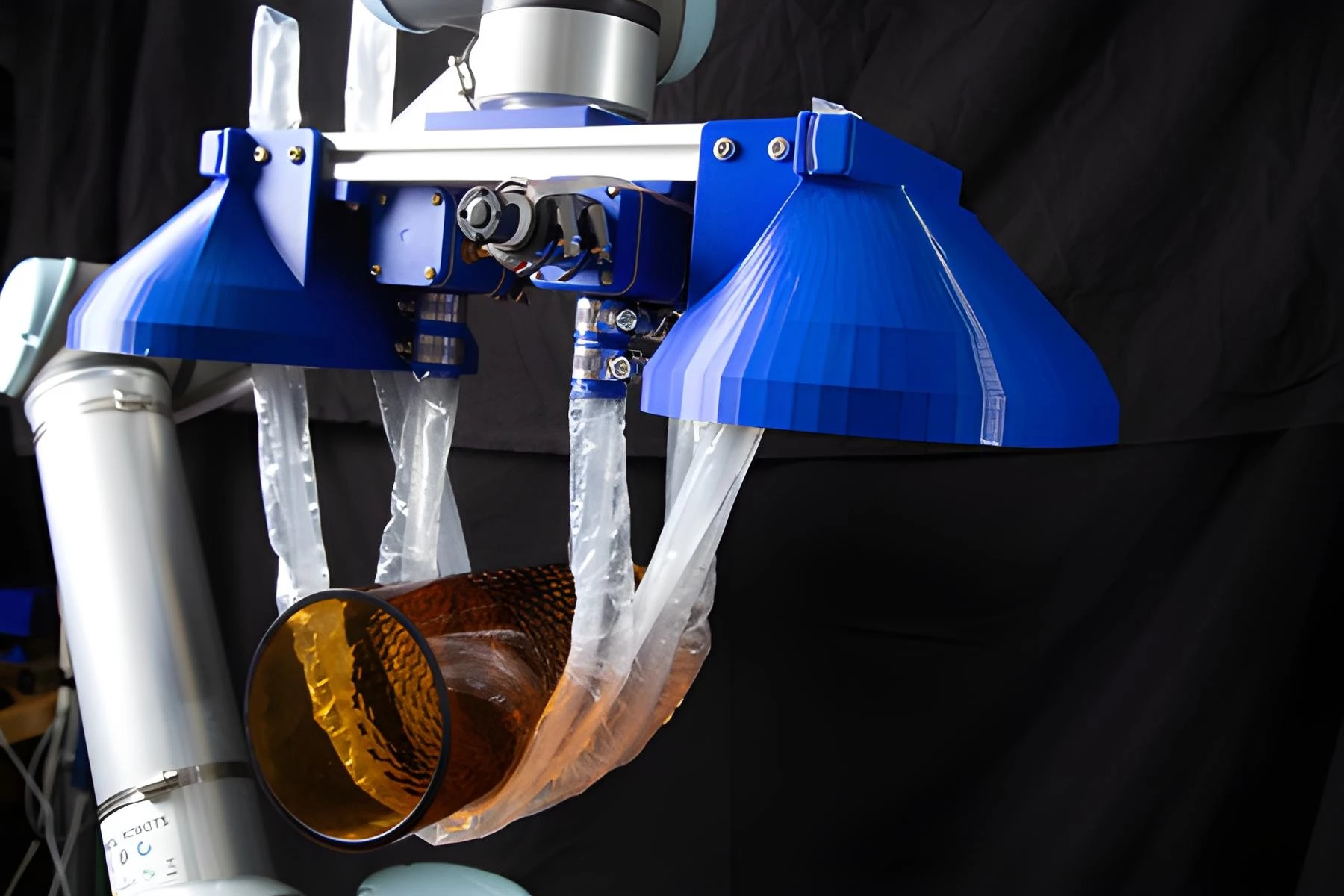

Although they're constantly improving, robots aren't necessarily known for their gentle touch. A new robotic system from MIT and Stanford takes a unique stab at changing that, with a robot that uses vine-like tendrils to do its lifting.
The system the engineers developed consists of a series of pneumatic tubes that deploy from a pressurized box on one side of a robotic arm, use air pressure to snake under or around a specific object, then rejoin the arm on the other side where they are clamped in place. Once clamped, the arm itself can move, or the tube can be wound up to lift or rotate the object in its grasp. The ability to deploy the tubes and then recapture them is the real breakthrough here, improving on previous vine-based robots by allowing the system to close its own loops.
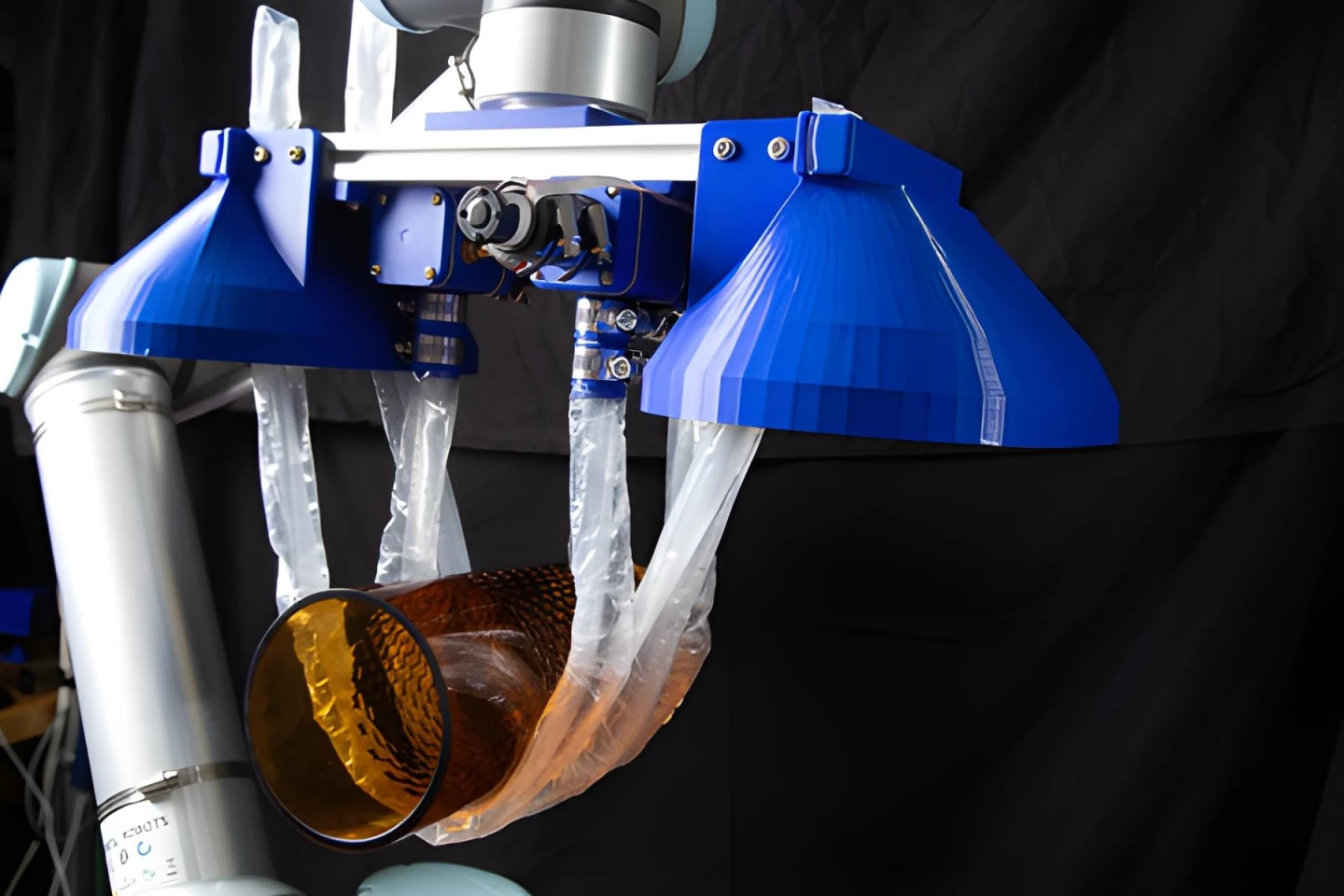
"People might assume that in order to grab something, you just reach out and grab it," says study co-author Kentaro Barhydt, from MIT’s Department of Mechanical Engineering. "But there are different stages, such as positioning and holding. By transforming between open and closed loops, we can achieve new levels of performance by leveraging the advantages of both forms for their respective stages."
In tests, which you can see in the following video, the team demonstrated that the system could lift round objects (0:18); objects in a cluttered environment (3:15); fragile objects like a glass vase (3:56), large objects like a bin from a distance (4:20); a group of objects like a bundle of metal rods (5:16); and a relatively heavy and odd-shaped object like a watermelon (10:50). While those are all impressive, the researchers say the real promise of their vine bot is to help lift human bodies in hospital and elder care facilities (which you can see at 7:30).
"Transferring a person out of bed is one of the most physically strenuous tasks that a caregiver carries out," Barhydt says. "This kind of robot can help relieve the caretaker, and can be gentler and more comfortable for the patient."
The most typical way of transferring patients today involves needing to rotate the person to both sides in order to get a hammock-like sheet beneath them, which is then lifted by a winch. This can cause pain to some patients and interfere with intravenous lines and other health-related inputs. Because the tubes can fit through extremely tight spaces, such as under a patient's body, the robot vine system has the potential to make transfers more gentle and less jarring.
"I am very excited about future work to use robots like these for physically assisting people with mobility challenges," adds co-author Allison Okamura from Stamford. "Soft robots can be relatively safe, low-cost, and optimally designed for specific human needs, in contrast to other approaches like humanoid robots."
While the researchers were primarily motivated to create the vine-like robot for help in medical situations, they say it also has applications in the other fields, as demonstrated by the paces they put it through in testing.
"We think this kind of robot design can be adapted to many applications," Barhydt says. "We are also thinking about applying this to heavy industry, and things like automating the operation of cranes at ports and warehouses."
The invention has been described in a study published in the journal Science Advances.
Source: MIT