
Rover
-
 The sandfish lizard moves very efficiently through the sand, and not surprisingly, it doesn't use wheels to do so. Scientists have now copied the reptile's swimming motion in an experimental Mars rover that outperforms others in sandy soil.
 -
 You wanna drive a Mars rover? Well sorry, but you can't. You could, however, buy and drive a li'l four-wheel-drive rover that can be controlled from anywhere in the world via 4G cellular networks. Appropriately enough, it's called the EarthRover.
 -
 Next time you're driving around on Mars and need to get your tire replaced, chances are good it'll look something like a revolutionary new version made by NASA and Goodyear. The mesh cage design can take a beating and roll right on.
 -
 NASA has selected three companies to develop extreme off-road vehicles that astronauts will drive on the Moon during Artemis missions starting in 2030, awarding US$4.6 billion in contracts to Intuitive Machines, Lunar Outpost and Venturi Astrolab.
 -
 India's Chandrayaan-3 Moon mission has hit the ground running with the Vikram lander and the Pragyan rover sending back their first images and instrument data while the rover makes a slow-motion swerve around a crater.
 -
 When SpaceX launches its lunar mission scheduled for 2026, it’ll be accompanied by Venturi Astrolab’s Flexible Logistics and Exploration (FLEX) rover, making it the largest, most capable rover to ever travel to the Moon.
 -
 Space exploration in 2021 will see some major milestones to look forward to. From maiden flights to fiery endings, long-awaited launches to history-making first steps, here are some of the biggest upcoming events in space exploration this year.
 -
 When NASA’s Perseverance rover touches down on Mars it will carry with it the first ever spacesuit samples to land on the Red Planet. The samples will be exposed to the high-radiation environment to test the durability of future spacesuits.
 -
 Scientists at the Georgia Institute of Technology have looked to shore up the mobility and freedom of future planetary rovers with a new design that uses some clever trickery to get itself out of tight spots.
 -
 There are some places that a solar-powered rover just can’t reach, like the Moon’s polar regions that are permanently in shadow. Now, ESA has outlined a new system where a lander shines a laser at a rover to keep it powered from miles away.
 -
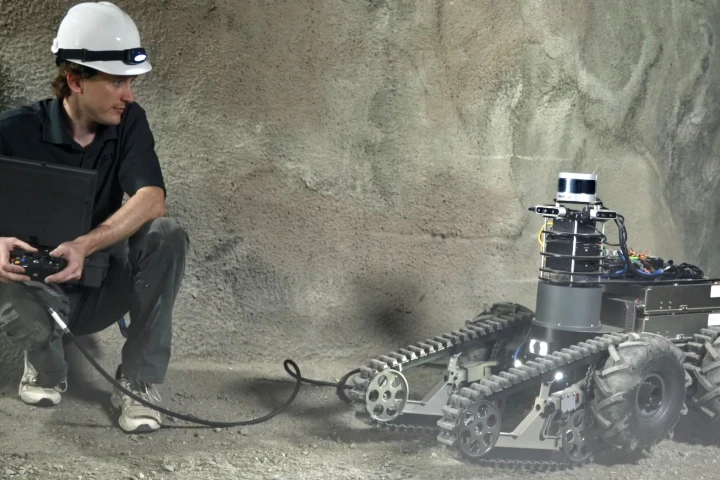 This week DARPA kicks off a competition called the Subterranean Challenge, where hordes of robots are unleashed into caves and tunnels to test how well they can autonomously navigate these environments. One team's designs could lead to robots that explore caves on other planets.
 -
 An educational tool first and a toy for playtime second, DJI's RoboMaster S1 will bring some battle and racing fireworks to the living room floor, but overall is designed to offer a gentle pathway into the world of AI, engineering and robotics.
Load More