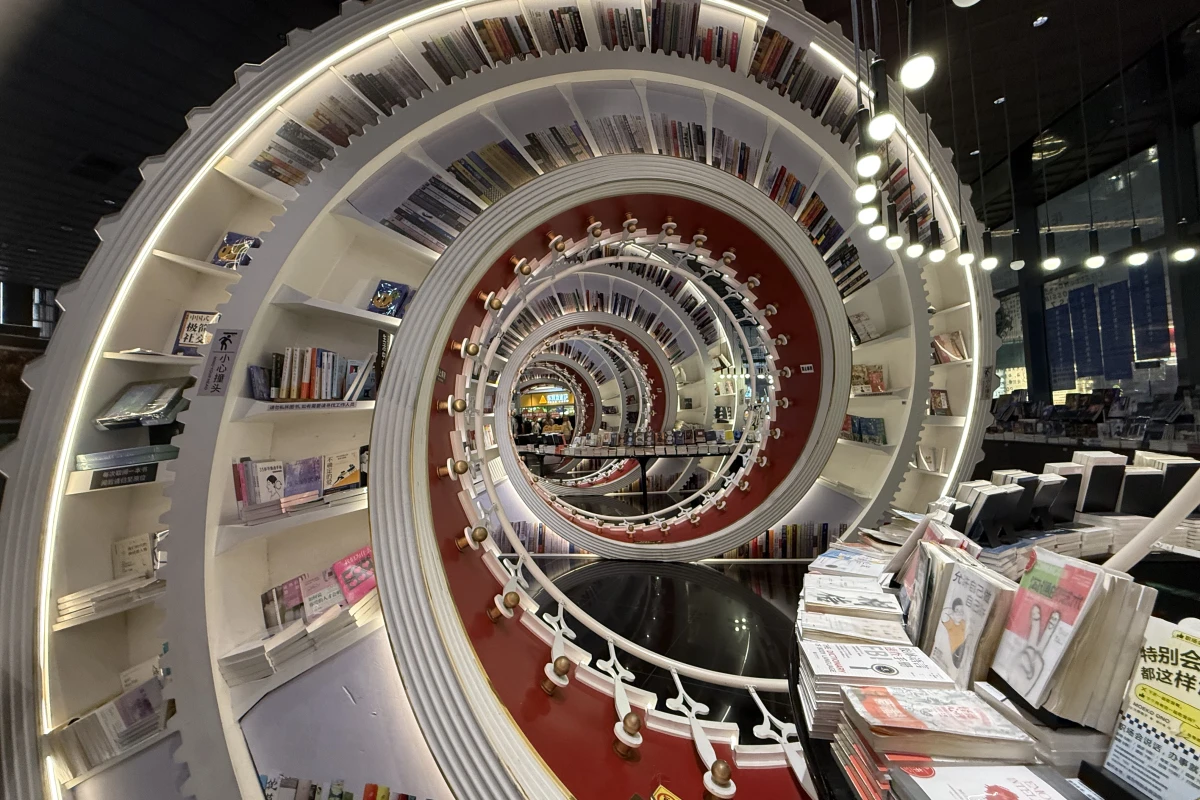


From unstaffed self-service book-borrowing kiosks open 24-7, to a grand building that has robots fetching paperbacks from its multimillion collection of titles across nine floors, there's a reason that Shenzhen is known as China's "city of libraries." Sure, this may sound kind of boring, but the city in the southern Guangdong province has also just been named as the country's leader in wealthy entrepreneurs and is the beating heart of China's AI and tech industry.
Shenzhen was recognized by the United Nations Educational, Scientific and Cultural Organization (UNESCO) in 2013 as global leader in promoting the value of reading. A decade earlier, in 2003, the city introduced pivotal moves to give everyone – well, Chinese citizens and foreigners aged three and above – a unified library ID number that gave them access to hundreds of borrowing outlets already spread across the developing metropolis. This was known as the City of Libraries initiative.
This week, The Wall Street Journal was the latest news outlet to highlight the dismal statistics of reading across the US. While, with some irony, it's hard for most people to read this article because it's behind a paywall, it essentially echoes what The New York Times and The Atlantic have addressed over the last few months: Smartphone scrolling may be the first real sign of the "end of reading."
Well, in some places.
Because in every subway station and train carriage, in restaurants, on park benches, in airport lounges and throughout the city's massive malls, Shenzhen residents are also spending a whole lot of time staring at their small screens, no book in sight. And there's plenty of scrolling of China's TikTok, Douyin (抖音) to be seen, too.
This pivotal 2026 paper looking at US readers found that people picking up a book – digital or otherwise – has continued to decline each year over the last two decades. What's more, plans for giving Americans better access to libraries were rolled back in 2025. In the people sampled for this study, only 0.3% reported reading at a library on an average day in 2023, with 0.5% visiting a library for any activity.
This is neither a criticism of the US nor a comparison between a city and a country (with far more differences than number of libraries per neighborhood), because there's plenty of digital distractions competing for people's attention in tech-forward Shenzhen. What's fascinating, though, is how reading culture appears to have developed in step with the geographical and economical growth of the city.
Prior to 1979, Shenzhen was largely a patchwork of rural farming and fishing villages; now it's home to some of the tallest skyscrapers and most ambitious architectural projects you're likely to see in a city that's yet to celebrate 50 years of one hell of a reinvention.
As this translated account from Shenzhen local government details, it was around the time the seeds of the city of the future were planted that its residents seemed to see new potential on a personal level. In the 1980s, people sought out textbooks – math, chemistry, physics – to self-study, which led to a whole new industry of learning. Pretty soon, reading – and libraries – were woven into the city's development strategy.
"The activity of 'read more and read good books' had created a reading craze among Shenzhen’s young employees in the 1980s," according to the government site. "Themed 'rejuvenating China,' it had four major characteristics. First, it had a wide scope. Second, it was diverse, lively and rich in content. Third, the participants had high enthusiasm, realizing the transformation from 'I have to learn' to 'I want to learn.' Fourth, it was practical and targeted. English and finance classes were also set up, which effectively improved the educational level of the employees."
In the most recent data gathered, Shenzhen's public libraries recorded 54.3 million visits and 29.5 million physical book loans according to city-level data compiled moving into 2026.
A recent Hong Kong-Shenzhen report on libraries and engagement cited Xinhua, which reported that Shenzhen adults, on average, read 22 books in 2024. What books is unclear, however. Either way, it's putting my 2026 Goodreads count to shame.
That same report also noted that in the same year, Shenzhen had 322 24-hour self-service "book bars" that recorded 1.17 million borrows (4.5% of total loans across the city). These spaces are often manned by volunteers to help visitors but are otherwise unstaffed.
And as of 2024, Shenzhen was home to 925 public libraries – some buildings housing millions of physical titles. These spaces, as well as the book bars, hold "68.3 million items." Interestingly, even though libraries have adopted the technology Shenzhen is famous for, physical book loans rose 12.4% in 2024 compared with the previous 12 months.
Obviously, the success of modern-day Shenzhen is not just because there are plenty of places to borrow books; it's been just one aspect of the city's development strategy.
But after visiting the disappointing viral "optical illusion" bookstore – essentially an Instagram background for pensive "candid" photoshoots – I nonetheless have it to thank for leading me down a rabbit hole of a far more interesting story, one where libraries and access to books helped shape Shenzhen, probably better known as the birthplace of Huawei, Tencent, DJI, BYD, just to name a few.
If nothing else, it serves as a nice antidote to the doomy stories about reading's rapidly approaching extinction event.
Source: Libraries Across Shenzhen, eyeshenzhen.com