Aircraft

Velocitor X-1 eVTOL could be beating the traffic in just a year

Velocitor X-1 eVTOL could be beating the traffic in just a year
The first 100 Velocitor X-1s are priced at $156,000
View 8 Images
The first 100 Velocitor X-1s are priced at $156,000
1/8
The first 100 Velocitor X-1s are priced at $156,000
The X-1 has a maximum payload capacity of 260 lb (118 kg)
2/8
The X-1 has a maximum payload capacity of 260 lb (118 kg)
The X-1 features a composite fuselage
3/8
The X-1 features a composite fuselage
The flight system is semi-automated
4/8
The flight system is semi-automated
One six-hour charge of the battery pack is claimed to be good for one hour of flight time, along with a 15-minute reserve
5/8
One six-hour charge of the battery pack is claimed to be good for one hour of flight time, along with a 15-minute reserve
The view from the X-1's cockpit
6/8
The view from the X-1's cockpit
One of the three platforms that has performed a test flight so far
7/8
One of the three platforms that has performed a test flight so far
A prototype performs a test flight
8/8
A prototype performs a test flight
View gallery - 8 images

3D commuting, that's the dream. Soaring over stopped traffic in a lightweight, quiet, safe personal eVTOL aircraft. The Velocitor X-1 joins a growing list of such machines, and it's slated to enter production within a year.

The X-1 is being developed by Michigan-based startup Velo X Aerospace, which is now taking $5,000 deposits on an initial run of 100 aircraft that are slated to begin production in the first quarter of 2027. The total price of each of those first 100 is US$156,000.

Like a number of similar eVTOL (electric vertical takeoff and landing) aircraft, the single-passenger X-1 utilizes eight electric motor/propeller modules mounted coaxially on the ends of four arms.
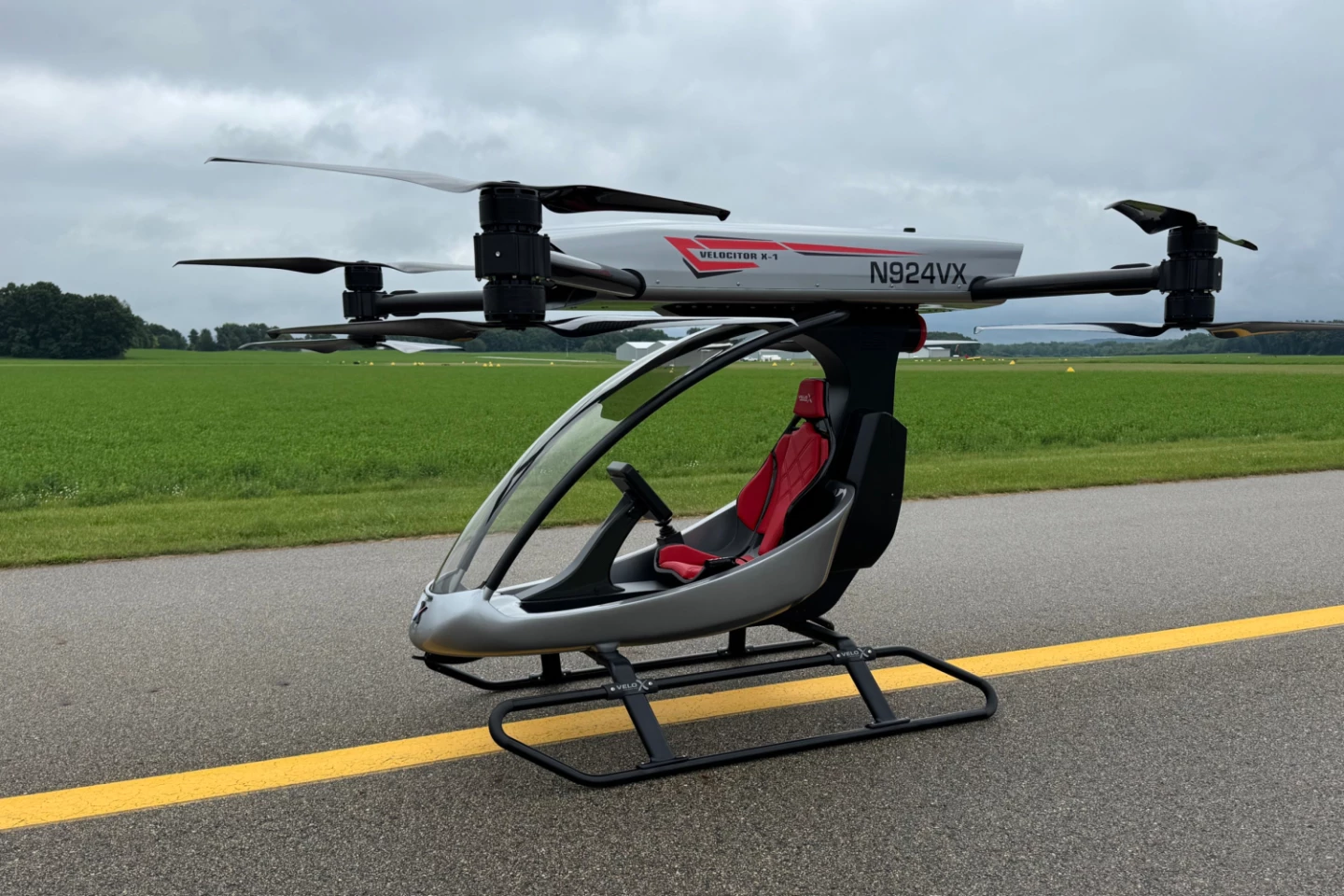
The X-1 has a maximum payload capacity of 260 lb (118 kg)

These allow it to takeoff and land vertically, and autonomously hover in place (via GPS) like a helicopter. It can also cruise forward at a speed of 70 mph (112 km/h). One six-hour charge of its battery pack is claimed to be good for one hour of flight time, along with a 15-minute reserve.

The X-1's flight system combines pilot input with automation - it should be considerably easier than flying a regular ol' drone, since you don't have to worry about orientation when you're sitting in the cockpit. According to Velo X, "If you can handle a side-by-side, a snowmobile, or a motorcycle, you can fly this aircraft."
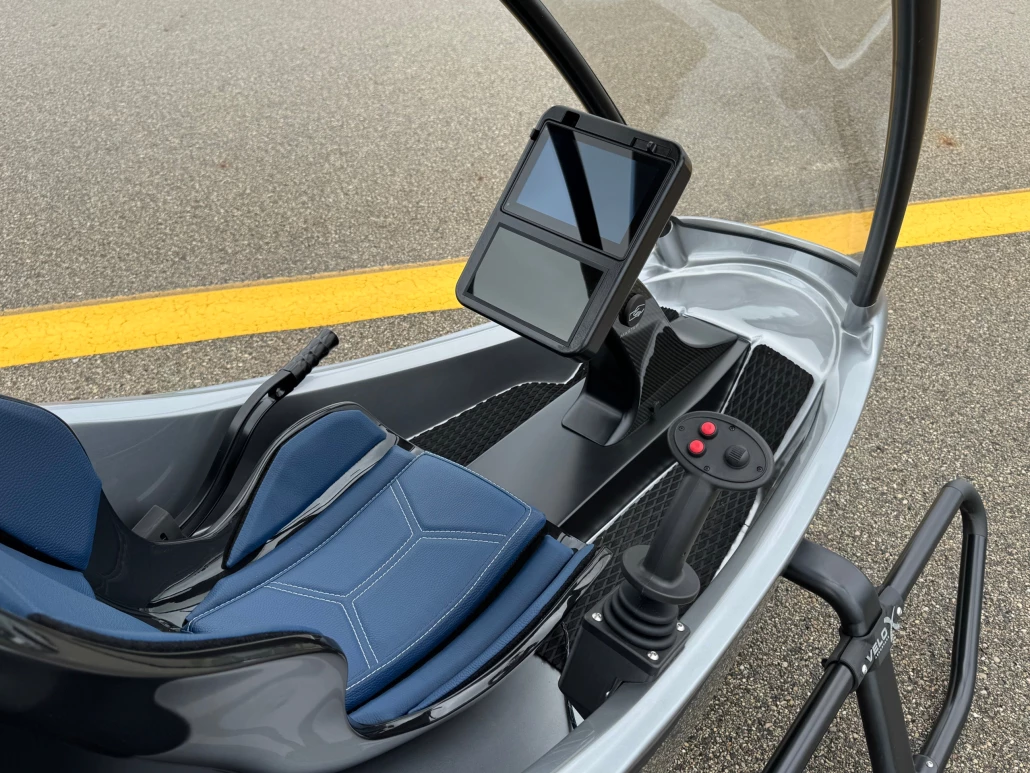
The flight system is semi-automated

Safety features include a LOWAS (LiDAR obstacle warning and avoidance system) that detects and avoids obstacles such as power lines and trees. There's also a distributed electric propulsion system in which multiple propellers, motors, controllers, and batteries ensure that no single point of failure can't be compensated for.

If the X-1 falls from the sky anyways, the sudden loss of control should trigger the release of a ballistic parachute – even at an altitude as low as 50 ft (15 m). If the landing is still a bit rough, the pilot will be helped by an "ultra-strong" composite seat with a four-point harness.
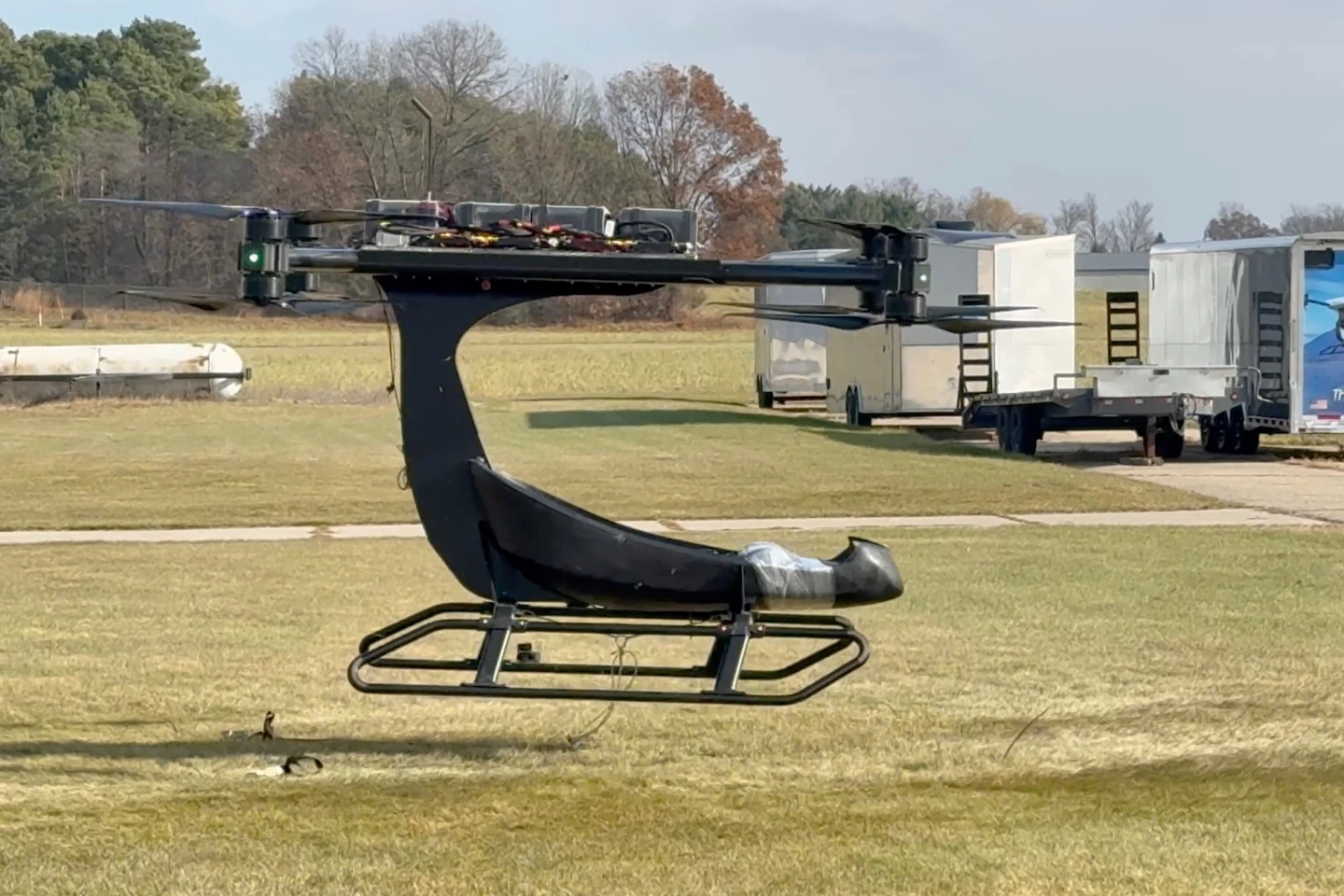
A prototype performs a test flight

"We have flown three different platforms to date," Velo X president Galen Geigley tells New Atlas. "Our current test platform is in the middle of upgrades right now with new-style propellers and higher-performance motors. Flight testing will resume in the coming weeks."

He adds that 56 of the first 100 Velociter X-1s have been claimed already … so if you want one of the remaining 44, you'd better head on over to the company website and plunk down your five grand.

Will you be able to glide over traffic? Probably not, if we're being honest. Velo's website has a cute little nod to certification, stating "we continue building, refining, and validating the aircraft under the evolving FAA MOSAIC powered lift framework. Our team works directly with industry leaders to ensure every component meets or exceeds the standards for this new class of personal aircraft."

This powered lift framework is the one under which high-tech behemoths like Joby and Archer are working toward type certification for their 5-seat eVTOL air taxis - an insanely expensive and difficult certification designed to ensure eVTOLs are as safe as airliners.

But we wouldn't expect the X-1 to launch with any such ticket. Most similar machines are selling as experimental aircraft, and we'd expect the same here - meaning no commercial flights, owner-pilot only, and heavily-restricted flight operations within defined areas - which probably won't include floating over highway traffic in the short to medium term.

But we live in hope!

The Velociter X-1 Personal eVTOL

Source: Velo X Aerospace

Editor's note: This piece was updated on Friday 6th Feb 2026, with information and speculation around the FAA licensing and category the aircraft is likely to launch under.

View gallery - 8 images
9 comments
9 comments
Rusty
I just don't see these things taking off (no pun intended). People can't even operate a motorized vehicle without crashing into each other on dry land, and you expect them to be ok in the air?
dan
Could this be misleading to the public? Please clarify exactly which FAA or EASA certification basis you are targeting or claiming (e.g. part 21.17(b), Part 23, Part 27, SC‑VTOL). Is the software intended to be fully certified (e.g. DO‑178(C), which level?), and by what date do you expect type/airworthiness certification? Can you provide evidence of successful ballistic‑recovery‑system tests, specifically at around 15 m altitude? For this kind of eVTOL, with no lifting wings or larger rotors, there is no glide or autorotation capability, making it a potential death trap in the event of system failure or bird strike. In that context, the claimed redundancy is questionable, as two propellers only a few inches apart are likely to be compromised simultaneously. I look forward to the team’s answers.
martinwinlow
Why *on Earth* put the battery above the pilot? It would be hugely more stable beneath the cabin and in a high speed vertical 'hard landing' you won't have 100kg of battery landing on your head.
TechGazer
I'd consider 3D commuting to be a nightmare, if the vehicles are controlled by humans. Besides, assuming that it was allowed, only the early users would benefit. Once it became more widely used, the same problems--congestion, parking, air-rage--would occur.
HokenPoke
@Rusty , well you unfortunately dont see the stark reality then, taking off it WILL being a major success Even More So ! You make the same mistake the majority of people do, the craft won't be "let Loose" to the public like candy trick or treat. You will have to have a strict license, and where you fly will be strictly controlled, those who shakes too much will sit while the craft flies itself. So there are multiple ways that it will be implemented to keep its operation Safe.
doc
@ Dan you keep repeating OLD outdated myths year after year even after the answers have been given to you countless of times. So Yet again. Autorotation is not safe so, it is a hit or miss many autorotations does not save the craft NOR the crew, a Deathtrap in itself ! YET they still fly !
Second: Again showing how little your knowledge wrt EVTOL's No 2 proppellers are NOT likely to fail on one arm, explain exactly how you came to that conclusion ? They Rotate on Seperate Motors, individually controlled via Seperate controllers ! that is EVTOL basics 101 ! Now tell us Dan what happens when a helicopter tailrotor fails ? Or should i point at the thousands of NTSB reports for you ?
So no trolling the excellence in safety of this technology won't stop the implementation of and value of this Exciting new field of flight. There is only 2 outcomes:
Embrace to the new age, Jump in and Fully embrace it or get left behind in it's wake. But Forward it will go and Revolutionary it WILL BE !
HokenPoke
@ TechGazer, Doc above explained it nicely, you come to the same mistaken conclusion the majority of newbies are making.
Arcticshade
Bring it ON ! RIGHT NOW !
Arcticshade
Batteries are at the top for system efficiency, nothing comes with Zero risk, see the countless of gyrocopters burnt to a crisp due to post fuel fires. The craft is redundant so motor failure wont bring it down hard. In fact unlike auto rotation you can precisely chose your landing spot and land like a feather evrytime.