






Epoxy is one of the great unifiers of modern materials science, bringing different materials together to form composites with combined properties that exceed those of any individual component. The problem is that once conventional epoxy cures, the resulting union is practically permanent. Separating the constituent materials for recycling can be extremely difficult.
Researchers at the Swiss Federal Laboratories for Materials Science and Technology (Empa), working with specialty-chemicals company Elantas, have now developed an epoxy-based composite designed to solve that problem. The enabling technology is a phosphorus-containing additive developed at Empa that is mixed into epoxy during production. The additive gives the cured material both flame-retardant properties and the ability to soften or break apart under the right conditions.
Modern engineering applications usually demand a range of properties that a single material cannot provide. Aircraft are a perfect example. Their materials need to be lightweight enough to keep fuel consumption down, strong and stiff enough to withstand loads, durable enough to survive years of service and, particularly inside the passenger cabin, capable of meeting strict fire-safety requirements.
“Bringing all these properties together under one roof is a challenge,” says Sabyasachi Gaan, a researcher at Empa's Advanced Fibers laboratory. “For example, when you make a material flame-retardant, you always end up altering its other properties as well.”
One way engineers achieve this balancing act is with sandwich composites.
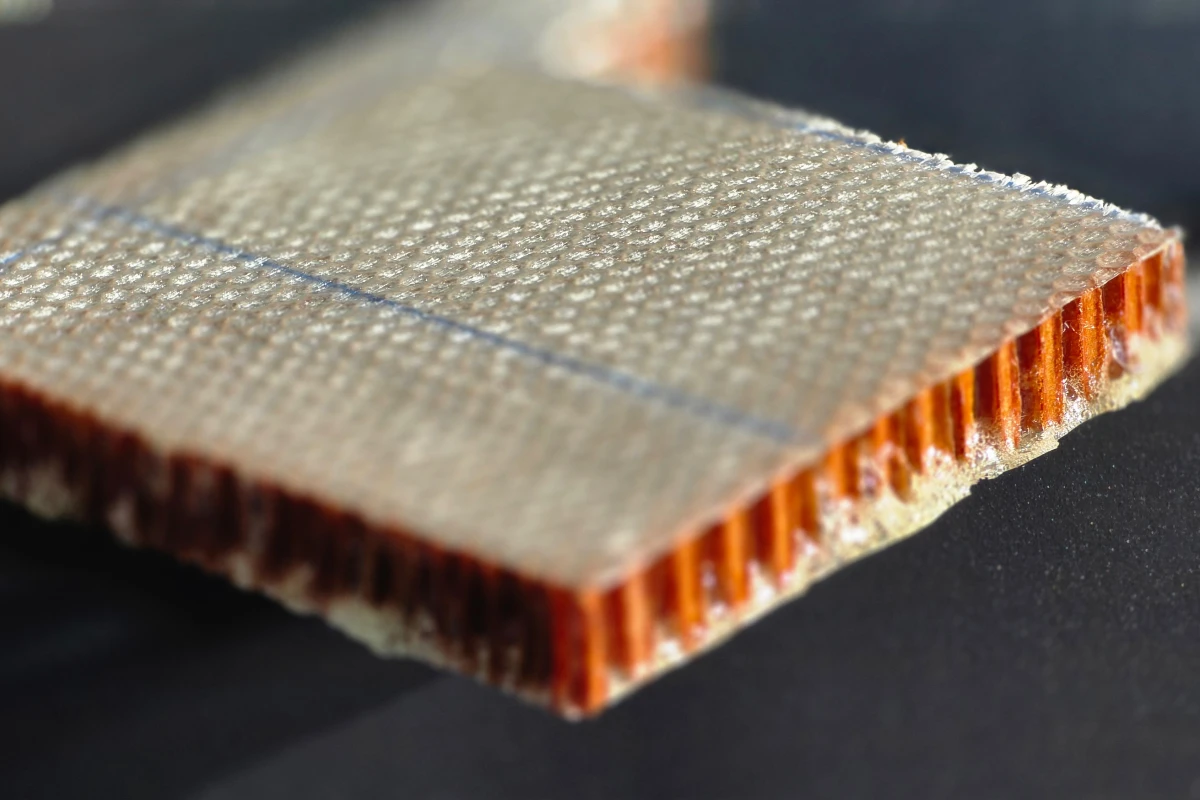
The researchers focused on a specific material used in aircraft and train interiors, including passenger-cabin flooring. At its center is a lightweight honeycomb made from aramid, the heat-resistant family of polymers that includes materials such as Kevlar. Several flat-woven layers of glass or carbon fiber are placed above and below this core. Epoxy resin impregnates and binds the reinforcing layers, helping turn the separate fiber skins and honeycomb into one stiff, lightweight structure.
Epoxy plays its role as binder exceptionally well. Perhaps too well, when you consider end-of-service recycling. You see, epoxy is a thermoset polymer. During curing, chemical reactions create a tightly cross-linked, permanent molecular network that is behind many of epoxy's useful characteristics, including its mechanical strength, heat resistance, and dimensional stability.
On the other hand, it also means you can't undo epoxy composites and pull out the comprising materials. Unlike thermoplastics that flow when heated, conventional thermosets retain their cross-linked structure as temperatures rise, eventually degrading.
As a result, valuable carbon or glass fibers and expensive aramid honeycombs can remain trapped inside an epoxy matrix after the component reaches the end of its useful life. According to Empa, epoxy-containing composites commonly end up being incinerated or sent to landfills.
The researchers’ solution changes that irreversibility.
Empa's underlying epoxy chemistry uses reactive phosphorus-containing molecules to introduce dynamic bonds into the thermoset. In the team's earlier published work, they incorporated a reactive bis H-phosphonate compound into epoxy before curing, producing a phosphonated network containing phosphorus-carbon and phosphorus-oxygen bonds. Under suitable heat and processing conditions, parts of this network can undergo bond-exchange reactions, allowing the network to rearrange rather than remaining permanently locked in one configuration.
This allows the cured epoxy to be softened and reshaped through thermomechanical recycling. Empa's earlier experiments showed that formulations with sufficiently high phosphorus content could be reprocessed after curing, with the dynamic network rearranging through transesterification reactions.
Much of that work focused on simply reshaping epoxy structures. For the new project with Elantas, the researchers applied the process to dismantle an entire aerospace-style sandwich composite.
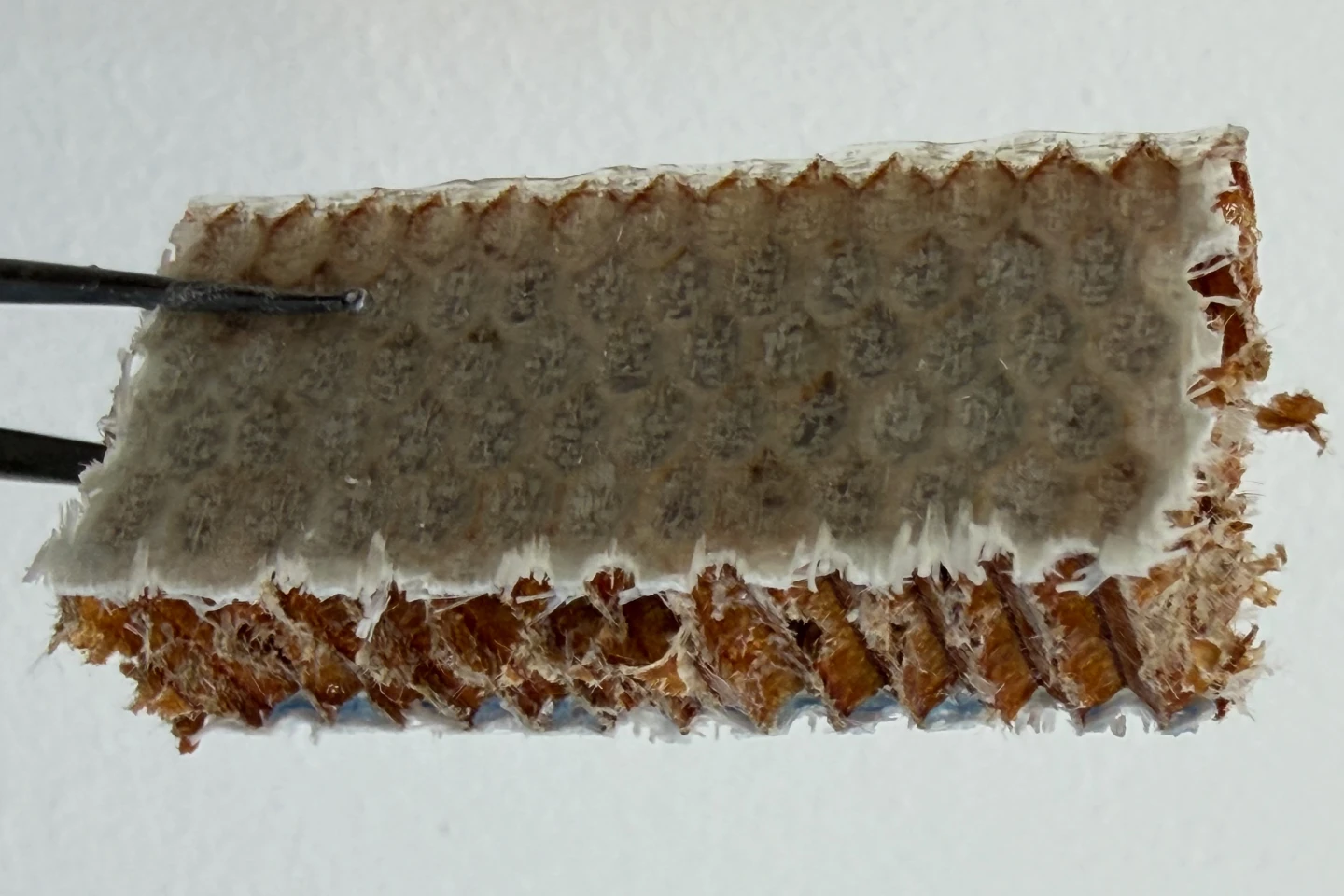
Using heat and the appropriate solvent, the researchers were able to break down the epoxy system enough to separate the sandwich into its individual structural components, recovering the aramid honeycomb and woven reinforcing fibers.
The major recycling achievement demonstrated here is the ability to free the valuable materials the epoxy previously locked together. The epoxy itself hasn't yet completed that same recycling loop in this project. The team says recovering the resin from the resulting solution should also be possible, and plan to tackle that in future work.
Another useful feature is embedded in the chemistry: phosphorus is also an effective route to flame retardancy.
In Empa's earlier work, introducing phosphorus dramatically changed how the epoxy behaved in a fire. While concentrations above 5% were required for effective reprocessing and recycling, a formulation containing 2.5% phosphorus reduced peak heat-release rate by 75% and total smoke production by 72.5% compared with the reference thermoset in cone-calorimeter testing. This combination is particularly relevant for aerospace and rail applications, where gaining recyclability at the expense of fire performance would be a rather poor trade.
According to Empa, the composite developed with Elantas complies with the required fire-safety regulations while retaining nearly the same advantageous mechanical properties as conventional epoxy-based material.
Carbon fiber production is energy-intensive, while aircraft and trains contain substantial quantities of highly engineered composite materials specifically designed to remain intact under demanding conditions. Giving manufacturers a practical way to reverse that integrity at the end of life could help turn some of those expensive materials back into feedstock instead of waste.
The chemistry isn't limited to aircraft either. Fiber-reinforced epoxy composites are found throughout cars, trains, ships, wind turbines, and numerous other lightweight structures, while Empa is already investigating applications for its recyclable flame-retardant polymer system in the energy and construction industries. The immediate hurdle is scale. The researchers and Elantas are now working to further scale both composite production and the recycling process.
Source: Empa


