





Few things are more annoying than an adhesive that refuses to stick. A strong contender, though, is one that refuses to let go when you no longer need it.
Researchers at Virginia Tech have developed two new adhesives aimed at solving both problems. Developed by two separate teams of chemists, one adhesive is four times stronger than the commercial adhesives used in duct tape, yet can be broken down in minutes with mildly alkaline water. The other is a tape whose adhesive and plastic backing can be recycled together.
Most pressure-sensitive adhesives are based on polymers, long chains of repeating molecular units that become entangled with one another. Depending on their chemistry and structure, these tangled chains can produce everything from rigid plastics to stretchy rubber and, in this case, sticky materials aka adhesives. These materials are everywhere, holding together packages, keeping labels on bottles, securing medical dressings, and positioning posters on many a bedroom wall.
Now, this stickiness creates problems at the end of the product's life.
Conventional tapes usually combine several chemically different materials, including a plastic backing, adhesive, and various additives. Even after the tape is removed, leftover adhesive residue can make materials such as cardboard difficult or impossible to recycle. There is also the problem of the tape just refusing to let go; that situation when you try to peel off a label and end up tearing random irregular streaks.
“We want this to be useful while we're using it, but as soon as we're done using it, it should go away,” said Josh Worch, assistant professor of chemistry at Virginia Tech. “We’re designing for end of life in every new material that we make.”
German researchers had earlier created an adhesive-free paper packaging technique, but that solves only the small packaging portion of the problem. The Virginia Tech solutions aim to incorporate the ability to break down directly into the adhesive's molecular structure.
Conventional tape combines the adhesive material on a backing that’s typically a different, mostly plastic film or paper. So even with a degradable adhesive, you are still left with the backing. To address this problem, Worch and his team created what researchers call a “mono-material” tape, comprising two layers that are physically different but based on closely related chemistry, despite performing very different jobs.
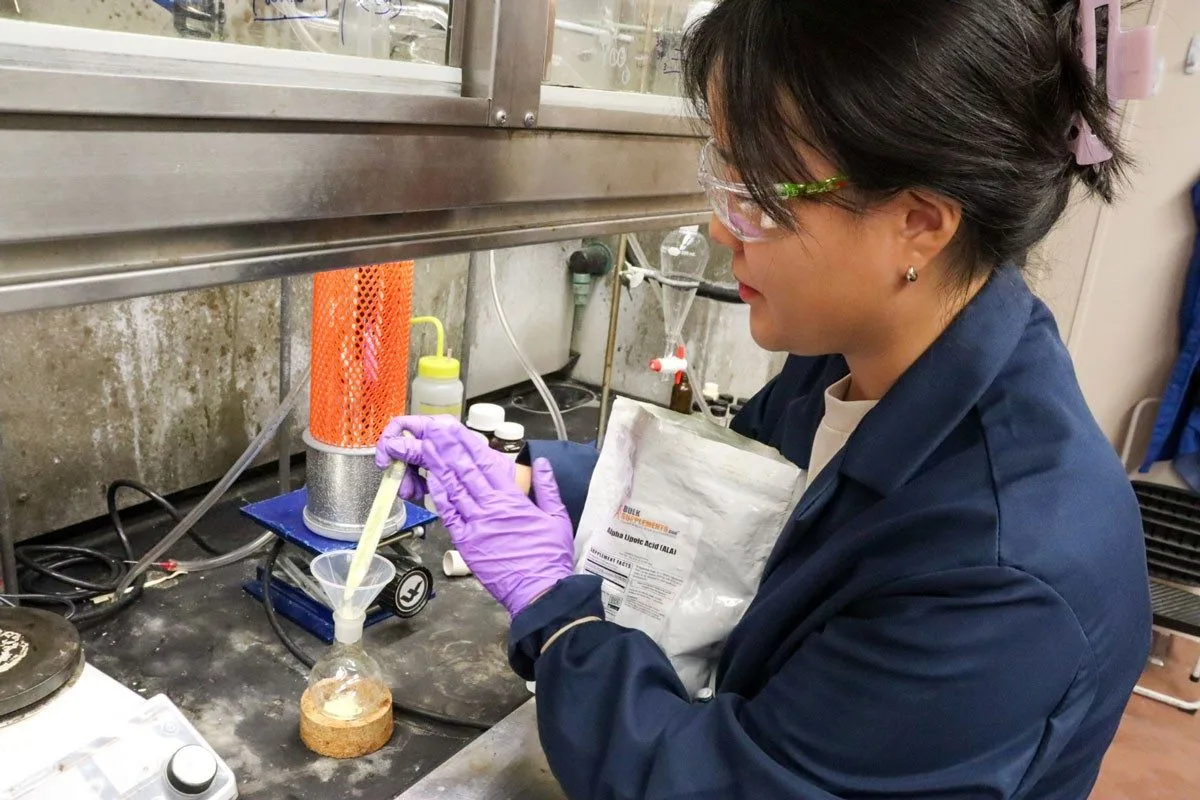
For the degradability, the starting point was lipoic acid, a naturally occurring sulfur-containing compound found in foods including broccoli and spinach. The researchers used it to make extremely large polymers that are naturally tacky, then carefully adjusted the amount of acid to balance two properties adhesives must get right: adhesion, which is how strongly the material sticks to another surface, and cohesion, or how well the adhesive holds itself together.
The resulting adhesive reportedly outperformed heavy-duty duct tape in adhesion strength. More importantly, the backing and adhesive can both be dealt with together at the end of their useful lives. A mild chemical reaction lasting a few hours breaks the two layers back down into their original components, which can then be used to make new tape.
A second team, led by chemistry professor John Matson, took a different approach to degradable adhesives, using what are known as bottlebrush polymers. These have a central molecular backbone with side chains sticking out along its length, much like the bristles on a bottle-cleaning brush, but on a molecular scale. The researchers linked molecules from a viscous oil and a gas to produce a new variation of this polymer, resulting in a transparent, moldable goo with a consistency similar to Blu Tack.
They then made it into a tape, applied it to a surface, and measured how much force it took to peel off.
The researchers said their initial reaction to the results was disbelief after discovering that the adhesive was “ four times stronger than the commercial adhesives used in duct tape.” But that was peel strength. To further test the adhesive’s stickiness, the team attached ropes to the ends of two strips of the tape, stuck the strips together, and used the setup for a tug-of-war between students and faculty. The rope broke before the adhesive gave out!
Now, the material solves the adhesive-strength problem, but could nightmarishly compound the end-of-life problem: when you no longer want the tape to be sticky. To prevent this, the researchers gave the adhesive an off switch. Simply douse it with mildly alkaline water, and the polymer begins degrading, breaking down within minutes. In summary, a tape with tiger-level strength that can instantly turn into a house cat on command.
However, unlike the Worch team’s recyclable adhesive, which can be broken down into its original components, the bottlebrush polymer-based adhesive stops at degradability. You can revoke its stickiness, but getting it back to its original chemical structure is impossible.
The two teams are now discussing ways to combine their results, pairing the stronger degradable adhesive with a fully recyclable backing.
For now, these remain research materials, and the university has not announced a commercial product or launch date. Still, the projects, detailed in the Journals Advanced Functional Materials and Angewandte Chemie International Edition, appear to have solved two conflicting issues with conventional tape at once, with a fantastic bonus of recyclability for one of the materials.
Source: Virginia Tech


