
Nanoscale
-
 Japanese scientists have created what may be the world’s smallest video game. Using a regular controller, players can control a tiny digital ship, firing nanoscale bullets to push around a physical polystyrene ball just a few microns wide.
 -
 You may have seen this video doing the rounds; it peers through the lens of a microscope at a smartphone chip and starts zooming in, giving you a visceral sense of just how insanely tiny today's transistors have become.
 -
 It's long been assumed that when a metal structure like a bridge or an engine develops a crack, it will only get worse over time. But that might not be the case, based on what researchers have just observed happening in a piece of platinum.
 -
 A light weight and slim form are two very desirable attributes when it comes to next-gen armor materials. With this in mind, scientists have used advanced nanoscale engineering to craft a new armor material they say outperforms Kevlar and steel.
 -
 It sounds like a scene from Ant-Man, but this is very much real life: scientists at MIT have devised a super shrinking system that can produce 3D nanoscale versions of much larger, custom-made objects – reducing them to around one thousandth the size of the originals.
 -
 MIT engineers recently managed to create cell-sized robots that could collect data about their environment, but were a little tricky to manufacture. Now, the team has found a way to mass produce these synthetic cells (syncells) through controlled fracturing of graphene.
 -
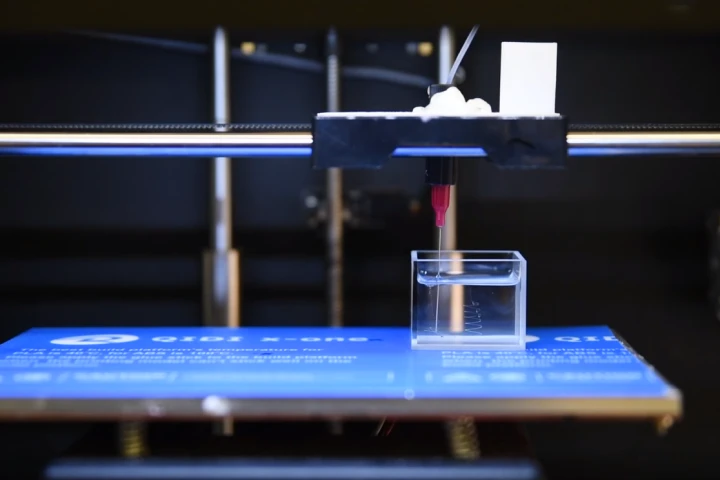 A new technique developed at Berkeley Lab allows liquid 3D structures to be printed within other liquids. This new form of 3D printing could give rise to flexible and stretchable liquid electronics, aid chemical synthesis, or serve as a transport and delivery system for nanoscale particles.
 -
 Generally, water repellent objects and those that attract or absorb water have very different microscopic-level attributes. Now researchers have discovered a way to use a single type of material to perform both functions, switching between the two simply by applying electric current.
 -
 A team of engineers has created a steel alloy that is much stronger than ordinary steel and is so resilient that it bounces back into shape, even when blasted with a cannon. The researchers believe it could make super-strong armor or help protect space vehicles from micrometeorites.
 -
 A versatile origami fold could be the key to creating just about any structure, from the nanoscale to full-scale buildings, according to new engineering research out this week. A team at Harvard says the key is a folding pattern known as the Miura-ori.
 -
 A material that has the strength and the lightness of titanium alloy and made from an amalgam of steel, aluminum, carbon, manganese, and nickel, has been developed that may see lightweight steel replace aluminum in lightweight, fuel-efficient automobiles and aircraft.
 -
 In an effort to improve the performance of lithium-ion batteries, scientists have turned to techniques used by snails to control the growth of their shells. Combining the method with a peptide that binds with materials used in cathodes promises to make batteries smaller and have longer lifetimes.
Load More