






Backpacking gear startup FLFQ-Aloner broke into the game in late 2025 year with an inflatable hammock-tent built for fast setup and serious weather. This time around, it's deflating its tent construction into an ultralight, modestly priced solo tent that shrinks down as small as possible. The company aims to create the absolute sweet spot in terms of an affordable, featherlight, roomy and convenient solo tent for rigorous backpacking, kayak camping, bikepacking and more.
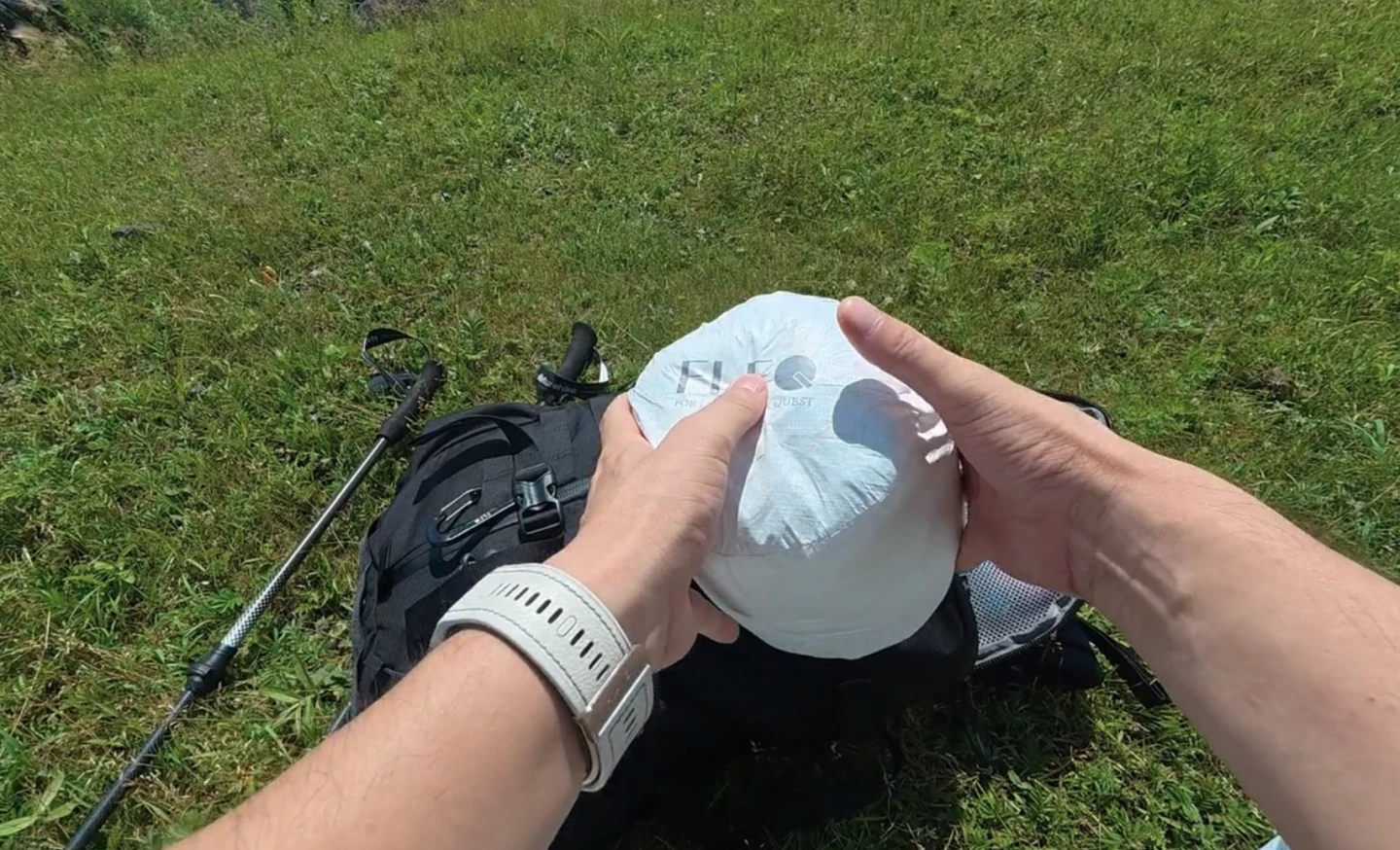
In all honesty, what caught our attention about the all-new Roamer tent was that it reminded us immediately of a roll of toilet paper. In reality, though, the packed tent is well larger. At 7 x 5.9 in (18 x 15 cm), the 3.1-L packed Roamer takes up about 2 liters more volume than a 4.5 x 4-in (11.4 x 10-cm) wrapped roll of the soft stuff.

Still, that's a small packed size for a tent, dipping just below the 8.5 x 5.5-in (21.6 x 14-cm) Hyperlite Mid 1 and the 12 x 5-in (30.5 x 12.7-cm) Gossamer Gear One, similar ultralight solo trekking pole tents. FLFQ-Aloner points out that when carrying a 35-L backpack around the backcountry, the 3.2-L Roamer stuffed tent takes up just 9 percent of total pack space. That's a small backpack by backpacking standards, best for a single night or light weekend, and if you're traveling for longer, the Roamer will take up an even smaller percentage of the larger pack you'll need.
As far as weight goes, the 26.2-oz (744-g) Roamer is heavier than both the 16-oz (454-g) Mid 1 and 19.7-oz (558-g) Gossamer One, but those numbers obscure the real story a little bit. Both Hyperlite and Gossamer Gear advertise weights that omit some of the components FLFQ-Aloner includes in its 26.2-oz estimate. For instance, when factoring in the stakes, stuff sacks and guy lines that go into the completely packed tent, Gossamer's One tent weighs 22.2 oz (630 g). Add Hyperlite's 3.5-oz (99-g) aluminum stake kit (sold separately) to the Mid 1's weight, and the package checks in at 19.5 oz (553 g) packed.
Where FLFQ-Aloner aims to separate itself apart from those lighter tents is in price. The Hyperlite Mid 1 retails for US$675, while the Gossamer One prices in at $315. The Roamer, on the other hand, is currently up on Kickstarter for a base pledge of $199. For now, that's a nice savings ... things will get more competitive with Gossamer and modestly priced options from brands like Durston Gear if and when the Roamer launches for its planned MSRP of $349.
But hotly contended price and weight figures are nothing new in the backpacking market, where those looking to optimize every spec for the best possible price could quickly drive themselves mad. FLFQ-Aloner ultimately appears to be looking to clear itself out a comfortable berth between high-priced, high-quality ultra-lightweight gear from boutique brands and slightly heavier, more dubious cut-rate wares from lesser-known brands and direct-to-customer manufacturers that pop up regularly on places like Amazon and Alibaba.
Whether it can ultimately do so amongst reasonably priced tents from established brands like Gossamer, Durston and Six Moon Designs remains an open question. But the below comparison FLFQ published on Kickstarter lends a deeper look inside what the company is trying to do with the Roamer, showing how the tent falls smack in between a discount solo backpacking tent and a high-priced boutique tent.
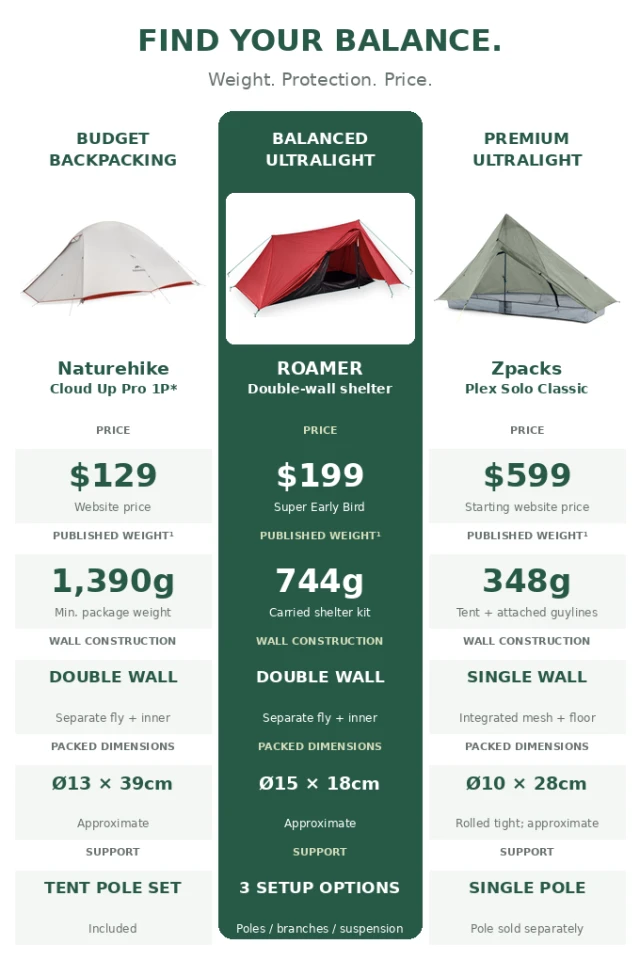
We imagine FLFQ picked the Naturehike Cloud Up Pro because Naturehike is one of the more well-known discount brands, but that tent is a poor comparison that isn't a trekking pole-secured design and has a full pole system that adds considerably to its packed weight. Naturehike doesn't have a trekking pole tent, so a better comparison would be something like the $145 River Country Products Trekker Pyramid 1, which packs a little larger than the Roamer at 10 x 5.5 in (25 x 14 cm) and weighs considerably more at 41 oz (1,163 kg).
Another selling point for the FLFQ Roamer is its double-wall design. Unlike the single- and 1.5-wall designs common in this category, the Roamer features a completely independent rain fly and a pure-mesh inner body aboard a tub floor. Double-wall constructions are superior to single- and 1.5-wall designs when it comes to airflow, anti-condensation performance and overall versatility.
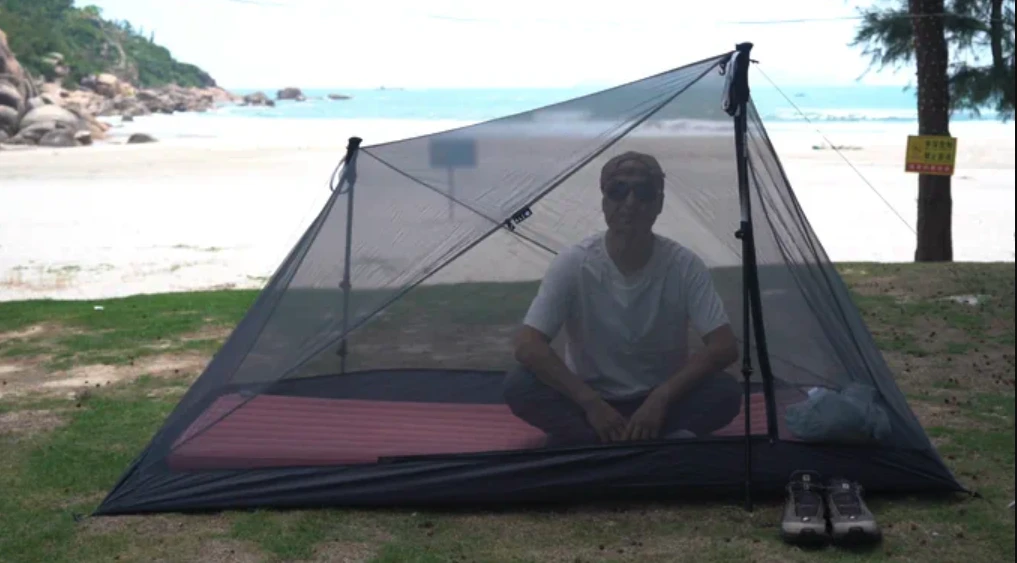
Much like Durston's X-Mid and some older tent designs like the Tarptent Stratospire, the Roamer offsets its trekking pole attachment points to open up clearer access to the entry and create a longer diagonal ridge line for a more generous amount of headroom and volume inside. The tent's floor measures 89 x 35 in (226 x 90 cm).
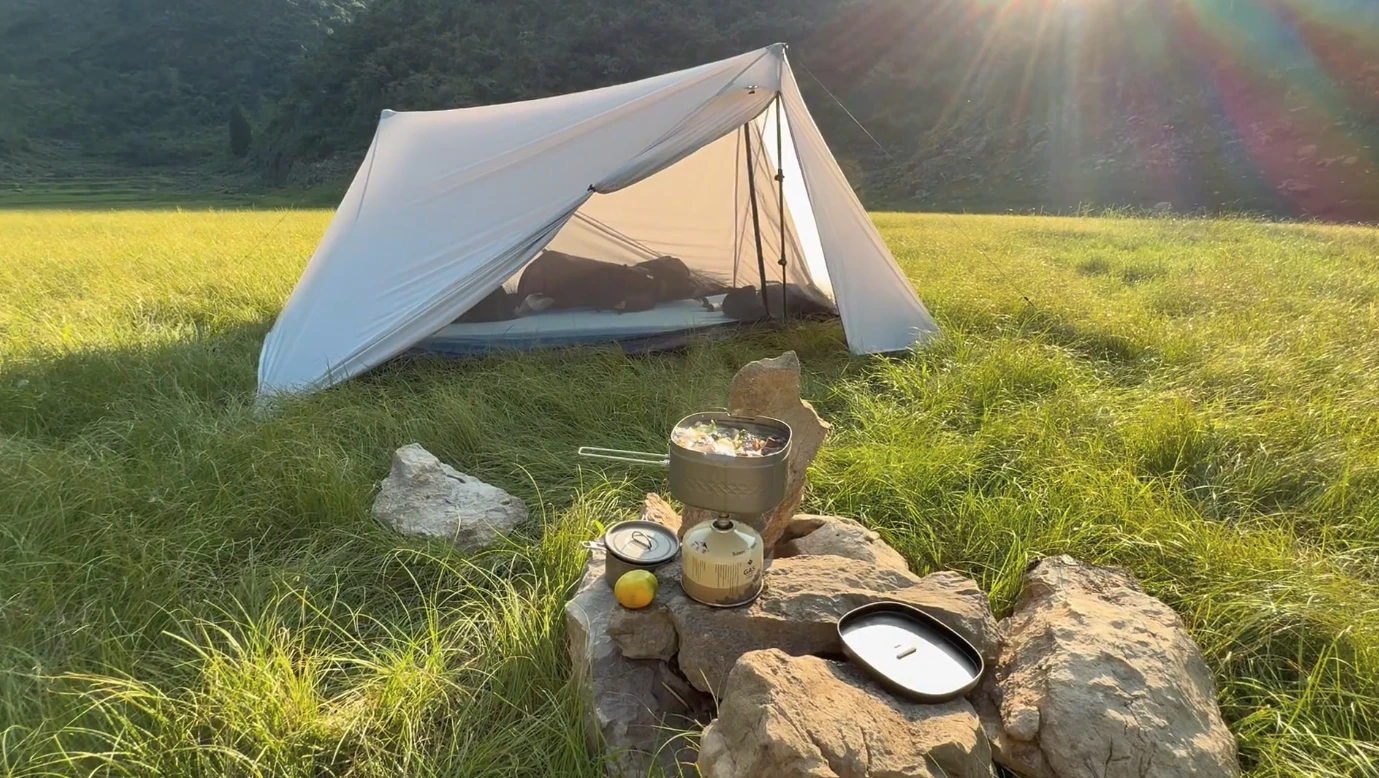
The Roamer is a three-season solo design with integrated fly ventilation. It includes an internal lantern hook and mesh storage pockets. In addition to pitching via trekking poles, campers can set it up using downed tree branches cut to the right size or by securing it from overhead to surrounding trees.
FLFQ-Aloner is raising money for the Roamer launch on Kickstarter now, offering the tent from the aforementioned $199 pledge level. It's also offering a pair of carbon fiber trekking poles to use with the tent as a $45 add-on. Each pole weighs 7 oz (200 g), so 14 oz (400 g) for the pair. The campaign is approaching 10 times its goal with close to $50,000 raised and a month left to go.
Source: Kickstarter


