





While everyone needs technology of one sort or another, certain people shrink from any stigma associated with it. In fact, those people may be less likely to let others see them using that tech no matter how much they need it, even if that wearable technology is as widespread as eyeglasses.
So, how much of a threat does that stigma pose when the wearable technology in question is for medical monitoring?
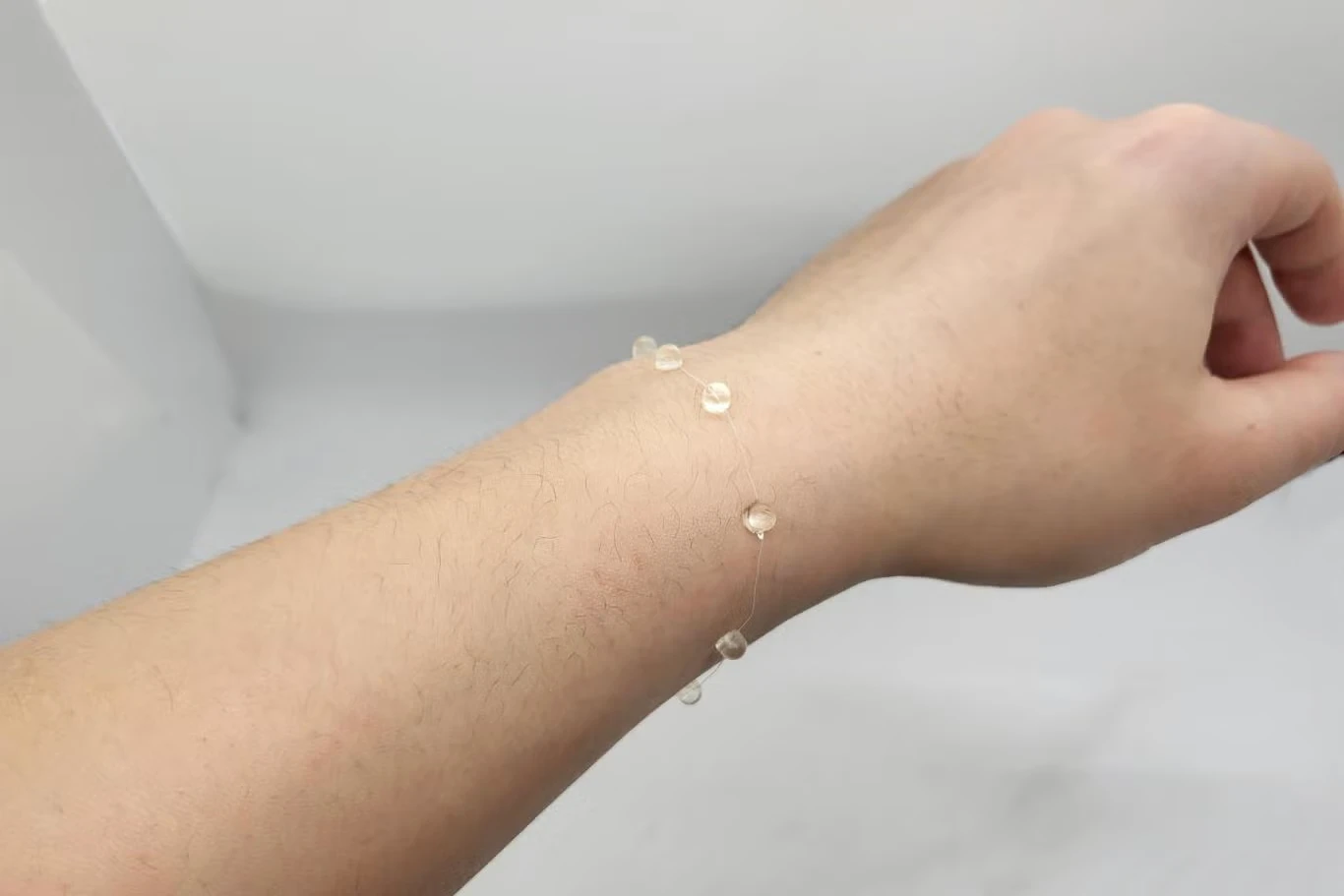
While professors at Tufts University in the US haven’t found a way to engineer the end of stigma, bigotry, or shame, they have created a wearable technology that’s so thin, light, flexible, and unobtrusive that even its own users barely notice they're wearing it. While around 33% of Americans wear smart rings and smart watches which can function as medical monitors, the Tufts breakthrough is in smart threads – think of them as “thread-ectronics.”
In their Applied Materials and Interfaces paper, Prof. Sameer Sonkusale and colleagues describe devising the complex integrated circuits of thread-ectronics from sensors, transistors, and other components.
To prove the effectiveness of thread-ectronic sensors, Sonkusale his team demonstrated how their innovation amplified subtle signals that could, in context, indicate stress, illness, and more. For instance, by using a sensor attached to one’s temple they could detect blinking, and by using a sensor on the thorax they could detect changes in respiration.
By their flexible design, these thread-ectronics also allow coiling, stretching, and bending without breaking. Designers could easily add them into any clothing including athletic and workwear for activities usually incompatible with protecting delicate body monitors. In fact, one could even attach thread-ectronics directly to the skin for transmitting environmental or somatic telemetry for improving healing, health, or even athletic performance.
“By moving electronics from planar patches to free-form threads,” said Sonkusale, “we have opened a path toward wearable bioelectronics that are more like fibers than hardware.”
The new med-tech will move naturally with the human body rather than forcing humans to adapt their movement to it, which rigid and fragile monitoring devices required. In fact, says Sonkusale, thread-ectronics “could even potentially be used like sutures to monitor processes inside the body,” monitor breathing in adults and infants, assess risk of falling, and generate movement profiles for identifying physical and cognitive decline.
To function, thread-ectronics contain flexible micro-transistors attached to gold-coated filaments. These transistors are composed partly from a plastic-like conductor connecting the gold-coated filaments entering and exiting them, allowing them to function like faucets for electrons.
The thread-ectronics also rely on eutectogels, which create a sub-millimeter gap between the thread-ends to control the flow of electrons via resistors, capacitors, or other components. While severing thread-ectronics will destroy them, eutectogels are stable, soft enough to touch or connect to the human body, and allow transistor repair through the simple application of low heat.
Furthermore, creating thread-ectronics doesn’t require delicate photolithography that is standard in building integrated circuits, nor high-temperature processing or clean rooms. Because manufacturing thread-ectronics works well with textile-style materials and soft polymers, future production should be low-cost.
As lead author and Tufts electrical engineering PhD candidate Wenxin Zeng explains, while “the technology platform is still in early stages ... we expect to improve the speed and precision of fabrication, and the ability of the thread-based integrated circuits to carry out more complex functions.”
Tufts thread-ectronics joins an exciting new breed of innovative medical monitors including paintable tattoos, skin stickers, and stethoscopic patches.
Source: Tufts University


