In the 1960s Hanna Barbara animated series The Flintstones, prehistoric human beings lacked modern technology, so they used ancient animals (including dinosaurs, who for some reason in this universe lived at the same time people did) as household appliances and industrial machinery. And, for extra-cheap laffs, these animals routinely mugged to the camera about how awful their lives were at the hands of the humans misusing them.
Well, thanks to researchers at the Massachusetts Institute of Technology (MIT) in the US, the past has become the future today.
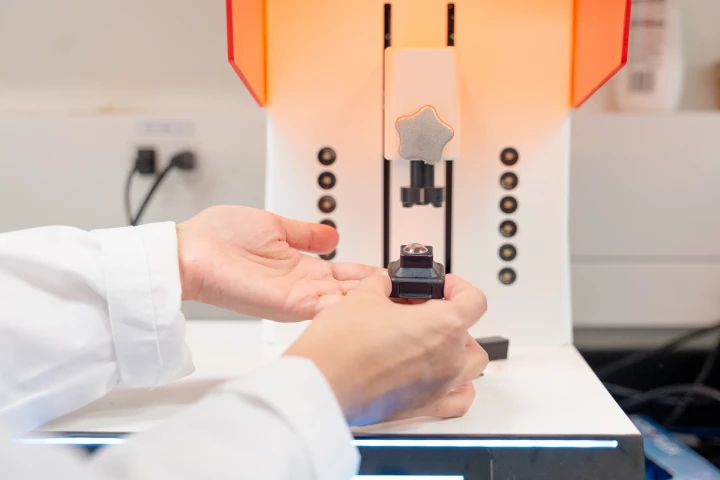
As MIT Electrical Engineering and Computer Science graduate student Yunyi Zhu says, “With our system, an object can tell you whether you are using it properly, without the need for sensors or any complicated electronics. The interactive display is mechanical, so you can create a self-contained, multistate, interactive device that a user can control very intuitively.”
In her HCI/CSAIL paper, Zhu and co-authors Dingning Cao (MIT undergraduate), Jeremy Mrzyglocki (Technical University of Munich graduate student), Stefanie Mueller (MIT associate professor in EECS and the Department of Mechanical Engineering), and Narjes Pourjafarian (Northeastern University doctoral student) explain their goal of avoiding fabrication complexity that “reduce[s] robustness in everyday settings” for interactive objects embedded with electronics to change their surface appearances.
Their innovation is ShiftLens, “a design and fabrication system for creating 3D objects with mechanically switchable surface appearances, enabling dynamic visual output without electronics.” That approach uses another blast-from-the-past: a lenticular lens layer that shifts a sheet of angled, transparent ridges over a second patterned image. As you slightly rotate, slide, or press the object, the optomechanism’s appearance changes.
So, if you failed to properly close a bottle of expensive medicine, or a container of a dangerous substance, or the cage of a creature eager to escape, then their surfaces wouldn’t look right – the color and/or pattern would be wrong – and you’d immediately know to seal them properly.
And because it functions without electronics or a power source, even if an object with ShiftLens got wet from rain or dunked in water, or if its seal loosened due to jostling or tampering, the warning would still operate. If you’ve ever dropped or dunked an electronic device with its own display, you can already imagine how much more reliable an optomechanism would be.
Even better, all you need to create one yourself is a single print-run on a multi-material 3D printer, and with a little bit of training, you could design your own optomechanisms.
As Zhu explains, her team designed the ShiftLens system “to communicate to users who are not familiar with optics or mechanical structures and let them specify and achieve what they have in mind” by employing a user-friendly tool that creates the actual structure with only a few specifications such as shape and curves. That means engineers, architects, artists, and even designers of clothing, jewelry, toys, games, and other products will easily be able to create optomechanisms for their own unique purposes.
In addition to solving problems such as identifying broken pipes and seals with ShiftLens, Zhu’s team plans to simplify the ShiftLens algorithm to require even fewer user specifications, thus making production simpler while improving the design tool to increase the variety of optomechanisms it can create.
Optomechanisms are a rich source of development in engineering, including telescopy, miniature projectors, tractor beams, and quantum optomechanical mirrors made from a few hundred atoms and only a few microns thick.
Source: MIT