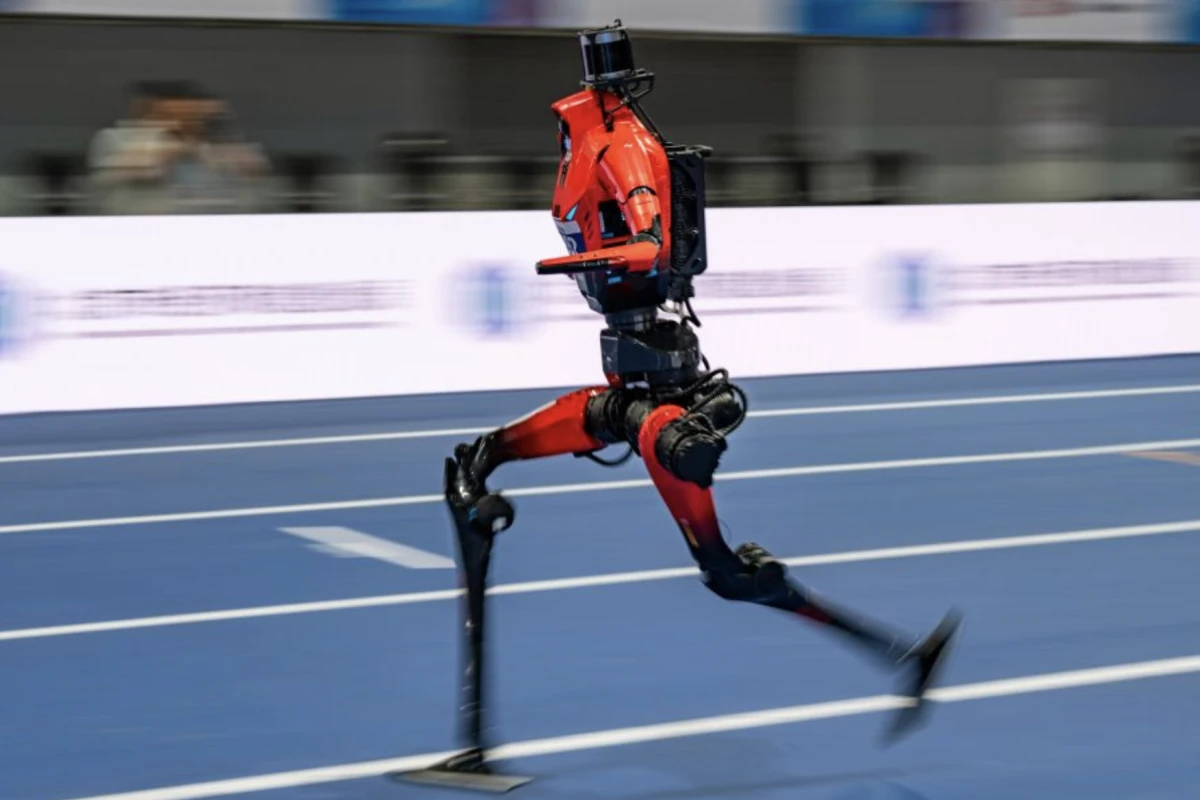



As the second World Humanoid Robot Games got under way on August 21 at Beijing’s National Speed Skating Oval, most of the interest has been on the machine sprinters and boxers. But away from the sporting arena, the five-day games reveal something telling about why China's winning this technology race.
The games, which this year involve 666 different teams and 2,056 humanoids, will see the robots take part in 30 competitive events and nearly as many showcase and demonstrative shows. The event also serves as a defining marker of where the industry is at in 2026. While we're nowhere near reaching the potential of this technology, you only have to look at the 2025 games highlights to see what a difference 12 months makes.
The biggest news so far has been the humanoid named Lightning, made by phone company Honor, who beat Usain Bolt's world record in the 100-m sprint. Lightning crossed the finish line in 9.32 seconds, with Bolt's 17-year record still unbeaten by any human, at 9.58 seconds.
In April this year, Honor humanoids won big in the Beijing robot half-marathon event, not just for speed but for best gait and design. These aspects to humanoid design have become the next stage of humanoid "growth" across the industry.
The key part here isn't the record but the robot's origin story. When I first started writing about Chinese technology, it seemed so strange that a company like Xiaomi and Xpeng would be making cars, phones and robots. And now eVTOLs.
But China's technology supply chain is unlike anything else on the planet – and it's one that enables this kind of diversification that seems to actually benefit, not hinder, each product, be it a phone or a robot. On top of this, events like the World Humanoid Robot Games encourage engineers to compare notes and learn from each other. In 2024, an initiative was launched to facilitate data sharing between humanoid startups and companies.
Of course the likes of Unitree and UBtech are eager to dominate the local and export markets, so there's certainly healthy competition. But they exist in an unusual ecosystem that is able to support hundreds of teams building robots in 2026.

“In my view, China’s supply chain is exceptionally complete," Jin Yongbin, Chief Technology Office of MirrorMe Technology, who took their humanoid Bolt to the Beijing games, told CCTV (translated to English). "For the entire robot system, its motors, batteries, electric drives and transmission systems, are perfectly aligned with the existing automotive industry’s supply chain. We are essentially transferring our established automotive supply chain to robotics."
Jin's company MirrorMe has developed a 175-cm (68.9-in)-tall 75-kg (165-lb) sprinter named “Bolt”, capable of reaching speeds of 11 meters per second (36 ft/s). Not as quick as Lightning proved to be, but speed is only part of the story.
“Speed is not just about velocity; it is actually a synthesis of a series of engineering limits – intensity, toughness, strength, fluidity and more,” Jin explained. “More importantly, achieving speed is about breaking the limits of existing cognition – examining the biological motion mechanisms behind it, understanding what the dynamic mechanisms look like, and determining whether we can harness these mechanisms.

“Moreover, we need to rely on events like this to continuously exchange ideas, evaluate the strengths and weaknesses of different technologies, and rapidly refine the robotics supply chain," Jin added.
This is another key difference seen in China's robotics and AI industries. Sure, there's healthy competition – and a news-making win at the Beijing games is excellent promotion – but this tech development feels more like a countrywide team effort, where engineers are learning from and collaborating with engineers across company lines.
Ultimately, the so-called "robot arms ace" between the US and China is lazy at best. Both countries are rapidly advancing, there's no doubt about that – but it's more like they're running different races in separate events.
Source: CCTV