






I'm almost always glad to see a throwback car design, especially when it references a whimsical one that's not meant to please everybody.
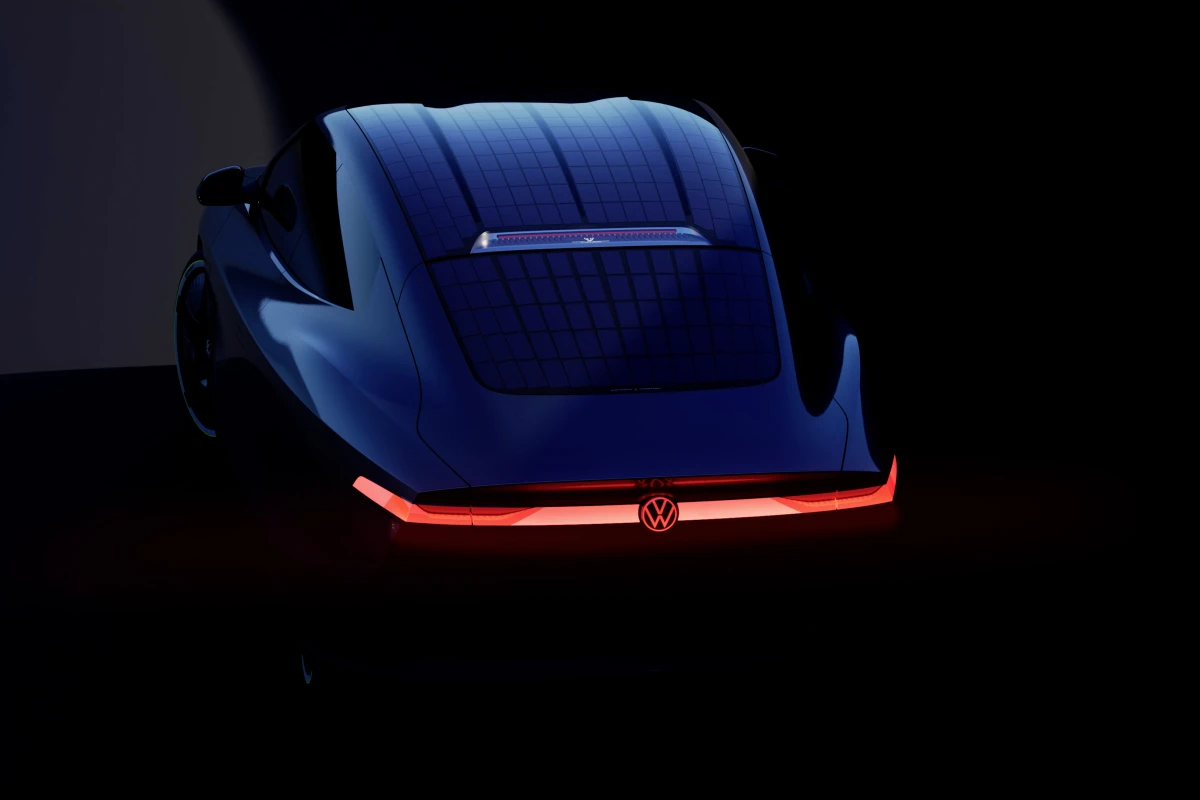
That's what Volkswagen has done with its concept for what it claims is "the world's most efficient near-production electric car." Mission Efficiency, as it's called, bears more than a passing resemblance to VW's XL1 from 2013, and the similarities are more than skin deep.
With its diesel plug-in hybrid powertrain, the XL1 was the most economical production car of its time. It featured a teardrop-shaped body that tapered dramatically toward the rear, narrow-track wheels partially enclosed within the bodywork, and a low, slender profile that stood barely over 3 ft (1 m) tall.
VW ran with that idea for Mission Efficiency (ME) and went further for this modern take. This is a zero-emissions machine based on the same front-wheel-drive platform as the new electric ID. Polo, and its aerodynamic design allows for a range of just under 500 miles from a small 54.9-kWh battery.
That's thanks to an extremely low, record-setting drag coefficient of 0.158 achieved with its streamlined exterior design, the ID. Polo's efficient 133-hp electric motor, and of course, modest driving habits.

On what VW terms an "ideal trip" with a constant speed of 42 mph (68 km/h), no uphill slopes, and the AC turned off, the ME manages a real consumption of 8.27 miles/kWh (7.51 kWh/100 km).
The car was put through its paces on a 794-mile (1,278.36 km) test drive from Germany's Wolfsburg to the Austrian capital of Vienna. It only needed to be recharged once – and still had roughly 100 miles (164 km) of range left at its destination.

That's impressive when you consider the fact that this used an existing powertrain – so the ID. Polo's engineers deserve props for that. For reference, the ID. Polo's WLTP consumption figure is 4.67 miles/kWh (13.3 kWh/100 km); that means the ME is nearly twice as efficient as this production model.
Several design elements – including the streamlined body with integrated door handles and frameless windows, the small frontal area, active cooling air flaps, and concealed rear wheels, and a fully clad underbody – contributed greatly to the car's overall efficiency. VW says that at speeds above 50 mph (80 km/h), the ME's consumption is more than 30% lower than in the the ID. Polo.

So what's this long boy all about – besides the low energy use? You're looking at an elongated body measuring 188 in (4,775 mm), with an aluminum structure, and carbon fiber-reinforced polymer and aramid composite components for those efficiency gains.
It's got four seats (though the ones in the rear are only really suitable for kids under 5ft3), 481 liters of storage, and a bit more room for the charging cable and other gear under the rear seating. The seats themselves are lightweight, and the cabin skips a full-fat infotainment system for a spot to mount your own phone or tablet.

The tires are custom designed to minimize energy losses while rolling, while the aerodynamically designed wheels feature rim deflectors that prevent air from causing turbulence inside. At the rear, you'll find all-new electromechanical brakes that reduce friction losses and improve recuperation.
Solar panels cover the glass roof and trunk lid, and can add up to 18.6 miles (30 km) of range on a good day.

That's a glimpse into what the future of more efficient zero-emissions vehicles could look like. Since the ME uses a conventional EV battery and a motor from the current-gen ID. Polo, its efficiency gains are largely due to aerodynamics.
It'll be interesting to see how much of this design thinking is adopted in upcoming models – not just to extend range for long trips, but to get more out of affordable, compact batteries and expand the variety of easily accessible cars for commuting.
Source: Volkswagen


