





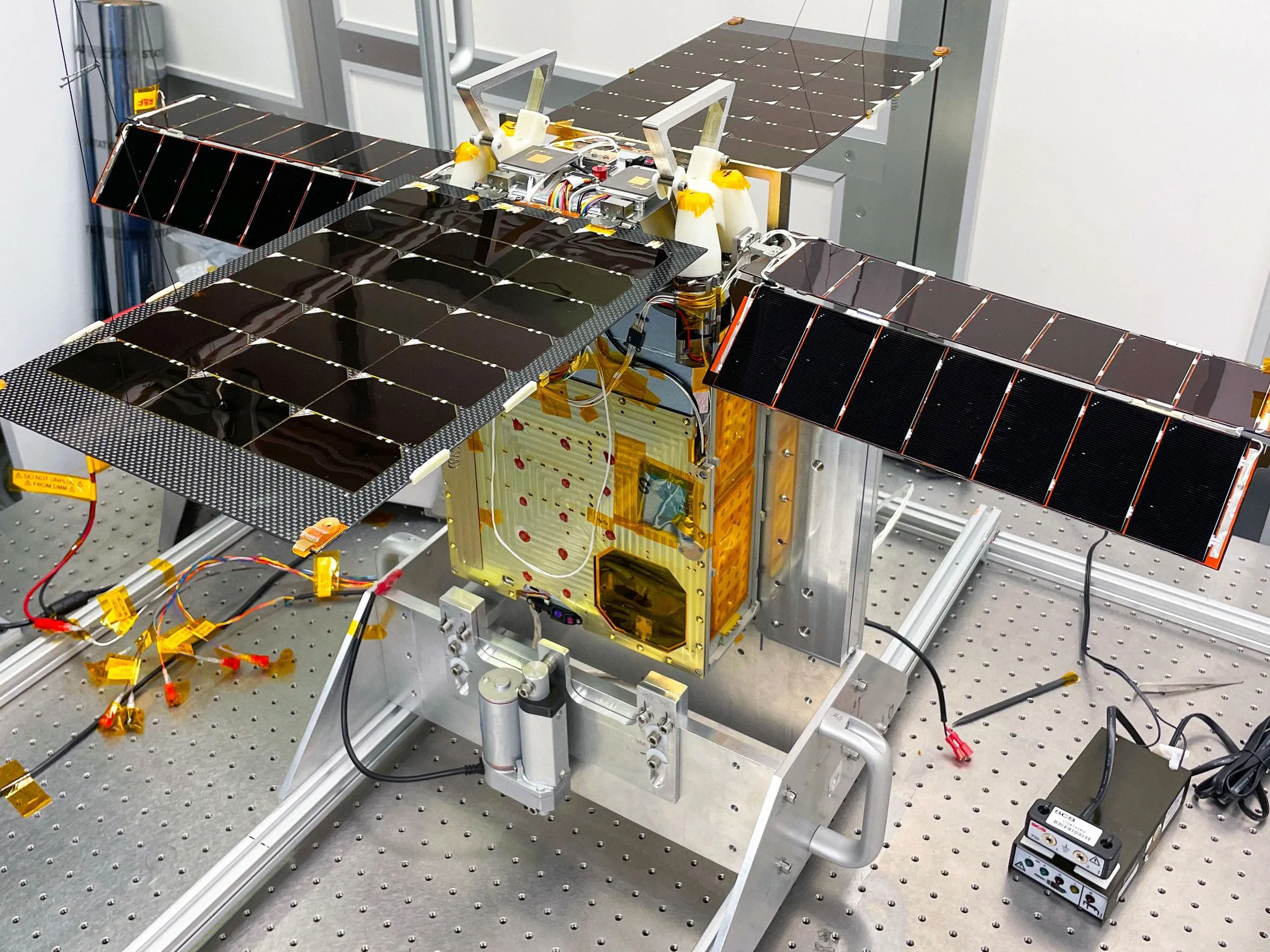


Engineers at MIT have successfully tested a hybrid propulsion system for small satellites that combines the raw punch of chemical rockets with the long-haul efficiency of electric thrusters – and crucially, both run on the same fuel. This tech could propel cheap, briefcase-sized spacecraft to Mars and beyond.
Microsatellites – roughly the size of a shoebox or carry-on bag – are cheaper and easier to launch than conventional satellites, but they've always faced a frustrating constraint. If you wanted one to perform quick orbital maneuvers and slow, precise adjustments, you needed two separate propulsion systems with two separate fuel sources. In a platform so small, that presents quite a challenge.
Chemical thrusters burn fuel fast and generate a powerful, rapid thrust that is key for changing orbit in seconds. Electric thrusters (specifically electrospray thrusters) are extraordinarily fuel-efficient, but slow. They can be used for making precise adjustments, or to accelerate a spacecraft gradually over months or years, making them ideal for long interplanetary voyages.

These technologies are complementary but have remained incompatible in a small format – at least until now. The breakthrough came from the US Air Force, which had spent years developing a propellant called ASCENT (Advanced SpaceCraft Energetic Non-Toxic propellant) as a greener replacement for hydrazine, a highly toxic chemical traditionally used in spacecraft propulsion. ASCENT was designed for chemical thrusters, but it had a hidden property nobody had yet exploited: it's an ionic liquid.
Ionic liquids are essentially salts that stay in liquid form even in the vacuum of space, which very few materials can do. That stability makes them perfect for electrospray thrusters, which work by applying an electric field to a liquid, charging its ions, and firing them out as a fine jet that generates thrust.
MIT's AeroAstro lab, led by Professor Paulo Lozano, has spent over a decade building and refining exactly this kind of thruster. "ASCENT happens to be an ionic liquid mixture," says Amelia Bruno, lead author of the study published in the Journal of Propulsion and Power. "And we said, hey, that's the stuff we typically use. Theoretically, this should work. Let's go figure out how."
The team loaded a gram (0.035 oz) of ASCENT into small tanks connected to electrospray thrusters mounted on a CubeSat. The researchers placed the micro satellite on a magnetic levitation platform – essentially a MagLev track that mimics the weightlessness of space – and fired the thrusters remotely at varying voltage levels, watching the satellite spin like a slow-motion top.

ASCENT delivered a thrust-to-power ratio of 40–65 micronewtons per watt, a specific impulse (a standard measure of propellant efficiency) of 600 seconds, and an overall efficiency of 15%. The thrusters ran continuously for up to 167 hours with no measurable degradation.
"Compared to our normal electrospray propellants, ASCENT can provide similar performance in terms of thrust," Bruno says. "Now that we know our thrusters work with ASCENT, we can start thinking of all the ways we can make them even better."
The next step is orbit. MIT is working with NASA on the Green Propulsion Dual Mode mission – a CubeSat carrying one chemical thruster and four electrospray thrusters, all fed by a single shared ASCENT tank. A launch is planned for later this year. "This will be the first time that a satellite will have a shared propellant tank," says study co-author Paulo Lozano, the Miguel Alemán Velasco Professor of Aeronautics and Astronautics at MIT.
If it works, the applications range from the practical – deploying satellite constellations to track a hurricane in real time – to the audacious. "We could send CubeSats to Mars, or the asteroid belt, where they could make the journey slowly using electrospray thrusters," Lozano adds. "You could then use your chemical thrusters to quickly move to look at interesting features."
Source: MIT


