

Automotive

Small, spry solar-roofed tractor looks to replace diesel

Small, spry solar-roofed tractor looks to replace diesel
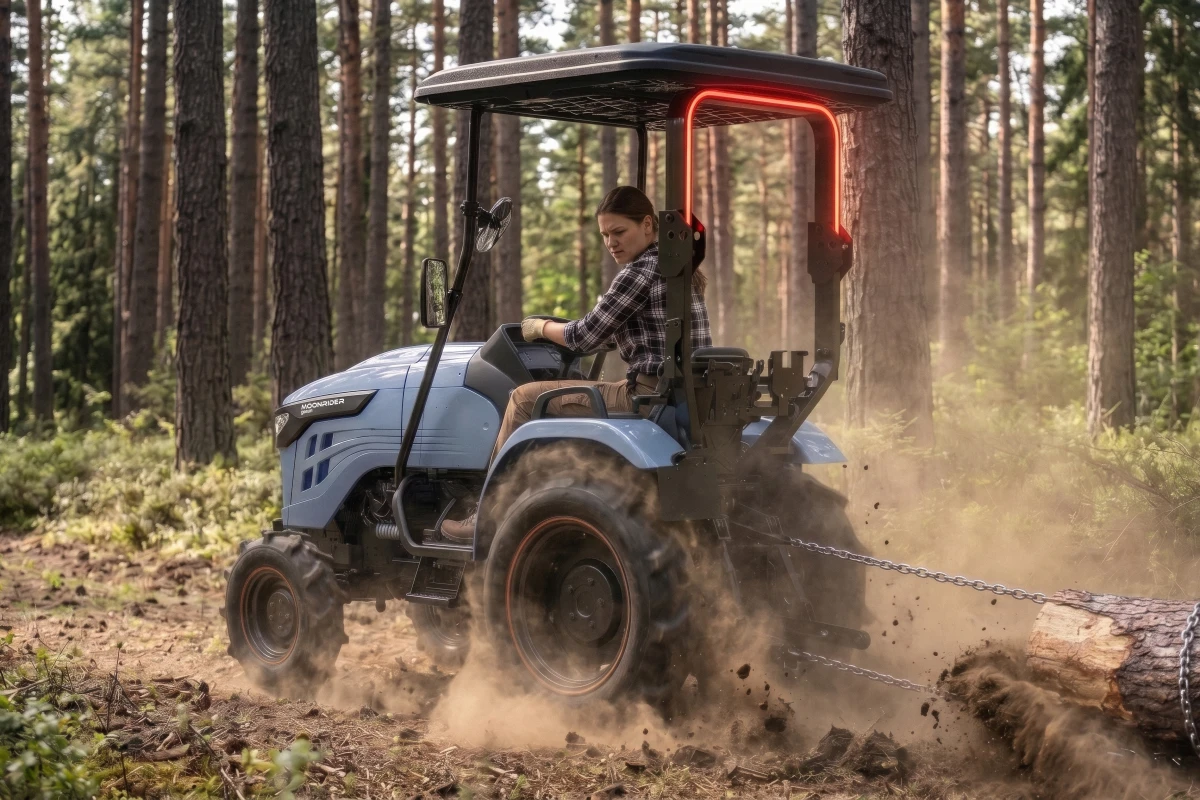
The Moonrider 27's 4x4 drivetrain and 27-hp (20-kW) motor are built for the kind of heavy-duty task that has traditionally kept diesel utility tractors in business
View 5 Images
The Moonrider 27's 4x4 drivetrain and 27-hp (20-kW) motor are built for the kind of heavy-duty task that has traditionally kept diesel utility tractors in business
1/5
The Moonrider 27's 4x4 drivetrain and 27-hp (20-kW) motor are built for the kind of heavy-duty task that has traditionally kept diesel utility tractors in business
GoSun's optional solar roof unfolds into wing-like panels rated at 1,100 watts
2/5
GoSun's optional solar roof unfolds into wing-like panels rated at 1,100 watts
The Moonrider 27 tackles routine chores like mowing and clearing
3/5
The Moonrider 27 tackles routine chores like mowing and clearing
Beyond its onboard panels, the Moonrider 27 can also draw power from stationary solar setups when parked
4/5
Beyond its onboard panels, the Moonrider 27 can also draw power from stationary solar setups when parked
Farming on the Moon?
5/5
Farming on the Moon?
View gallery - 5 images

For small-scale farmers, diesel is a recurring headache. A bill that swings with global oil prices and never really goes away. Battery power has been pitched as the fix for years, but it's barely made a dent in the tractor market. GoSun thinks it has found a way to close that gap using an energy source most farms already have in steady supply, sunlight.

GosSun, the American company known for solar cookers, portable fridges, and off-grid water purifiers, has unveiled the Moonrider 27: a compact 4x4 electric tractor built by Moonrider in India and distributed by GoSun across North America. Rated at 27 horsepower (about 20 kW), it's aimed squarely at everyday farm chores like mowing, tilling and hauling – the kind of work that has traditionally meant firing up a diesel engine.

The tractor's standout feature is an optional 1,100-watt solar roof that trickle-charges the battery both while the machine is working and while it sits parked outside. The panel array doubles as a sunshade for the driver. GoSun is careful to frame this as a supplement rather than the primary charging method: when a faster top-up is needed, the Moonrider 27 can simply be plugged into a standard electrical outlet.

Electric Tractor: GoSun Moonrider 27

Ditching the combustion engine also strips out a chunk of routine maintenance: oil filters, air intakes, and exhaust systems all become unnecessary. And because there's no exhaust to speak of, the tractor doesn't expose animals or workers to combustion fumes.

GoSun says the Moonrider 27 will reach the market by early 2027, with reservations already open on its website. The starting price is US$19,995, a figure the company is pitching as competitive with similarly sized diesel tractors. It's worth noting that there's no independently verified data yet on real-world range, charging times, or how operating costs actually stack up against diesel.

"At GoSun, our vision has always been to build solutions that allow people to live, work, and thrive off the grid using the power of the sun," said Patrick Sherwin, the company's founder and CEO. "Small-scale farming and property management have relied on noisy, costly diesel utility vehicles for far too long. With our new All-Electric Tractor, we are empowering farmers and land managers to literally work on sunshine – reducing operational costs while protecting the soil and air. Electric tractors are a key part of the future of farming."
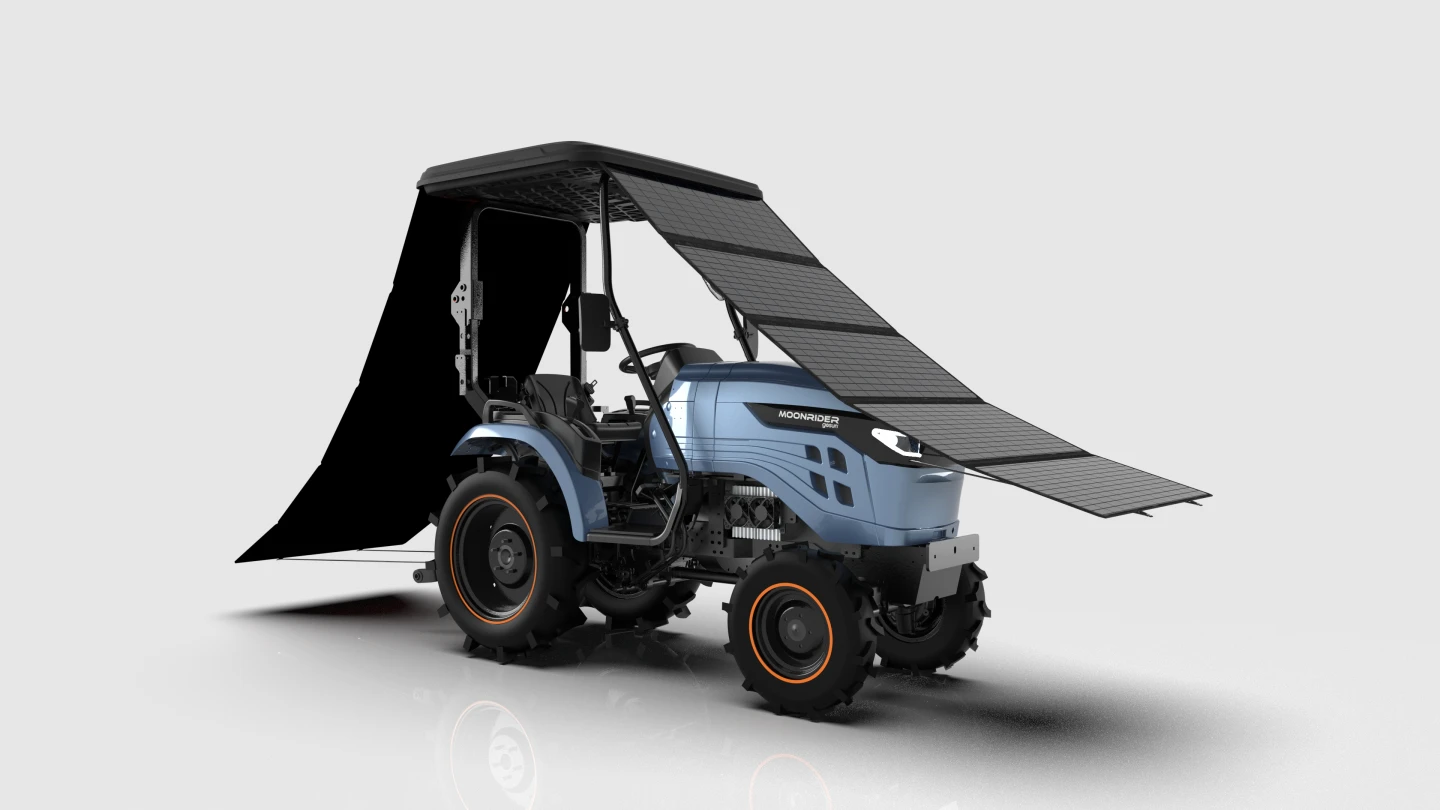
GoSun's optional solar roof unfolds into wing-like panels rated at 1,100 watts

The Moonrider 27 isn't the first tractor to wear a solar roof – a handful of alternatives are already on the market. The Dutch E-Horse, built by Machinefabriek Boessenkool, is a lighter tractor for towing farm implements (plows, tillers, and similar attachments) that can add eight to twelve solar panels to its roof, claiming six to eight hours of runtime for tasks like weeding and seeding, though it costs a steep €99,500 (~US$115k).

At the other end of the spectrum, the American e2T from Renewables is a two-wheel electric tractor for small farms with a 5-kWh battery, starting around $7,500 (plus $1,900 for an optional 550-watt solar canopy). In Malawi, the Aftrak project takes a different tack entirely: a microtractor powered by solar microgrids (small, localized power networks not tied to a national grid), aimed at cooperatives and smallholders without reliable grid access, estimated at $3,500 per unit plus roughly $1,500 for solar panels.

Fully electric tractors still account for less than 1% of sales in the world's major farming markets, but industry forecasts point to faster growth ahead. For now, the Moonrider 27 stands out on price and ambition, though the diversity of approaches on display suggests there won't be a single winning formula. Farmers who want to ditch diesel entirely – and want their tractor's roof to do more than throw shade – will likely choose whichever solar-electric setup fits their scale and geography.

Source: GoSun

Note: New Atlas may earn commission from purchases made via links

View gallery - 5 images
9 comments
9 comments
TechGazer
To me, vehicle-mounted solar panels seems silly. For this example, assuming that the 1.1 kW rating isn't based on being on a tall mountain at the equator, would provide 5% of the full load. In other words, if you needed to do a few hours of tractor work, you'd extend your time by a few minutes, assuming bright sunlight. I expect a price premium for vehicle mounting, compared to mounting the panel on a building or rack, where it could charge the tractor. The panel's contribution would only take a few minutes at full-rate charging, so having it on the tractor isn't saving a lot of time. There's also extra expense from duplicating the panel controller electronics.
Solar panels on vehicles only makes sense if you've already covered all available land with panels and the vehicles spend a lot of time in sunlight (unlikely in cities). An exception would be a vehicle that needs to be away from other charging sources for long periods of travel.
Username
I was intrigued until I saw the abomination in question. Turning what should be a convenience into an impractical pain in the back side. @TechGazer one exception is a golf cart which spends most of its time sitting in the sun and doesn't use all that much power.
Nobody
Considering that a tractor this size will run all day on five gallons of diesel fuel. who would want the expense and hassle of an electric one? I can't imagine an electric one running for more than a couple hours under a heavy load and four wheel drive.
Rustgecko
It’s not a toy…but it’s not a real tractor either. The Moonrider 27’s specifications need to be kept in perspective. At just 27 hp (20 kW), it is a compact tractor rather than a genuinely heavy-duty agricultural machine, and its 24-kWh battery would theoretically sustain maximum motor output for only about 1.2 hours. The claimed five-hour working time therefore depends on substantially lighter average loads; prolonged ploughing, heavy cultivation or demanding PTO work could reduce operating time considerably. It may be a credible electric alternative to a small 25–30 hp diesel tractor, but it should not be presented as a replacement for the teal diesel tractors used for sustained heavy farm work.
1stClassOPP
I owned a 33hp John Deere tractor for about 10 years. It had PTO drive, three point hitch, four wheel drive, a hydraulic loader. I used it to haul logs out of the bush, attach a seven foot mower etc. all I used every year was a 45 gallon drum of fuel. The cost to run that tractor would probably be less than charging an electric system and it’s ancillary costs. So, for a small tractor electrified, I say “meh”
mlynch002
This is the "tractor" for people who have never owned or operated a real tractor, even a real compact tractor. Another electric pipe dream. Another wealthy, hobby farmer's toy. Diesel is not going to be replaced by electricity in agriculture on a scale that will feed nearly 8 BILLION human beings any time soon.
Nobody
The most useful thing about a tractor this size is a good end loader. Once again this one would be a dud.
Lamar Havard
I saw a video by a farmer who swapped his tractor engine with an electric motor, and 10 lead/acid batteries, and built a big solar shed in the middle of his small field. Two days of sun would let him harvest the whole thing. This was around 15 years ago.
TM62
Electrically driven heavy machinery is not a pipe dream - consider diesel electric locomotive train engines. The limitation at this point is battery capacity compared with its cost and, to some extent, its size. I suspect that in less than 5 years, this will no longer be a limitation.