

One of the most interesting concepts revealed at this year's Japan Mobility Show was also one of the simplest. It was even buried within a big, bold Toyota Group press conference in which flashier reveals dominated the world's attention. And while it may not be as posh as a rare Rolls-Royce-level ultra-premium brand or as highly coveted as a tiny Land Cruiser, the IMV Origin concept is potentially one of the most versatile vehicles Toyota (or any automaker) has ever built. Stripped down to the absolute barest of minimums, the flatbed truck (if you can even call it a truck) packs up like furniture so it can be built and upfitted on arrival for all kinds of work and lifestyle duties.
We wouldn't have previously imagined it possible, but the IMV Origin concept, officially billed as a truck concept aimed at rural Africa, takes a step backward from the IMV 0 concept Toyota revealed in 2022. It's a simpler blank canvas that welcomes even more modular upgrading possibilities. We suppose you could say "Origin" rolls the clock back to "sub 0" level.

The IMV stands for Toyota's long-running "Innovative International Multi-purpose Vehicle" platform ... so multipurpose versatility is baked right into the bones. Toyota furthers that flexible, multipurpose architecture with what it calls "deliberate incompleteness."
"The first idea was: We will ship this vehicle from our production plant unfinished," Koti Sato, Toyota president and CEO, explained at the Japan show press conference. "This vehicle leaves its plant before it is ready to be driven. It is the local people who assemble and complete it."

Koji Sato, Toyota President & CEO, presents the IMV Origin at the 2025 Japan Mobility Show – behind him is an illustration of the boxed rolling chassis and components that could slide into a shipping container for delivery
Borrowing imagery from IKEA, the idea is that the truck ships out as a set of assemble-yourself components in a crate and the buyer puts the end product together after arrival, presumably using included assembly instructions and tools, but perhaps requiring a few larger, more complex tools from their own garage. Hopefully the instructions are a little less vague and infuriating than the connect-the-picture schemes for which IKEA is infamously known – otherwise local roadways could get the wrong kind of interesting.
"The second idea was that customers would define the vehicle on their own terms, even after it's assembled," Sato continued. "Will it carry people or cargo? Will the cargo be boxes or something else? We just build the base. From there, each customer completes the vehicle to fit their needs."

Toyota showed images of a few example configurations at its press conference, including a produce delivery truck and logging truck. Beyond those, the open-ended nature of the IMV Origin concept could spur a large customization ecosystem for the African markets in which it would theoretically be sold.
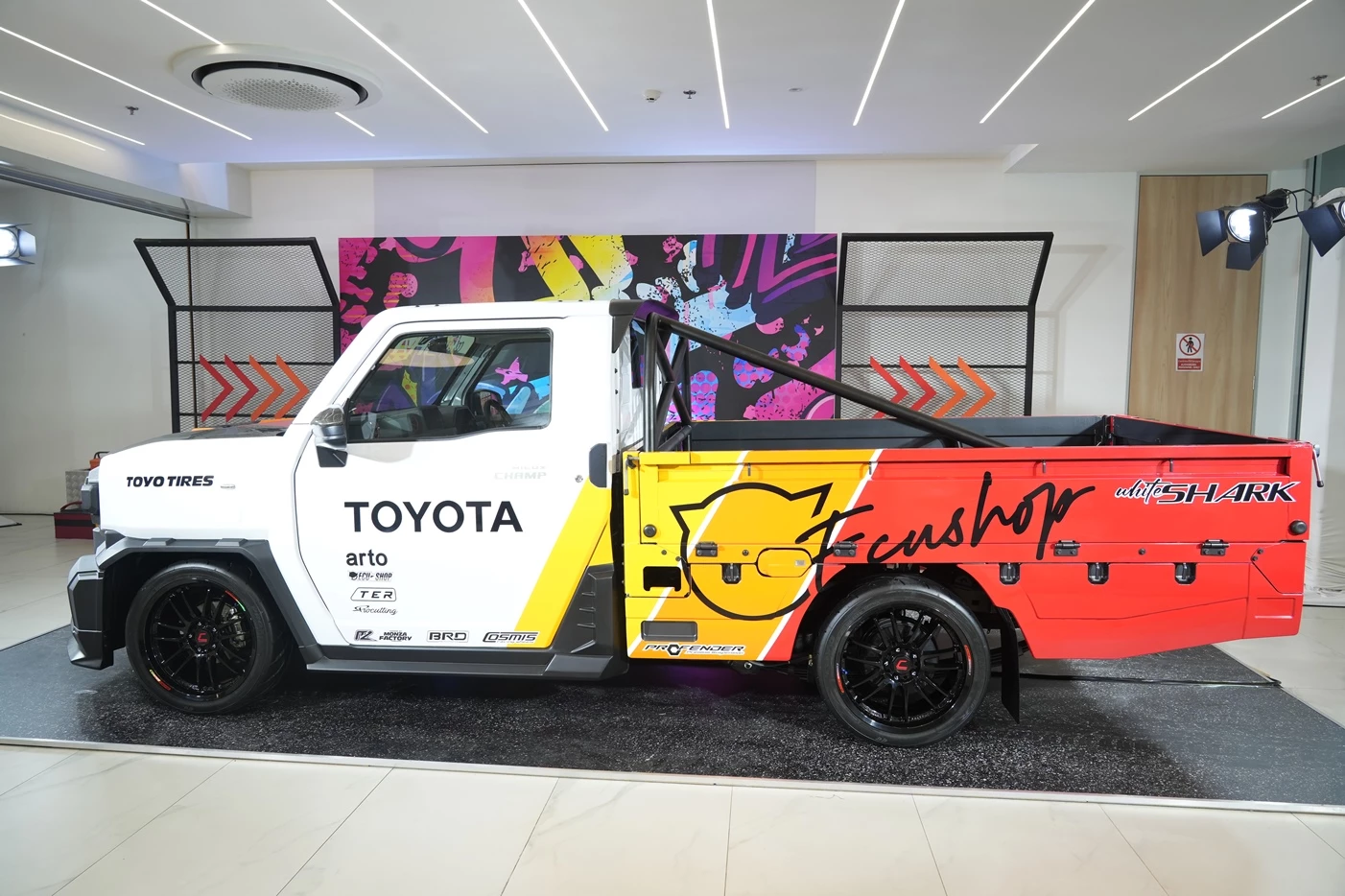
Toyota already showed how quickly a simple, modular truck platform inspires market-specific creativity with the IMV 0 that evolved into the Hilux Champ small pickup truck. It stressed the modularity of the truck from the very beginning, and worked to render and develop many different body and bed styles for commercial and private uses.
Ahead of debuting the Hilux Champ in Thailand in November 2023, Toyota worked with eight different body shop partners to premiere a series of specialty vehicles alongside the base pickup. Those included an impressive mini-motorhome, a delivery truck, an expandable food truck, and an overland truck with Aussie-style canopy and rooftop tent.

Toyota did much the same in Indonesia, where it ran a competition that challenged local designers to come up with specialty bodies and carrier solutions for the small pickup, called the Hilux Rangga locally. The contest focused on three categories: commercial, public service and lifestyle, and selected finalists built 1:1 models of their designs.
The contest produced a number of intriguing specialty vehicle ideas, from camper vans and RVs, to fire trucks and police tactical vehicles, and on to business-specific transport for agriculture and other industry. Some of them have been developed and put on offer through the Hilux Rangga after-sale conversion network.

As an even whiter, emptier canvas that's little more than a flat bed topped with a skeletal, open-air single-person cab, the IMV Origin could inspire even more solutions and configurations. Do you add an adjacent cab area and make it a two-seater? Do you enclose the one- or two-seat cab area for security? Do you add a tall cargo box to make it a delivery truck? Perhaps a set of removable walls and tailgate to box the bed in? What types of delivery modules or carrier systems are most needed to support the local market? A micro-RV would definitely be cool, maybe even a multipurpose skeletal toy hauler with a rooftop tent, like a truck version of the Jayco Crosstrail.
We could stay here thinking up possibilities all day, but Sato wraps it up nicely and sticks a tidy bow on it: "As a carmaker, not finishing this vehicle was frustrating. However, not finishing it is what makes it a 'for you' car, because people have different needs in their daily life and work."
Indeed they do, and we hope the IMV Origin will advance beyond concept stage to help meet them. We also hope it will be joined in production by a van series based on the highly modular Toyota Kayoibako and Daihatsu K concepts.
Source: Toyota