

Gear

Freezable titanium plate keeps your cooler chilled way longer than ice packs

Freezable titanium plate keeps your cooler chilled way longer than ice packs
The Frost Titan Core Plate promises to keep everything in your cooler, well, cooler – for longer
View 4 Images
The Frost Titan Core Plate promises to keep everything in your cooler, well, cooler – for longer
1/4
The Frost Titan Core Plate promises to keep everything in your cooler, well, cooler – for longer
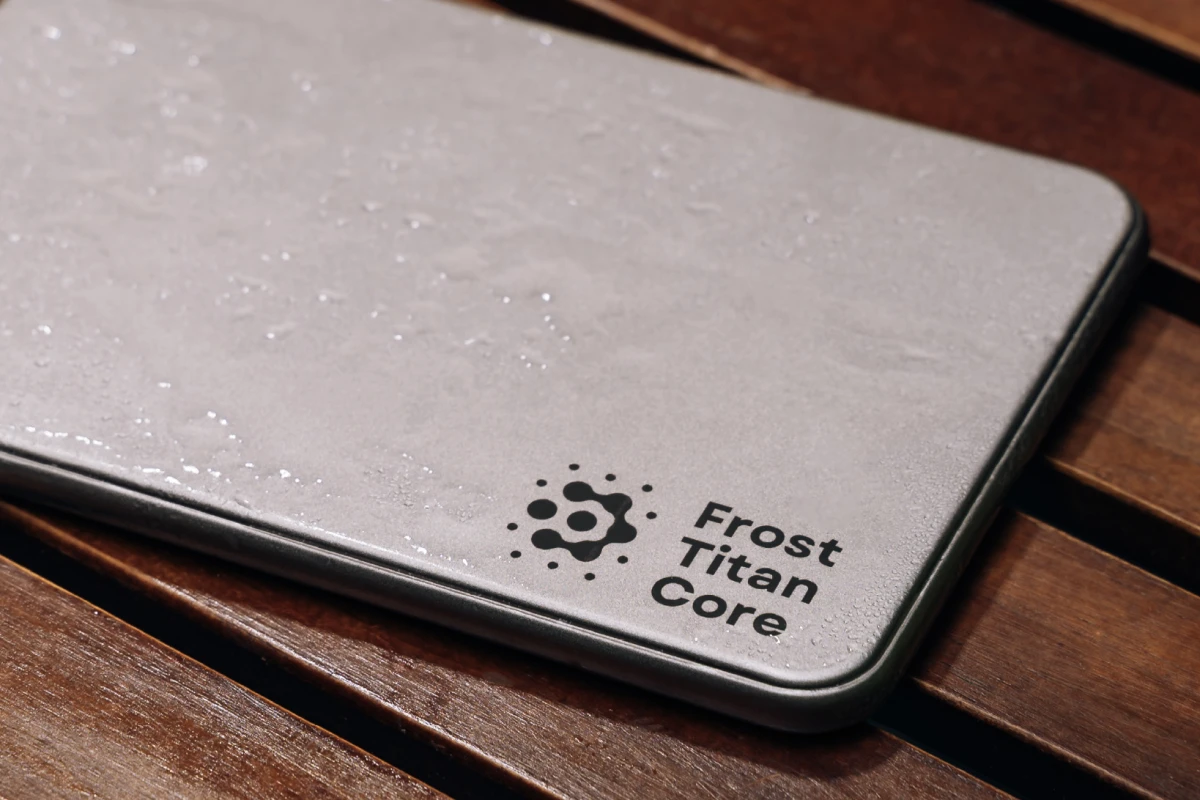
The plate is only 10mm thick, so it won't take up as much room in your cooler as a conventional ice pack
2/4
The plate is only 10-mm thick, so it won't take up as much room in your cooler as a conventional ice pack
The Plate is slim and small enough to carry in a stuffed-to-the-brim cooler
3/4
The Plate is slim and small enough to carry in a stuffed-to-the-brim cooler
The titanium exterior can resist corrosion and cracking, and won't pick up odors over time
4/4
The titanium exterior can resist corrosion and cracking, and won't pick up odors over time
View gallery - 4 images

If you often pack food and drinks for outdoor trips, you know the struggle of keeping those items cool. This new piece of kit for camping and hiking looks like a simple way to keep your stuff chilled for longer.

The Frost Titan Core Plate is a titanium cooling plate that freezes in an hour, and promises to stay stay below 32 °F (0 °C) for up to 12 hours. The team behind it says it's lighter than a similar sized steel plate or ice pack, and holds its low temperature for many more hours to boot.

Frost Titan Core Plate: Elevate Your Outdoor Experience

The Core Plate is only 0.4 in (10 mm) thick, measures 6.5 x 4.1 in (165 x 104 mm), and weighs just 9.5 oz (270g). That should make it easy to drop into coolers of all sizes without adding a lot of bulk.

Since it's got a titanium exterior, the Core Plate is highly resistant to corrosion, cracking, and odors – so you can expect it to hold up over years of use. It's easily washable too.

To be clear, the plate features a 99.9% pure titanium shell, and also features glycerol, water, and a latent heat storage material inside to serve as a phase change coolant that should perform better than conventional ice packs.

The Core Plate is expected to retail at US$113, but you can get it for as little as $79 while it's being crowdfunded on Kickstarter.
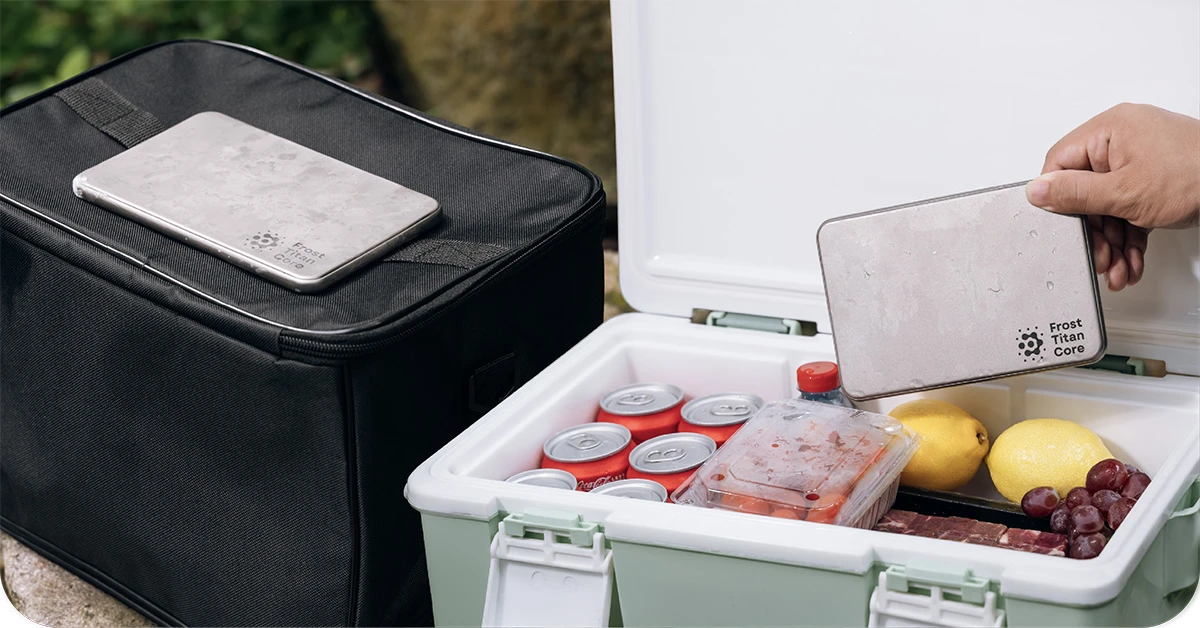
The Plate is slim and small enough to carry in a stuffed-to-the-brim cooler

If you're not keen on the plate form factor, you can also get a pair of titanium Core Balls that can chill whiskey, cocktails and wine; there's even a set of six titanium cubes on offer. Both come with storage cases. The Balls are $49 (down from $62), while the cubes are pitched at $61 (down from $77).

All crowdfunding campaigns carry an element of risk, so you'll want to keep that in mind if you choose to back this campaign. I haven't seen any other products from Storage LLC Japan, the company behind this. But for what it's worth, this campaign has already raised more than $70,000 from over 350 backers.

If all goes to plan, orders are slated to ship worldwide in February 2027, and delivery costs will be calculated once the campaign ends (about $25-$36 for US and Canada orders).

Source: Kickstarter

Note: New Atlas may earn commission from purchases made via links.

View gallery - 4 images
9 comments
9 comments
warmer
I dont but the claims of 60min in a freezer for 12 hrs below 32f. If it takes 60min to cool it. its going to take 60min to warm. That is basic thermo dynamics of heat transfer/retention.
SeaDad
I created an account -just- to comment on this. The article is absolutely wrong, a titanium plate will not even come close to performing as well as ice, let alone beating it.
True, titanium has a higher specific heat, but that means absolutely nothing against the energy required for phase change between a solid and a liquid for ice.
While warming, but not melting, titanium beats ice by less than a joule per cc (1.9 vs 2.3). But that phase change takes a whopping 306 joules per cc. That half a joule during the warming phase is essentially meaningless.
This is also why we still use ice cubes rather than those steel ice cubes. Also why the best performing ones have water inside rather than being solid, and they're still worse than a regular ice cube.
vince
Should work great with my patent pending cold wrap which uses syretchable fabric and ball ice inside dual plastic bags to keep I've frozen for longer when paired with steel pad. One for each side of wrap which works om thighs, arms, feet and neck. Gonna get a few test.
Zareth
Absolutely wrong. Even if it stays below 32 for longer that's not why ice is amazing. The phase change from ice to water requires 160x more heat. That is to say going from below freezing to above freezing requires so much more energy that a solid of similar mass can NEVER outperform ice, atleast with current materials science.
Cosine
Hi doubters: It's not solid titanium, the centre is a liquid coolant that freezes and thaws.
Not saying it's going to work, just that it has a better chance than solid metal.
Bodger
Seems like some of the old physics rules I've been taught are being broken here. Is this thing solid titanium or is there some liquid inside which is undergoing phase change (a.k.a. water ice -> water)?
Uncle Anonymous
Ah Kickstarter, home of inventions that are overpriced solutions to problems that have already been solved.
Trylon
For Pete's sake, people. Read the article before commenting. "To be clear, the plate features a 99.9% pure titanium shell, and also features glycerol, water, and a latent heat storage material inside to serve as a phase change coolant that should perform better than conventional ice packs." I was and still am skeptical, too, but at least I took the time and effort to read it before I lashed out at it.
Chuck
A lot of folks commented about phase change here without reading the article first. I'll admit that when I saw the words "Titanium Plate" in the title, I thought it was solid too and came here to comment about phase change. Thanks to Trylon for straightening us out.