

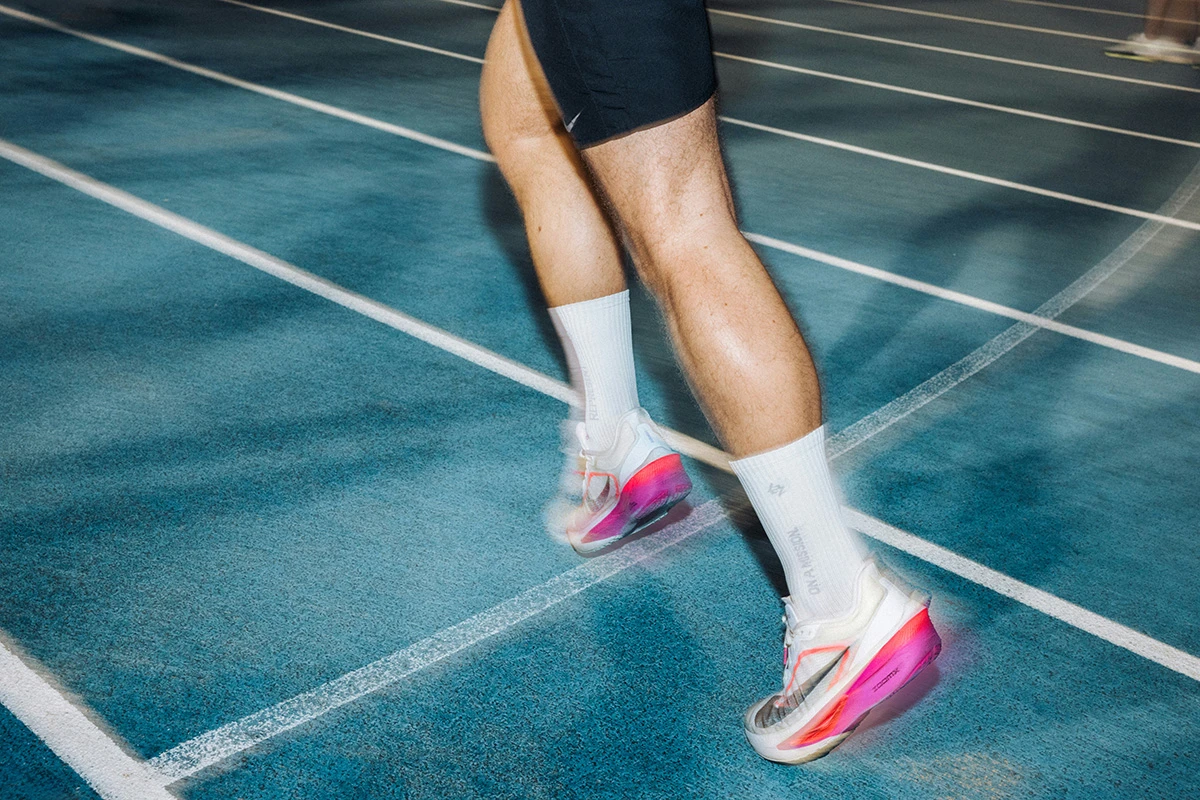


The footwear brands behind the shoes that routinely set marathon and speed records aren't going to reveal what makes their racing gear fast – but a Stanford student has managed to pull back the curtain and show us the magic in these elite kicks.
Jeremy McCulloch, a mechanical engineering student and an accomplished trail runner, recently set about examining 'super shoes' – the extremely light ones with oversized foam outsoles, a carbon fiber plate inside, and big price tags to match.
First introduced in 2016 with varied models for track and endurance running, these improve running economy by multiple percentage points - which can really count when you're trying to beat and set records – and return energy with each step.

Beyond their lightweight construction, a large part of what makes them 'fast' is the specialized foam in the sole – even more so than the energy-returning plates. McCulloch ran experiments to find out what that looked like in numbers.
Through a series of mechanical tests, McCulloch and his team were able to quantify specific properties in the foam, which have previously been hard to model. They also developed formulae to help predict how these foams would perform under various conditions – which could help design the next generation of high-performance shoes.

Working at an engineering lab that looks at how soft materials deform under different kinds of loads and pressure, McCulloch and his team took apart several pairs of two models of Asics Metaspeed shoes. These both have two proprietary foams in them, but layers of these foams are arranged differently to match different running styles.
The Metaspeed Sky shoes, designed for stride-length runners, places FF Turbo Plus foam above the carbon fiber plate and FF Leap foam below it. In Metaspeed Edge shoes (designed for cadence runners), this setup is reversed.
The foams were sliced away from the carbon fiber plate, and put through a material testing machine that stretched, squashed, and twisted them. In doing so, the team tested the foams' ability to withstand forces including tension, compression, and shearing.

The group learned that both foams are more than twice as stiff when stretched than when squeezed, allowing them to cushion impacts easily while remaining structurally resilient when pulled. And when compressed vertically, the foams show an effective Poisson’s ratio close to zero, meaning they squish down without bulging out sideways. They also returned between 83% to 94% of the energy put into them with minimal energy loss, helping propel runners forward.
The two foams differed greatly in other ways, though. FF Turbo Plus is 42% stiffer in tension (stretching) and nearly twice as stiff in shear (lateral twisting) compared to FF Leap.
The FF Leap's lower shear stiffness makes straight-line marathon running efficient, but can cause instability during sharp turns or on uneven ground. FF Turbo Plus' higher shear stiffness offers superior lateral support and cornering stability, so it's better suited to trail running. So it makes sense that Asics made two different models for specific running styles using these foams.
Beyond these findings, the researchers created a computational model to capture the foams' behavior. To do so, they combined a material physics-informed constitutive neural network with lab test data and a machine learning technique called sparse regression.
With that, they arrived at compact, 3-term mathematical formulae to accurately predict foam responses across all loading conditions. These allow for precise gait simulation, so you can model how a runner’s body and shoe might interact, and potentially optimize performance and prevent injuries in future shoe designs.
McCulloch and his team published their study in Engineering with Computers. They'll next work on modeling an entire shoe and pair it with a simulated runner; that could answer complex questions about the best type of shoe for a particular athlete, and what makes for a truly great fit.
Source: Stanford University