









First Slate and now REO. It looks like America is done chasing hefty, overdesigned trucks the size of cruise ships. After years of watching pickups grow bigger, fatter, more complicated, and increasingly expensive, there's a growing appetite for something a little more sensible.
And that means trucks that don’t need a 15-inch touchscreen, a dozen cameras, or enough horsepower to tow a small apartment building. REO wants to capitalize on that change of heart with its new Runabout lineup, led by the T4X, a no-nonsense, four-wheel-drive work truck with an estimated starting price of just US$21,500.
Rather than throwing more technology and luxury at buyers, REO is going in the opposite direction: a naturally aspirated four-cylinder engine, a proper ladder-frame chassis, mechanical 4WD, and even a good old-fashioned manual transmission. And the T4X isn't coming alone. REO has also revealed a five-seat crew-cab pickup and a six-seat SUV alongside, all built around the same platform.
REO brought in Frank Stephenson and his studio to work on the Runabout's styling. That's the same man responsible for the 2001 Mini, the 2007 Fiat 500, and quite a few iconic cars from Ferrari, Maserati, Alfa Romeo, and McLaren.
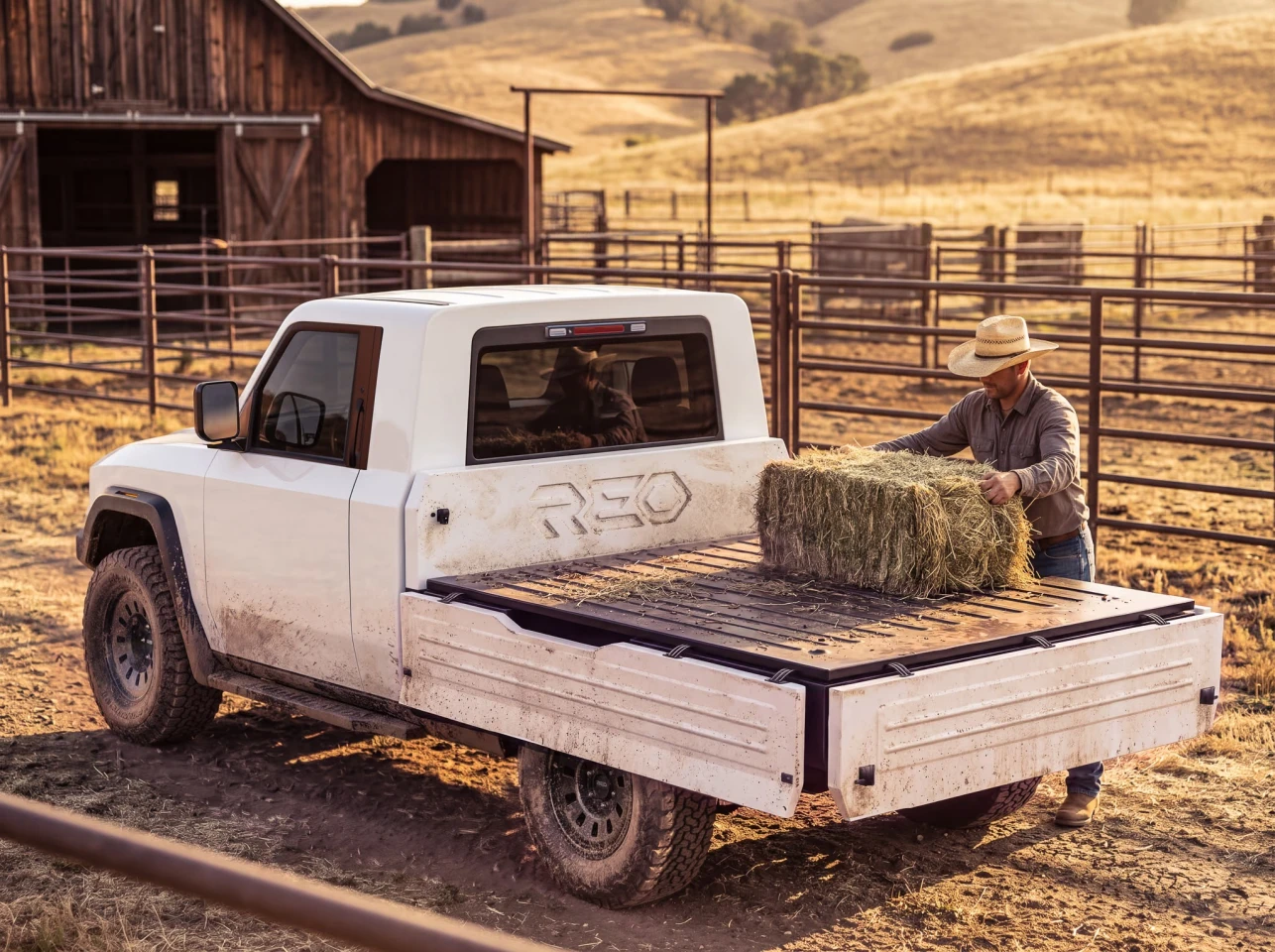
Now, while I don’t particularly hate how the truck looks, let's just say the Runabout doesn't exactly look like the studio's finest hour. It's not exactly going to make a Lamborghini designer lose sleep, is it? But then again, beauty is in the eye of the beholder.
And while we’re on the topic of design, REO says the truck draws inspiration from its 1915 Speed Wagon, which it describes as the world's first pickup, as well as the American bison. Yes, the actual shaggy, four-legged animal.
I’m struggling to spot much of a connection to either, though. And no amount of creative interpretation seems to make that particular design story any easier to swallow.
Anyhow, all trims of the Runabout lineup share the same front-end treatment, regardless of which one you pick. There's a wide, open-mouth grille, a nose that slopes forward, and four LED headlamps.
Meanwhile, the hood gets a raised power bulge that seems to borrow its visual cues from American muscle cars (although there's nothing particularly muscular about the naturally aspirated four-cylinder engine underneath). An upright windshield, however, should make for reasonably good forward visibility.
Although that front end does look like it's perpetually surprised to see you. Perhaps that's the bison influence.

Things get a little more straightforward along the sides, with flat bodywork, vertical door handles and a single character line running above the wheel arches. Those arches are bolt-on components, meaning you can swap them out or remove them altogether when fitting larger, more aggressive off-road tires.
REO has also designed several exterior and interior components, including the bumpers, door panels and headliner, to come off in less than five minutes. The idea is to make repairs and replacements relatively painless rather than turn every minor bit of damage into an expensive workshop visit. There's even talk of making the Runabout an open-source platform, allowing owners and third-party designers to develop their own accessories and replacement parts.
The real differences between the three models begin behind the B-pillar. The T4X is the simplest of the bunch, with two doors, seating for two and a 2-meter-long (6.6-ft) drop-side cargo bed.
The T4C adds a second row of seats, accommodating five occupants in a double-cab layout, although that comes at the expense of a shorter pickup bed. REO has also found room for a few quirky touches at the back, with the tailgate incorporating a ruler, built-in cupholders, and bottle openers. Neat!
Then there's the S4C, which swaps the pickup bed for an SUV-style body with seating for six. It gets side-facing jump seats, a full-size spare mounted on the rear, and a side-hinged tailgate with a rear window that can retract into the door. At 182.7 inches (4,640 mm) long, it's surprisingly compact, measuring only marginally longer than a Toyota RAV4.
Beneath that deliberately uncomplicated exterior is an equally old-school mechanical package, which REO believes is precisely what some American truck buyers are looking for. While the company hasn't ruled out an all-electric version down the road, the initial lineup will stick with an internal combustion engine.

It'll be a naturally aspirated four-cylinder gasoline unit, with REO targeting a powertrain lifespan of 500,000 miles (804,672 km). Keeping things simple is clearly the priority here, so there'll be no turbocharger, direct injection, automatic start-stop functionality, or hybrid assistance … and a healthy disregard for the 21st century.
Power will be sent through a choice of manual or automatic transmissions, with four-wheel drive standard across the range. All three models will also get a mechanical low-range transfer case, while a locking rear differential will be available as an option.
The T4X, T4C and S4C will share the same ladder-frame chassis, with steel body panels throughout. Both ends will ride on solid axles, and REO promises the sort of old-school, truck-like driving experience that has largely disappeared from modern pickups.
Hydraulic power steering is part of the package, as is straightforward access to service items such as the oil filter and fuel pump. In other words, don't expect this to behave like a stripped-down rival to the likes of the Ford F-150. It's a much more old-school proposition.
The suspension setup follows the same philosophy, with coil springs up front and leaf springs at the rear. Braking duties are handled by ventilated discs at the front and conventional drum brakes at the back.
As for the cabin, REO hasn't released any proper interior images yet, and judging by the details in its announcement, there's a good chance the cabin is still being worked on.

Now, considering I’m still a dinosaur at heart, I’m secretly hoping for a set of old-fashioned analog dials. Maybe we’ll see those, but for now, REO has confirmed that the Runabout will surely feature a digital instrument cluster and a central touchscreen with navigation and media functions.
The important driving controls, however, will remain mechanical. As De Bernardi puts it, anything responsible for steering, braking, or shifting won't be subject to over-the-air software updates, and those updates won't be used to remove existing features remotely either.
Hallelujah!
The cabin has been designed with the same repair-friendly mindset as the exterior, with interior panels that can be removed without much fuss. REO is even planning to include a collection of tool bits inside the glovebox, covering every fastener used across the vehicle. That's a rather refreshing approach in an age when something as simple as replacing a trim panel can turn into a dealership visit.
You know things are getting serious when a manufacturer starts advertising the absence of technology as a selling point. “I knew exactly the vehicle I wanted, but when I looked at today’s truck market in the United States, I couldn’t buy it anywhere,” explains Zach De Bernardi, REO’s founder, who also happens to be a Texas real estate developer.
“No one was offering an honest, affordable, compact truck built on a proper ladder-frame chassis, with four-wheel drive, and a naturally aspirated gasoline engine – and nothing on it that hasn’t earned its place.”

REO intends to kick things off with the T4X, which comes priced at $21,500. The five-seat T4C crew cab follows at $25,000, while the six-seat S4C SUV will start at $28,500. Assuming everything stays on schedule, REO expects to begin pilot production in 2027, open the order books in 2028, and start handing over customer vehicles toward the end of that year or early 2029.
The company is also skipping the traditional dealership model in favor of direct-to-consumer sales. That means fixed pricing, no haggling, and no additional destination charges.
Interestingly, owners won't be locked into buying replacement components from REO itself. The Runabout won't have any system to verify where its spare parts come from, meaning aftermarket alternatives, including cheaper third-party replacements, should be fair game.
REO is also developing an Authorized Maker program, which will allow companies that meet its quality requirements to access the vehicle's technical plans and sell their components through the company's own online marketplace. There's something genuinely refreshing about REO's approach, especially at a time when much of the global work-truck market is increasingly looking toward Chinese manufacturers for affordable, utilitarian alternatives. The US, after all, remains one of the world's biggest pickup markets, with Americans buying hundreds of thousands of these machines every year.
De Bernardi and REO are betting that there's room for something a little different: a genuinely affordable, uncomplicated workhorse that prioritizes durability, repairability and function over an ever-growing list of gadgets and luxury features.
Of course, promising a 500,000-mile powertrain and easy repairs is one thing; delivering on those claims in the real world is another. REO still has to get the Runabout into production and prove that its unconventional approach works. But at a starting price of $21,500, this is one American pickup I’m certainly interested in seeing hit the road.
Source: REO


