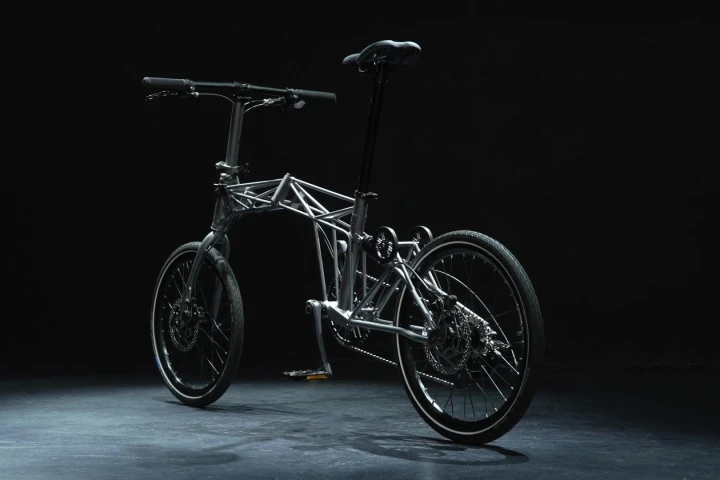
For decades, the recipe for a premium folding bicycle has been to engineer a smart hinge mechanism, choose your metal and fire up the welding torch. But when UK-based e-bike manufacturer Flit designed its latest flagship commuter machine – the M2i – the engineering team ditched the welding torch entirely.
Instead, they reached for a solution from modern aerospace manufacturing and elite supercars: structural bonding. By replacing traditional welds with high-performance chemical adhesives, Flit shaved critical grams to create a single-speed folding electric bike weighing just 13.3 kg.
To put that into perspective, it aggressively undercuts its primary competitor, the titanium Brompton in both weight and cost. We’ve covered Flit repeatedly in the past but the new bike is its most competitive yet.
The materials science behind polymer chains explains why a bicycle manufacturer would choose to glue a frame together. When you weld aluminum tubing, intense heat permanently alters the crystal structure of the metal, weakening it and creating the most common point of failure on a bicycle frame.

Flit bypasses this by using aerospace-grade structural epoxies. These two-part resins work through a chemical reaction: when mixed, they form tightly cross-linked polymer chains that lock into the microscopic surface imperfections of the anodized 6061 aluminum.
The metal retains 100% of its factory strength. There is no warping, no heat distortion and no structural degradation. For a precision folding bike where millimeter-perfect alignment dictates how smoothly the hinges open and close, keeping the metal perfectly straight is a manufacturing advantage.
When chasing the lowest weight, the industry standard has long been titanium. Materials purists love its strength-to-weight ratio. However, Flit’s decision to stick with 6061 aluminum is a clever engineering switch.
Fashionable titanium is more than 60% denser than aluminum. Engineers can specify aluminum tubes with wider diameters and thicker walls without incurring a weight penalty. In an electric bike, where the top tube must house a 230Wh battery pack, these wider, inherently stiff aluminum tubes actually provide superior rigidity over narrow-titanium piping.
Aluminum is also vastly easier to machine. Flit can mill ultra-precise, nested male-to-female sleeve joints required for adhesive bonding with a 1mm tolerance. Trying to mill titanium requires slow, specialized and expensive CNC processes. By choosing a highly machinable material and bonding it, Flit achieves a frame that as light and structurally sound as titanium, but at a fraction of the production complexity – and cost.

This brings us to the inevitable marketplace showdown. The Cambridge-built Flit M2i was explicitly designed to take a swipe at the UK’s folding bike king, Brompton from London.
The key specs are that the bonded aluminum Flit weighs half a kilo less than the welded titanium Brompton T-line electric and costs almost half the price: £2,999 (US$4,090) instead of the market leader’s £5,799 (US$7,900).
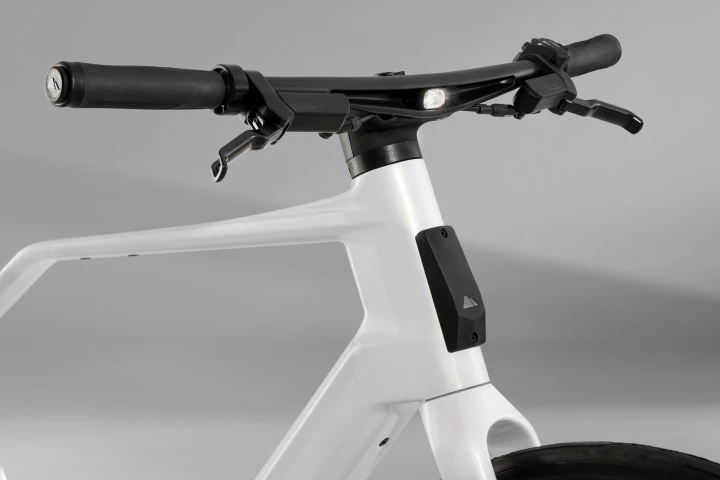
Where Brompton has to save weight with stripped-back components, Flit packs the M2i with premium, third-party performance gear. Lancashire-based Hope supply high-performance hydraulic disc brakes, wheels are wrapped in Goodyear Eagle F1 R tires and even the saddle is a carbon-reinforced fizik Vento Antares R3. Integrated LED lighting comes standard, with proprietary mudguards
that add 450 g to the bike's weight available as an optional extra.
The underlying science is crucial. When a rider stomps on the pedals, resulting forces pull along the length of the overlapping tubes. This is known as shear stress. While adhesives can be vulnerable to peeling forces, they are incredibly strong against shear stress, distributing loads across a massive surface area rather than a single, thin welded bead line.
Convincing urban commuters to trust their safety to an adhesive joint requires more than just theories though. To validate the frame, Flit subjected the bonded joints to lab tests and brutal real-world abuse.
In the lab the frame was locked into an industrial rig where pneumatic pistons continuously hammer thousands of Newtons of force into the joints. To pass, the bonded frame must withstand up to half a million continuous stress cycles without a single micro-fracture appearing in the chemical bond.
The destructive real-world phase involved Flit’s engineering team deliberately riding overloaded prototype bikes. They found the worst urban roads Cambridge had to offer, slamming the bikes into steep curbs and deep potholes at maximum velocity.

Early pothole testing actually caused a slight structural bend in a rear swingarm. However, the adhesive joint itself remained entirely unfazed. This gave engineers the data they needed: the chemical bond was sound, but the metal swingarm was redesigned to double its strength.
The resulting Flit M2i is lighter, mechanically truer and highly resistant to the vibrations of daily city riding. For the bike industry, it is a demonstration that perhaps the best way to build something stronger is to simply glue it together.
The US$7,850 Brompton Electric T Line is widely available across the US. Currently international Flit buyers must email hi@flit.bike for an export quote, with the base price roughly $3,300 without UK VAT, though buyers must pay shipping fees and import duties.
Source: Flit