Cruisers are probably the first motorcycle most people get to know early on their riding journeys. Think back to the old-school Harley-Davidsons and Indians from decades past, and you’ll recall relatively simple machines built around a big engine, a low seat, a long wheelbase, and not much else getting in the way of the ride. That simplicity was part of the appeal.
Cruisers were never really about chasing lap times or packing in as much technology as possible. They were about kicking back, stretching your legs out, listening to a big V-twin thump away beneath you, and pretending you had nowhere else to be.
Which is why I find it slightly amusing that Benda has decided its latest V-twin cruiser needs adaptive air suspension. The word "adaptive" in there is perhaps more important than anything else, because we’ve seen the likes of Harley-Davidson and Indian cruisers come with conventional air-suspension hardware. To have an electronically controlled, load/ride-height-adjusting system puts it in a very selective class.
The bike’s called Rock 707, and in design terms, it is a fairly conventional-looking cruiser at first glance. That familiar low-slung stance, a V-twin engine, and enough chrome and blacked-out hardware to satisfy the traditionalists.
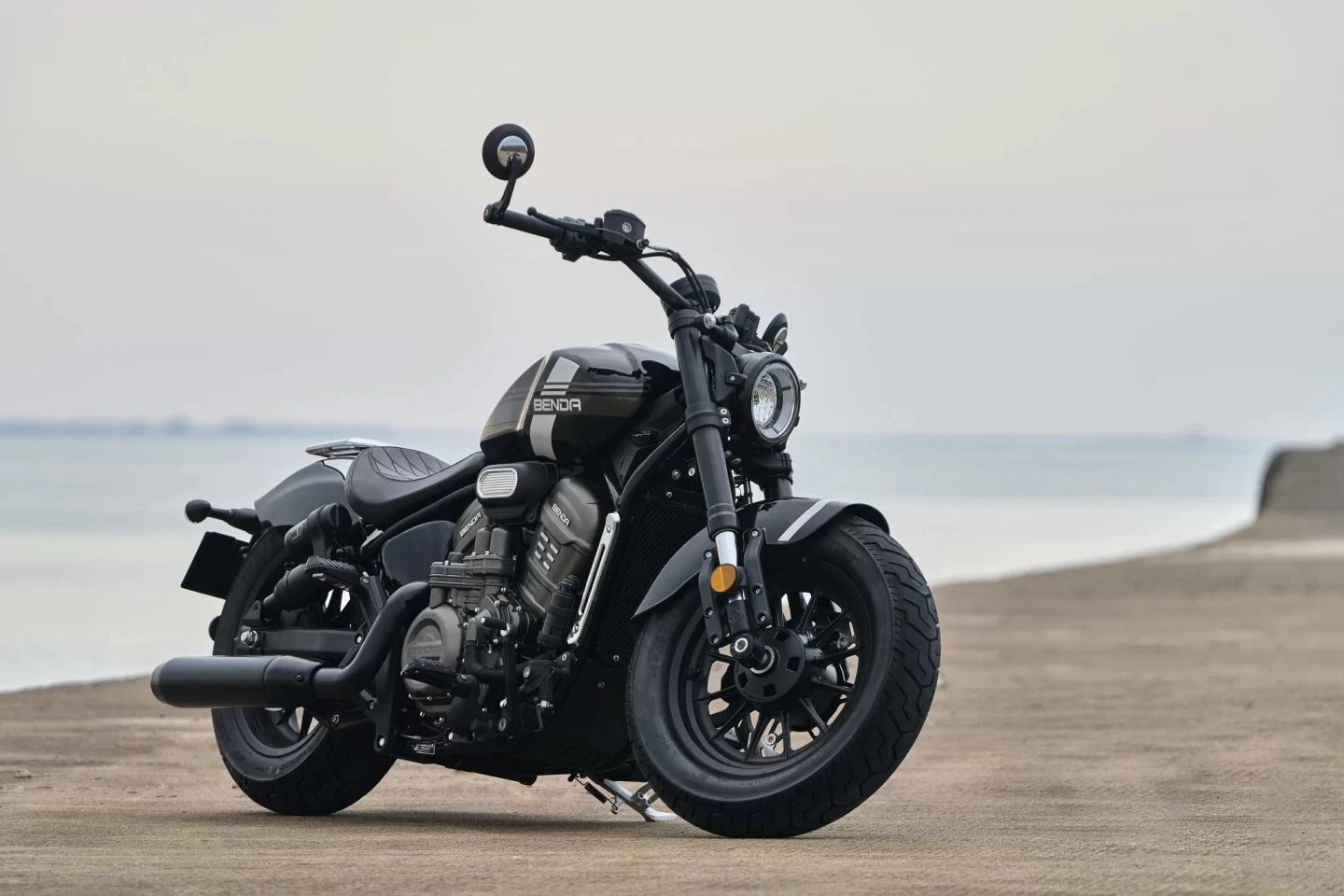
But underneath all that cruiser DNA is technology you’d normally associate with far more expensive machinery: an electronically controlled air suspension system that can raise or lower the motorcycle on demand. But that’s not all; there’s also a BEC (Benda Electronic Clutch) MK-III system.
Let’s start with the suspension. While the front makes use of fairly standard upside-down forks, you get two-chamber electronic air suspension units as opposed to twin shocks at the back. This basically helps with adjusting the ride height automatically by lowering the seat by up to 1.1 inches (28 mm) – from 28.3 in (719 mm) down to 27.2 in (791 mm) when you come to a stop.
This would make it simpler for shorter and less experienced riders to plant their feet firmly on the ground. Not just that, but the suspension would also adjust itself as per the state of the road. What’s unclear as of now is whether you, the rider, will be able to manually adjust the system.
You’ll recall Harley-Davidson introducing similar tech in the Pan America 1250 Special adventure motorcycle around 5 years ago. The only difference was that Harley used an electronic spring preload adjustment instead of air to change the height on the adventure bike.

Then, there’s the BEC MK-III system. It’s basically Benda’s version of Honda's E-Clutch and Yamaha's Y-AMT. There’s still a clutch lever, but it only activates when your foot reaches the shift peg. You could basically shift without the need for a clutch, thereby making the Rock 707 a "semi-automatic" bike, of sorts.
"The Rock 707 shows where we believe the cruiser can go next," stated Constantin Heinemann, the company's Head of Marketing Europe. Benda claims the tech on this bike is intended to make middleweight cruisers more accessible to a broader spectrum of riders. No complaints there.
The rest of the bike is a typical cruiser. A liquid-cooled 692cc V-twin powers the bike, which makes 72 hp at 9,000 rpm and 50 lb.ft (67.8 Nm) of torque at 6,500 rpm. The motor’s tuned for low-end torque, while being responsive enough for city riding in the mid-range.
A six-speed transmission with an electronic clutch and a slip-and-assist system transfers power to the rear wheel. It also comes with a belt drive, which helps reduce regular maintenance.

There's a 3.6-inch TFT display with a 120-degree viewing angle, USB and Type-C charging ports, as well as cruise control, and traction control as standard. It rolls on chunky 16-inch wheels with a wheelbase of 61 in (1,550 mm), and twin-disc brakes to bring it to a halt – 320-mm disc at the front and 260-mm disc at the rear.
The whole thing weighs 518 lb (235 kg). That’s more or less in the same weight range as most midweight cruisers.

The Rock 707 will be on display at this year’s EICMA, and will be available with European dealers this year. American availability and pricing have yet to be confirmed, but I’m sure it’ll undercut most traditional rivals. That would include the likes of the $7,649 Kawasaki Vulcan S and more expensive rivals like the Harley-Davidson Nightster and Indian Scout Sixty – both of which start at $9,999.
I’d probably be most interested to see how it competes with Royal Enfield’s pricing. For instance, the Super Meteor 650, Royal Enfield’s proper cruiser, which starts at $7,299 in the US.
But keep in mind: none of those bikes come even remotely close to the Rock 707 in terms of the tech on offer. And we’re not talking about some six-figure exotic wearing a fancy badge.
Source: Benda